Gary Saretzky Photo Books
White, Minor. Minor White: Rites & Passages. His Photographs accompanied by Excerpts from His Diaries and Letters.
White, Minor. Minor White: Rites & Passages. His Photographs accompanied by Excerpts from His Diaries and Letters.
Couldn't load pickup availability
Biographical Essay by James Baker Hall. Aperture, 1978. An Aperture Monograph. Presumed first edition, no later printings indicated. Beige cloth hardcover, fine with very good protected dust jacket, with front inner pane price clipped, and with two closed short tears and very small spots of edge wear at spine tips. Large format, 142 pages, includes chronology and bibliography. Also issued with illustrated boards as Aperture 80, the more commonly found version. Summary:
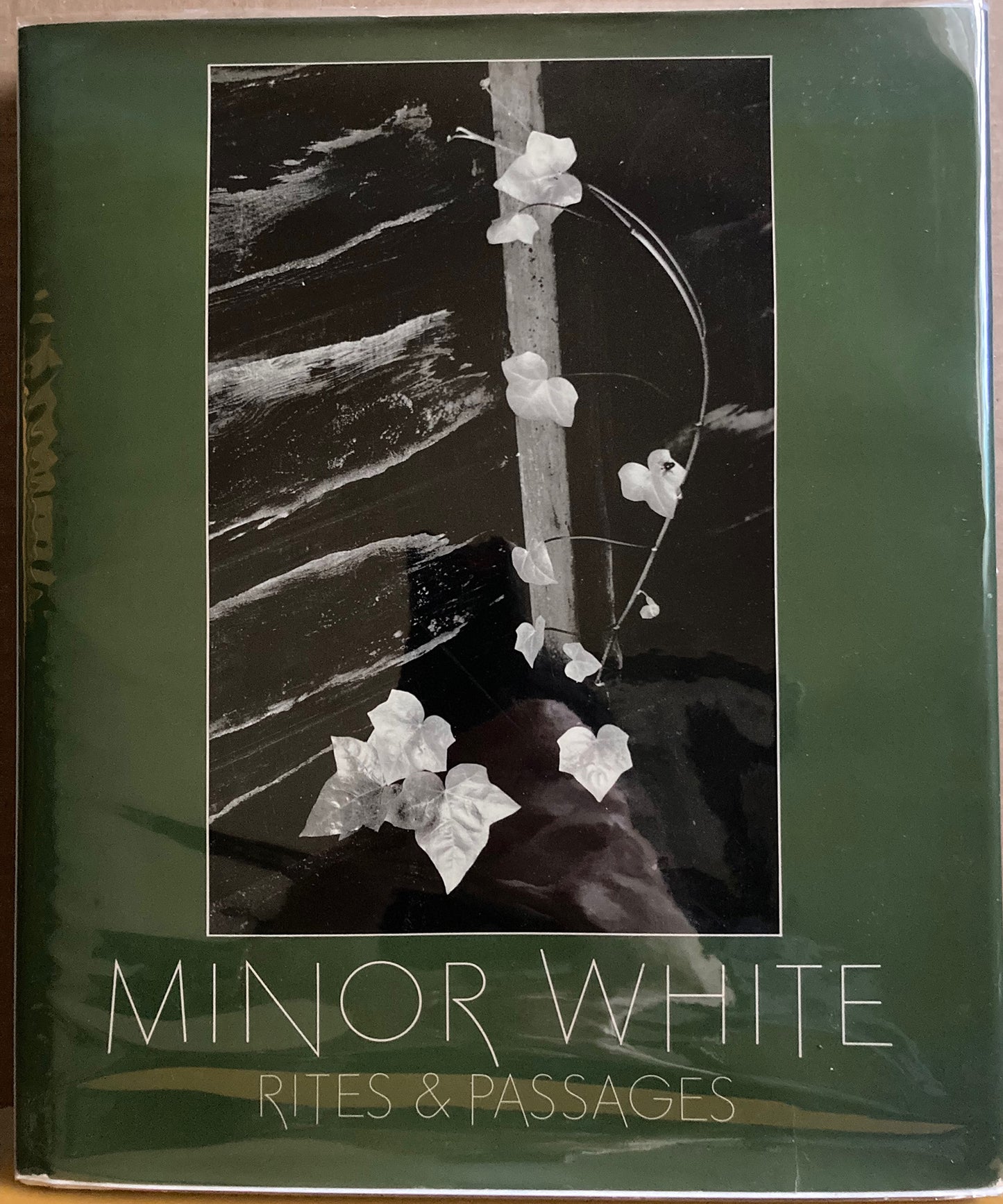
Minor White: Rites & Passages (1978), published by Aperture as a posthumous tribute, is a profound "autobiographical monograph" that synthesizes the spiritual and the technical. Edited by James Baker Hall, the book weaves together White’s iconic, high-contrast imagery with intimate selections from his personal journals and letters, tracing his journey from an army photographer to the preeminent mystic of American photography.
Core Themes and Narrative
-
The Spiritual Journey: The book is organized around the "Rites and Passages" of White’s life—his struggle with his identity, his conversion to Catholicism and later interest in Zen and Gurdjieff, and his belief that photography was a path to self-discovery.
-
The "Equivalence" Philosophy: Building on Alfred Stieglitz’s work, White argues that a photograph of a physical object (a peeling wall, a frost-covered window, a rock) is an "equivalent" for the photographer’s inner emotional or spiritual state.
-
The Camera as Sacred Instrument: For White, the act of photographing was a form of "heightened awareness." The book captures his role as a teacher and a "monk of the lens," focusing on the discipline required to "be still" enough to see the essence of a subject.
Visual and Technical "Finish"
-
The Luminous Deep: White was a master of the Zone System (having worked closely with Ansel Adams), but he used it to create "mood" rather than "documentation." His "finish" is characterized by "velvety blacks" and "shimmering whites," creating an almost subterranean or celestial glow in mundane objects.
-
Metaphorical Texture: The monograph emphasizes White’s ability to find "monumentality" in the microscopic. His technical precision makes a piece of weathered wood or a tide pool look like a vast, cosmic landscape.
- Minor White (1908–1976) was an influential American photographer, editor, and educator whose deeply spiritual, metaphoric approach to photography helped shape mid-20th-century fine art photography. Born in Minneapolis, Minnesota, White studied botany and literature at the University of Minnesota before committing fully to photography in the late 1930s while working for the Works Progress Administration (WPA) in Oregon. Influenced by Alfred Stieglitz's concept of "Equivalents" as well as Zen Buddhism, Gurdjieff philosophy, and Christian mysticism, White championed the idea that a photograph could function as a visual metaphor—representing not merely the literal subject depicted, but the inner psychological and spiritual state of the photographer and viewer. In 1952, alongside Ansel Adams, Dorothea Lange, and Beaumont and Nancy Newhall, he co-founded Aperture magazine, serving as its primary editor for over two decades and establishing it as one of the most vital critical forums for creative photography. A master of black-and-white visual sequencing, infrared film, and high-contrast tonal control, White taught extensively at the California School of Fine Arts, Rochester Institute of Technology, and the Massachusetts Institute of Technology (MIT), shaping generations of photographers through his rigorous, contemplative workshops and leaving a profound legacy that treated the camera as a instrument of self-discovery and spiritual awakening.