Gary Saretzky Photo Books
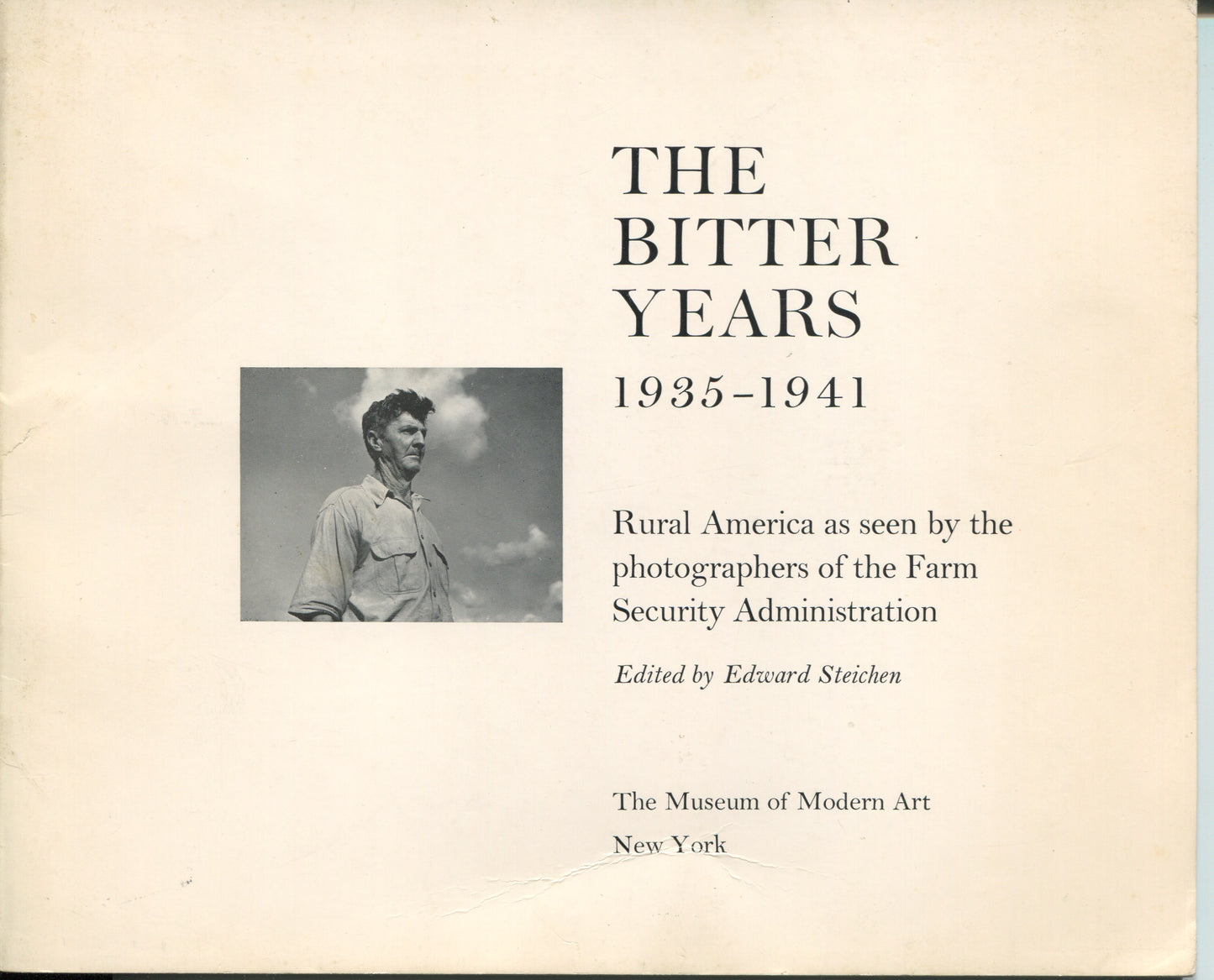
The Bitter Years, 1935-1941. Rural America as seen by the photographers of the Farm Security Administration.
The Bitter Years, 1935-1941. Rural America as seen by the photographers of the Farm Security Administration.
Couldn't load pickup availability
Museum of Modern Art, 1962. Exhibition catalog edited by Edward Steichen. Texts by Rexford Tugwell and Grace Mayer. Wraps, very good with crimps on covers and near bottom of pages. Second of three known printings. FSA Photographers illustrated: Dorothea Lange; Jack Delano; Ben Shahn; Walker Evans; John Vachon; Arthur Rothstein; Carl Mydans; Russell Lee; Marion Post Wolcott; Summary:
The Bitter Years, 1935–1941, published by the Museum of Modern Art (MoMA) in 1962, is the catalog for the final exhibition curated by the legendary Edward Steichen before his retirement as Director of the Department of Photography. It serves as a powerful retrospective of the Farm Security Administration (FSA) project, documenting the devastating impact of the Great Depression and the Dust Bowl on rural America.
Core Themes and Historical Significance
-
The "Bitter" Narrative: Steichen selected 209 images from the vast FSA archive (originally overseen by Roy Stryker) to tell a visceral story of human endurance. The catalog focuses on the "bitter" struggle of sharecroppers, migrant workers, and displaced families, moving from the drought-stricken fields to the crowded roadside camps.
-
A Humanist Manifesto: Like his earlier Family of Man (1955), Steichen’s curation in The Bitter Years is deeply humanist. However, while Family of Man was optimistic and global, this collection is stark, nationalistic, and focused on the "cracks" in the American Dream.
-
The FSA "All-Stars": The volume features the definitive work of the era’s greatest documentary photographers, including but not limited to:
-
Dorothea Lange: Capturing the maternal anxiety of the "Migrant Mother."
-
Walker Evans: Documenting the architectural and social "bones" of the deep South.
-
Arthur Rothstein: Showing the literal erasure of land in his Dust Bowl studies.
-
Ben Shahn and Jack Delano: Focusing on the dignity of labor amidst poverty.
-
Visual and Curatorial Style
-
The Steichen "Edit": The catalog reflects Steichen’s signature style of dramatic, large-scale presentation. He favored high-contrast printing and tight cropping to emphasize the emotional "punch" of a face or a parched landscape.
-
Graphic Continuity: The layout uses juxtaposition to create a cinematic flow—placing a photo of an empty larder next to a photo of a starving child—forcing the viewer to confront the systemic nature of the crisis.