Gary Saretzky Photo Books
Szarkowski, John. From the Picture Press by John Szarkowski. Museum of Modern Art, 1973.
Szarkowski, John. From the Picture Press by John Szarkowski. Museum of Modern Art, 1973.
Couldn't load pickup availability
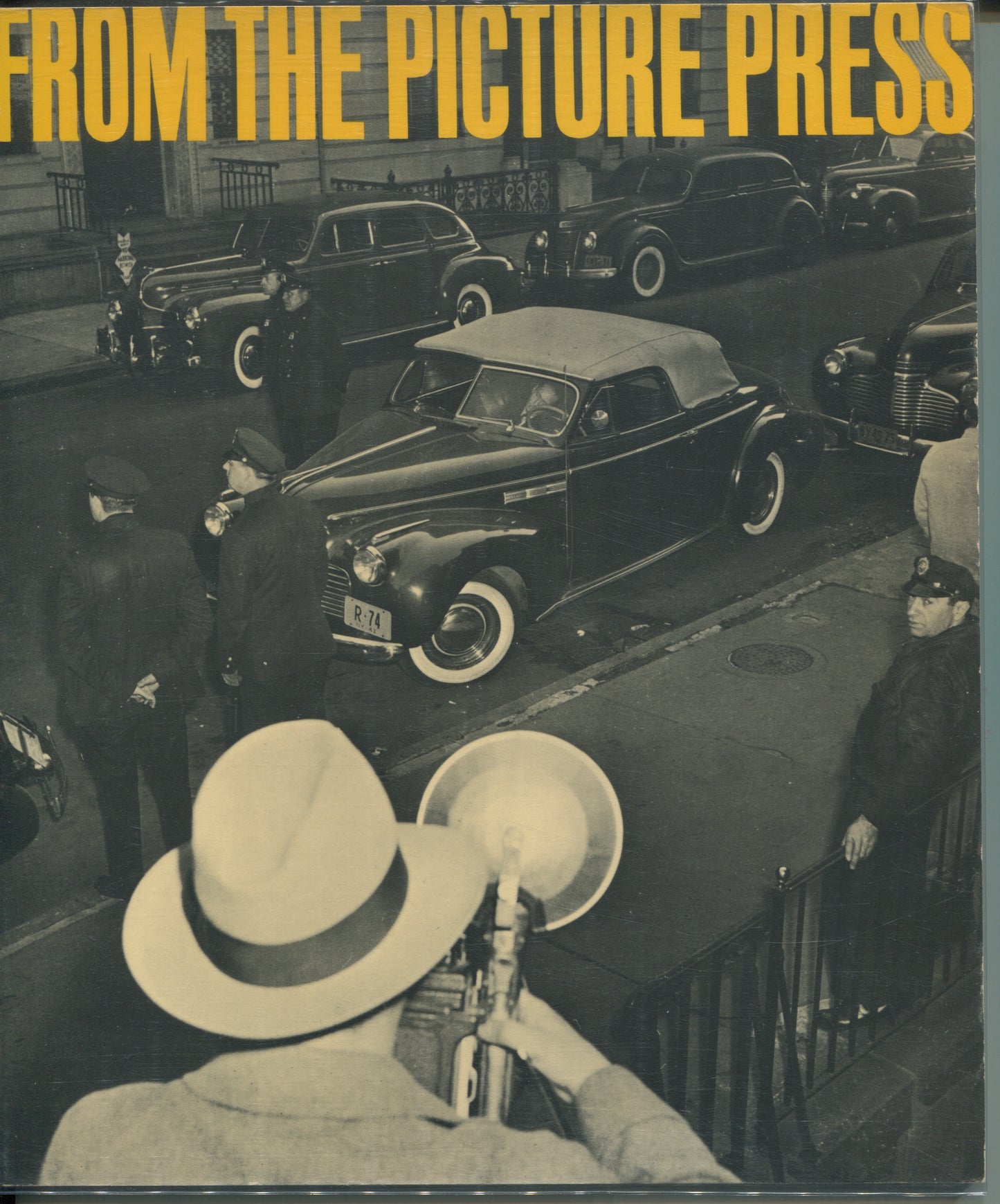
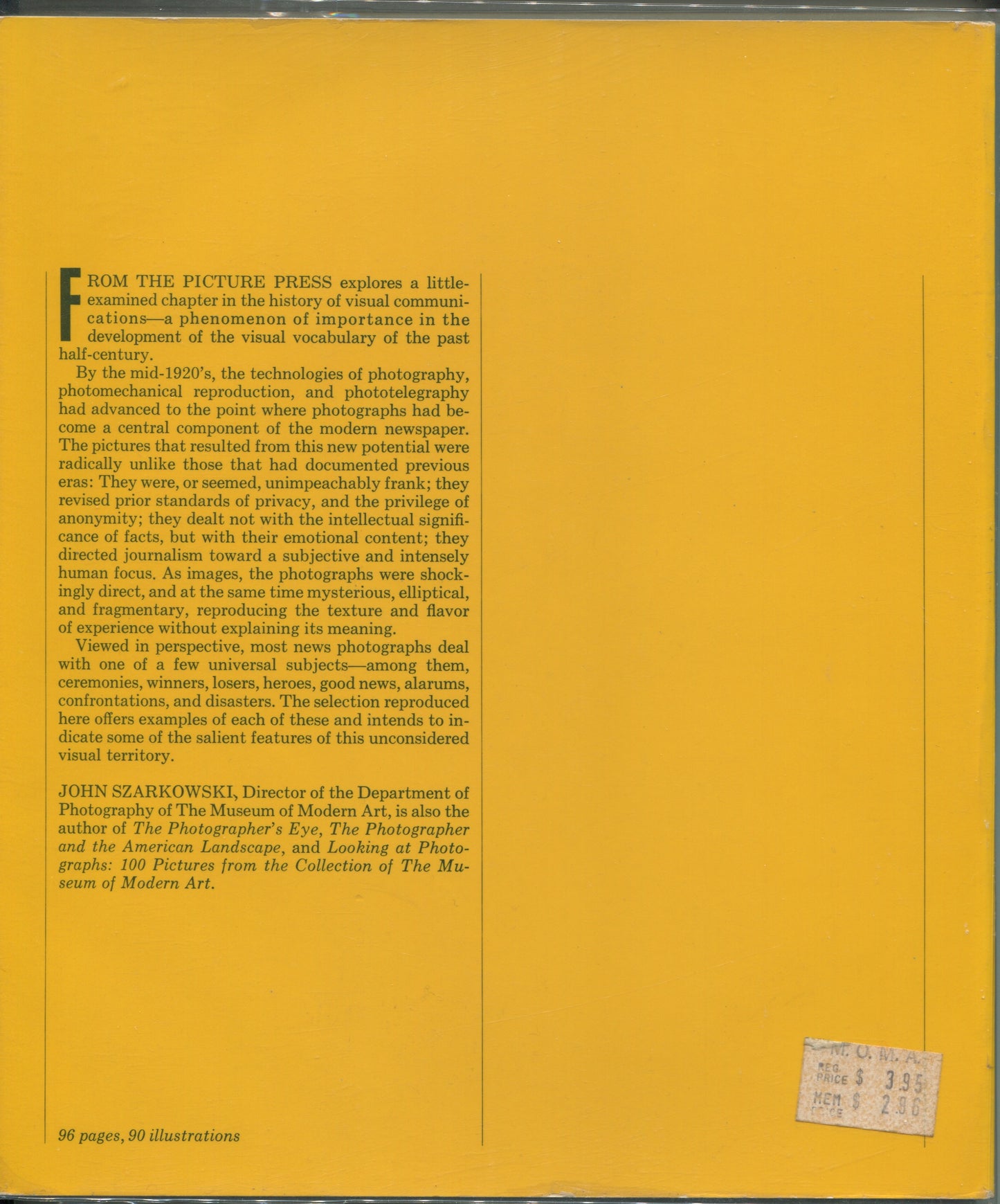
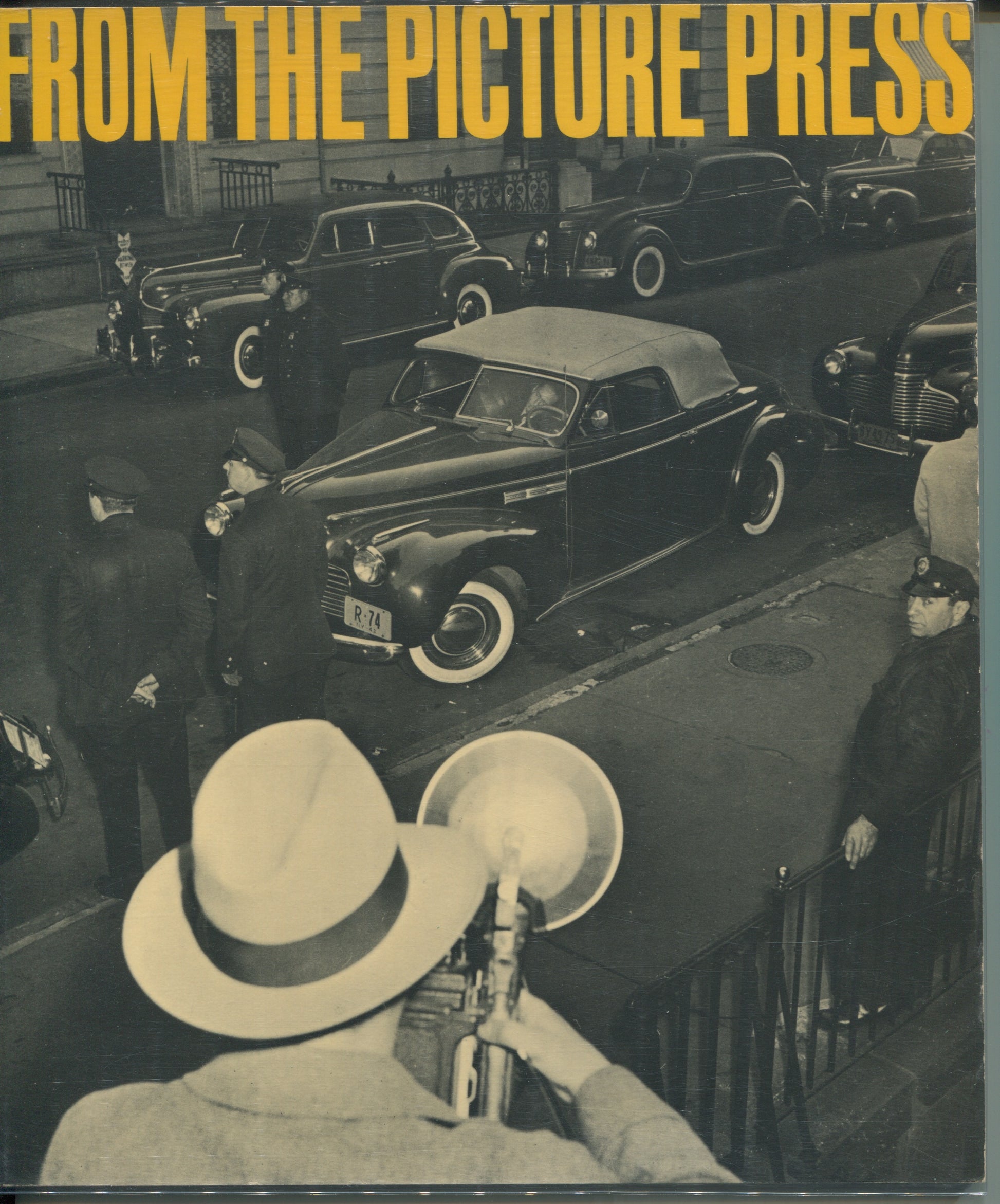
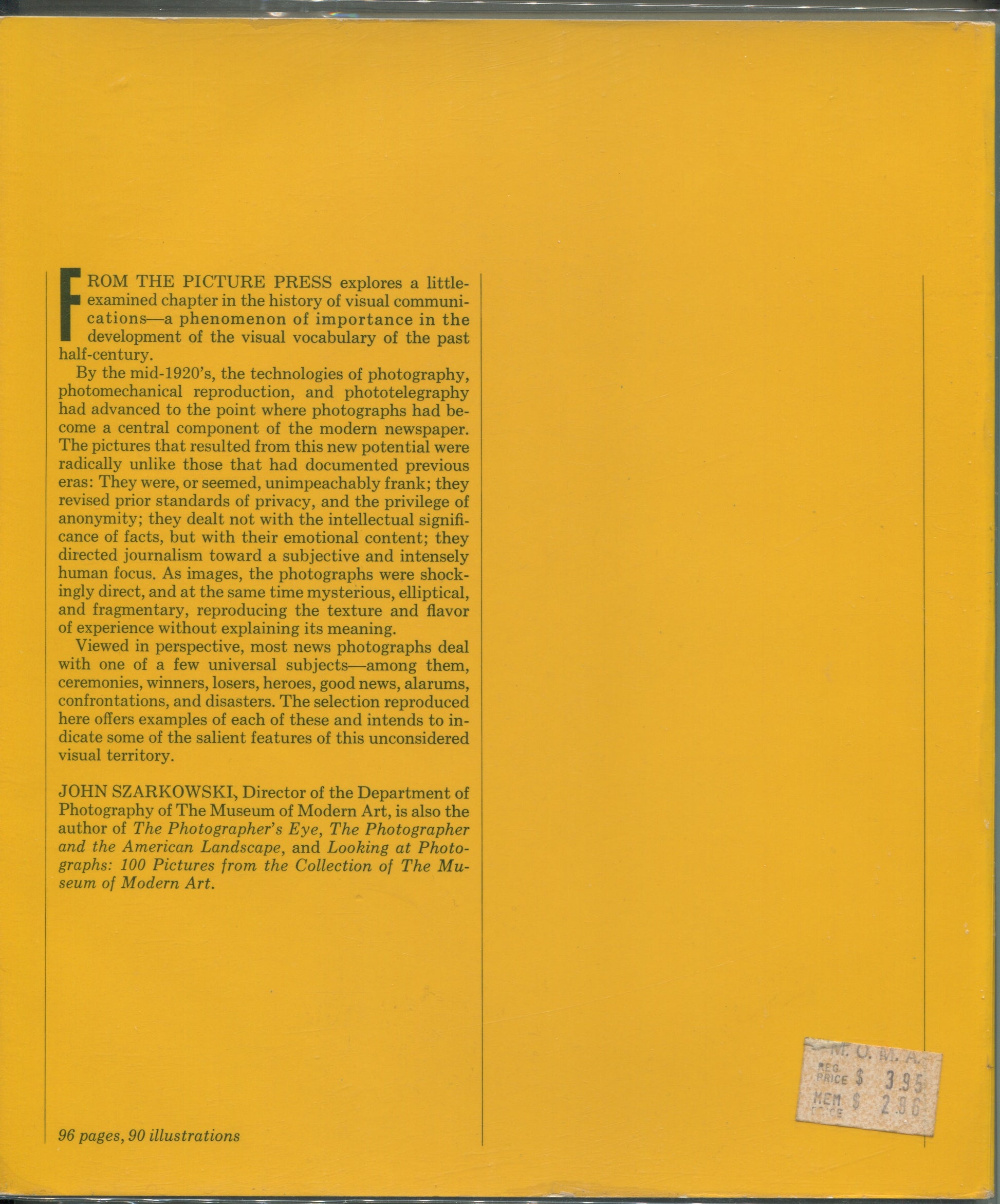
Illustrated wraps, like new with custom made 4-mil polyester jacket. Cover photo by Weegee. Other press photographers include Nick Ut, Walter Kelleher, Art Whittaker, Bill Klein, Charles Corte, Al Willard, Bob Costello, George Torrie, Charles Hoff, Bill Quinn, Dick Peare, Ted Needham, Gary Kagan, George Mattson, et al. 96 pages, 90 illustrations in black-and-white. Chapters: Ceremonies; Disasters; Alarums and Conundrums; Good News and the Good Life; Contests and Confrontations; and Heroes. Includes some sports photos such as boxing, baseball, and running. Celebrities depicted include politicians and Hollywood stars. But most of those depicted in these either humorous or dramatic photos are not household names. Caption list in back of the book, which accompanied an exhibition of the same name at MoMA, New York. Summary:
Published by the Museum of Modern Art in 1973, "From the Picture Press," edited by the influential curator John Szarkowski, is a landmark exploration of the aesthetics and function of news photography. The book accompanied an exhibition of the same name and serves as a critical study of how images behave when stripped of their original journalistic context.
Core Philosophy
Szarkowski’s primary argument is that news photographs—often taken in haste by anonymous or working-class photographers—possess a unique, raw visual energy. He suggests that these images are frequently more interesting as visual artifacts than as historical records. He focuses on the "vernacular" style, emphasizing the camera's ability to capture fragments of reality that the human eye might miss or overlook.
Key Themes and Structure
-
Decontextualization: The book features photos from the archives of the New York Daily News, but Szarkowski deliberately omits or simplifies the original captions. This forces the viewer to confront the formal qualities of the image (composition, lighting, gesture) rather than the "who, what, where" of the news story.
-
The Aesthetics of the "Accident": Szarkowski highlights the beauty in the unplanned. Because press photographers often had to work quickly under chaotic conditions, their photos often contain jarring crops, harsh flash lighting, and surreal juxtapositions that "art" photographers might avoid.
-
Categories of Human Experience: The images are organized into thematic sections rather than chronological ones. These include:
-
Ceremony: Award ceremonies, handshakes, and official rituals.
-
Disaster: Fires, crashes, and public tragedies.
-
Winners and Losers: Sports figures and politicians in moments of victory or defeat.
-
The Bizarre: Oddities of daily life that caught a reporter's eye.
-
Impact on Photography
-
Validation of Photojournalism: Along with his work on Weegee, Szarkowski used this book to elevate "low" news photography into the realm of "high" museum art.
-
Influence on Street Photography: By celebrating the unpolished, grainy, and high-contrast look of the picture press, Szarkowski helped validate the aesthetic that would define much of 1970s and 80s street photography.
"The news photograph... is a fragment of a larger and more complex reality. It is a report of an event, but it is also an object in itself, with its own structure and its own meaning." — Summary of Szarkowski's perspective.
Critical Reception
While some critics argued that Szarkowski was being "elitist" by ignoring the social and political importance of the news, the book remains a pivotal text for understanding how the meaning of a photograph changes based on where and how it is viewed.