Gary Saretzky Photo Books
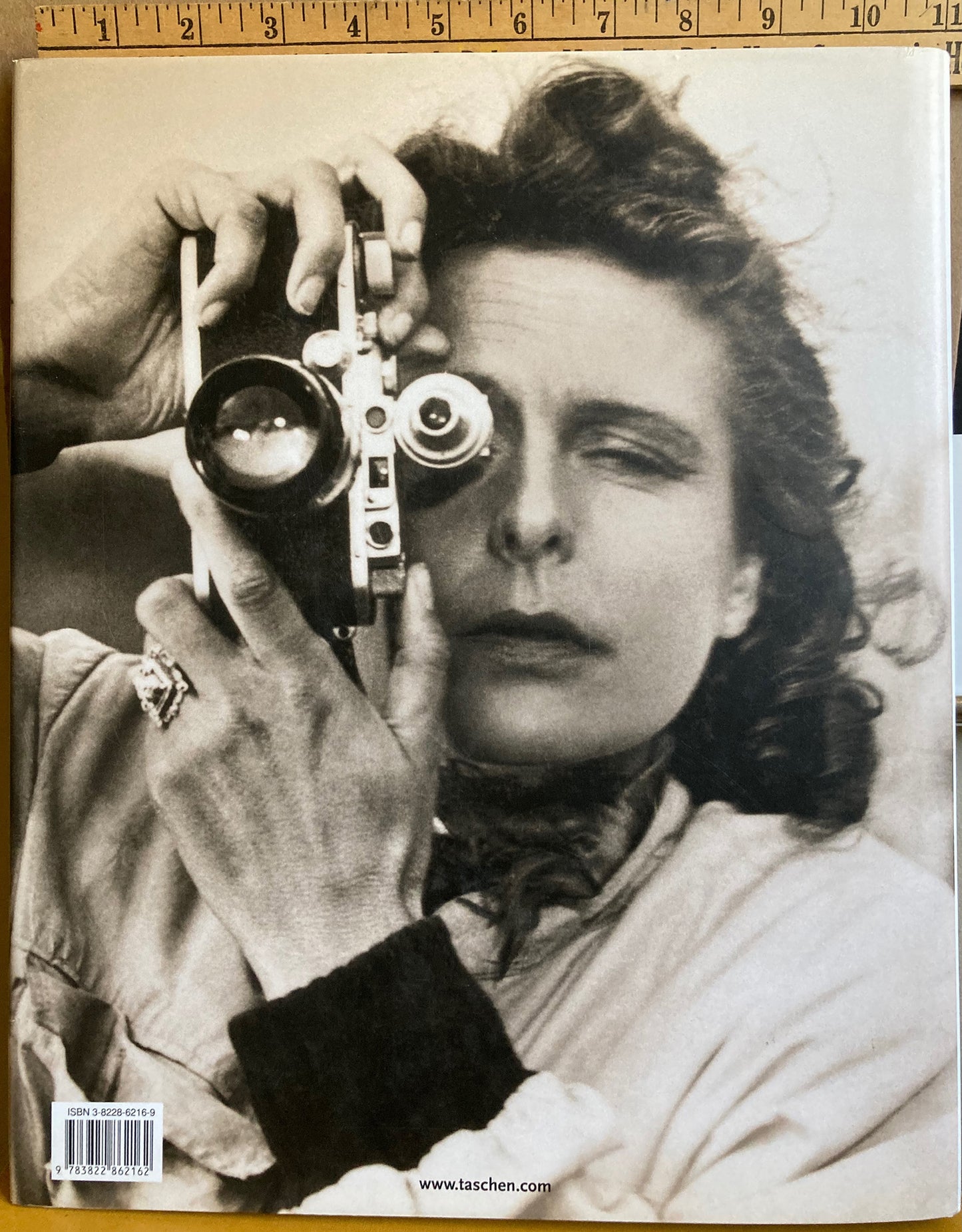
Riefenstahl, Leni. Leni Riefenstahl: Five Lives by Leni Riefenstahl, edited by Angelika Taschen.
Riefenstahl, Leni. Leni Riefenstahl: Five Lives by Leni Riefenstahl, edited by Angelika Taschen.
Couldn't load pickup availability
Taschen, 2000. 1st edition. Large profusely illustrated hardcover with dust jacket. Fine/fine. Text in English, French, and German. 336 pages. Includes Riefenstahl's (1902-2003) long, impressive, sometimes controversial career as dancer, actress, film director, photographer, and scuba diver, with extensive biographical information in back of the book, with biography, bibliography, and filmography. Like new. Summary:
Leni Riefenstahl: Five Lives (2000), edited by Angelika Taschen, is a comprehensive visual autobiography and monograph that categorizes the controversial German artist’s career into five distinct phases: her beginnings as a dancer, her stardom as a film actress in "mountain films," her internationally acclaimed yet politically condemned work as a director for the Third Reich, and her later-life reinventions as a photographer of the Nuba people and an underwater documentarian.
Core Themes and Narrative
-
The Pursuit of Perfection: The book tracks Riefenstahl's obsession with the "heroic" body and the sublime. Whether she is filming the 1936 Olympics or photographing African tribesmen, her theme remains the same: the glorification of physical power and aesthetic symmetry.
-
Artistic Autonomy vs. Moral Accountability: Taschen’s curation highlights Riefenstahl’s technical genius while implicitly forcing the reader to confront the ethical vacuum of her "vision." It presents a woman who claimed to be a "pure artist" while creating the most effective propaganda in human history (Triumph of the Will).
-
Survival and Reinvention: The narrative arc is one of relentless adaptation. After being blacklisted from filmmaking post-WWII, she pivoted to still photography and later, at the age of 71, lied about her age to obtain a diving certificate, beginning a fifth career in marine biology.
Visual and Technical "Finish"
-
The "Epic" Style: Riefenstahl’s visual signature is characterized by low-angle "hero shots" that make her subjects appear monumental. Her finish is razor-sharp and high-contrast, designed to evoke awe rather than empathy.
-
The "Nuba" Saturated Tones: Her later color work in Africa features a hyper-saturated, almost "plastic" finish that treats the human skin as a sculptural surface, much like the bronze statues she sought to emulate in her earlier films.
- Leni Riefenstahl (1902–2003), born Helene Bertha Amalie Riefenstahl, was a German filmmaker, photographer, and dancer whose aesthetic genius and groundbreaking formal innovations remain forever bound to her history as a chief visual propagandist for the Nazi regime. Born in Berlin, Riefenstahl began her career as a expressive dancer and film actress in German "mountain films" before directing her debut feature, The Blue Light (1932). Impressed by her vision, Adolf Hitler commissioned her to direct Nazi propaganda films, leading to her notorious masterpieces Triumph of the Will(1935), a chronicle of the 1934 Nuremberg Rally, and Olympia (1938), a revolutionary two-part documentary on the 1936 Berlin Olympics that pioneered slow-motion, underwater cameras, and tracking shots to heroicize the human form. Though classified as a "fellow traveler" rather than a war criminal during post-WWII denazification trials, her cinematic career in Europe was effectively destroyed. Reinventing herself as a still photographer in the 1960s and 1970s, Riefenstahl traveled to Sudan to produce internationally acclaimed color photo essays on the indigenous Nuba people—published in books like The Last of the Nuba (1973)—and later earned scuba certification in her seventies to pioneer vibrant underwater marine photography, remaining until her death at age 101 one of the most controversial and polarising visual artists of the 20th century.