Gary Saretzky Photo Books
Photography: A Cultural History by Mary Warner Marien. 1st edition, 1st printing.
Photography: A Cultural History by Mary Warner Marien. 1st edition, 1st printing.
Couldn't load pickup availability
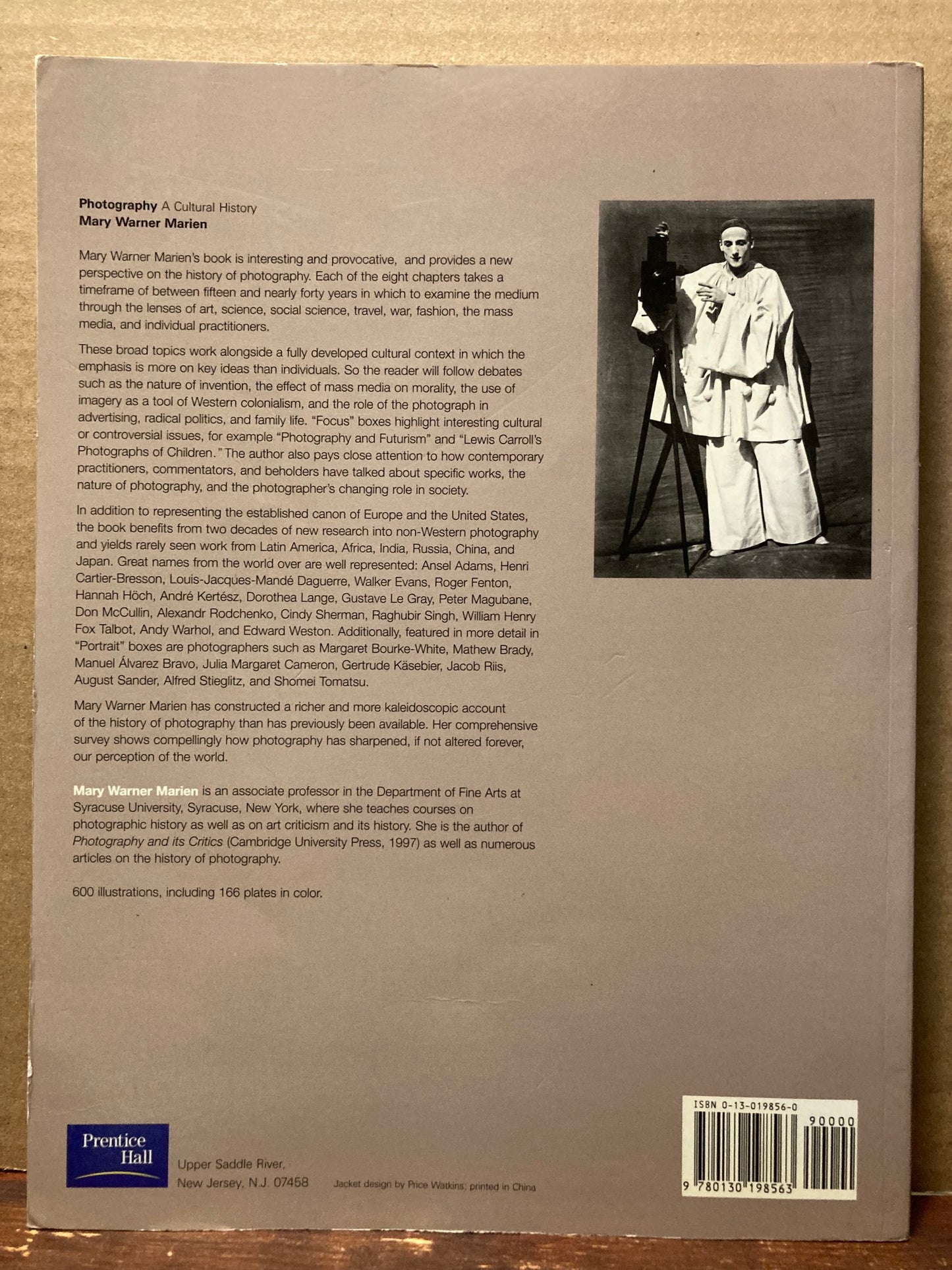
Prentice Hall and Harry N. Abrams, 2002. Softcover, 528 pages. A thorough history of photography, well illustrated in black-and-white and color. A favorite textbook for history of photography courses. Near very good with some cover crimps and neat blind stamp on preliminary title page of Professor Alberro Alter of Columbia University. Cover photo of the famous showgirl Evelyn Nesbit, the paramour of architect Stanford White, by Gertrude Käsebier. Summary:
Photography: A Cultural History (2002) is a seminal survey that moves beyond a mere timeline of technological inventions to explore how photography has both shaped and been shaped by global culture. Mary Warner Marien’s approach is unique in its "interdisciplinary" focus, weaving together the history of art, science, politics, and social change.
Core Framework and Themes
1. Contextual History
Unlike traditional histories that focus strictly on "great masters," Marien examines the medium’s role in everyday life. She explores how photography influenced:
-
Social Reform: The work of Jacob Riis and Lewis Hine in changing labor laws.
-
Scientific Discovery: The use of the camera to map the stars and the microscopic world.
-
Imperialism and Exploration: How photography was used to document (and often misinterpret) foreign cultures during the colonial era.
2. The Evolution of Art vs. Document
A central thread of the book is the shifting definition of photography as an art form. Marien traces this journey through various movements:
-
Pictorialism: The effort to make photographs look like paintings to gain "artistic" legitimacy.
-
Straight Photography: The embrace of the camera’s mechanical precision (Modernism).
-
Postmodernism: The late-20th-century shift where photographers began questioning the "truth" of the image and exploring its role in mass media.
3. Global Perspective
The book is noted for its inclusivity. It highlights the development of photography not just in Western Europe and North America, but also in Asia, Africa, and South America, providing a more comprehensive look at the medium’s global impact.
Structural Features
-
Thematic Snapshots: Scattered throughout the text are "Focus" boxes that provide deep dives into specific topics, such as the daguerreotype craze, the impact of the Kodak Brownie, or the ethics of war photography.
-
Technological Milestones: While the focus is cultural, the book provides a clear technical foundation, explaining the transition from wet-plate processes to film and, eventually, the digital revolution.
-
Visual Richness: The first edition is extensively illustrated, featuring not only iconic masterpieces but also vernacular images like advertisements, family snapshots, and scientific plates.
Critical Takeaway
Marien’s work is a comprehensive "social biography" of the camera. It argues that photography is not a static technology but a dynamic language that reflects the values, fears, and aspirations of the society that uses it. It remains a foundational text for students and historians for its ability to connect the "click of the shutter" to the broader movements of human history.