Gary Saretzky Photo Books
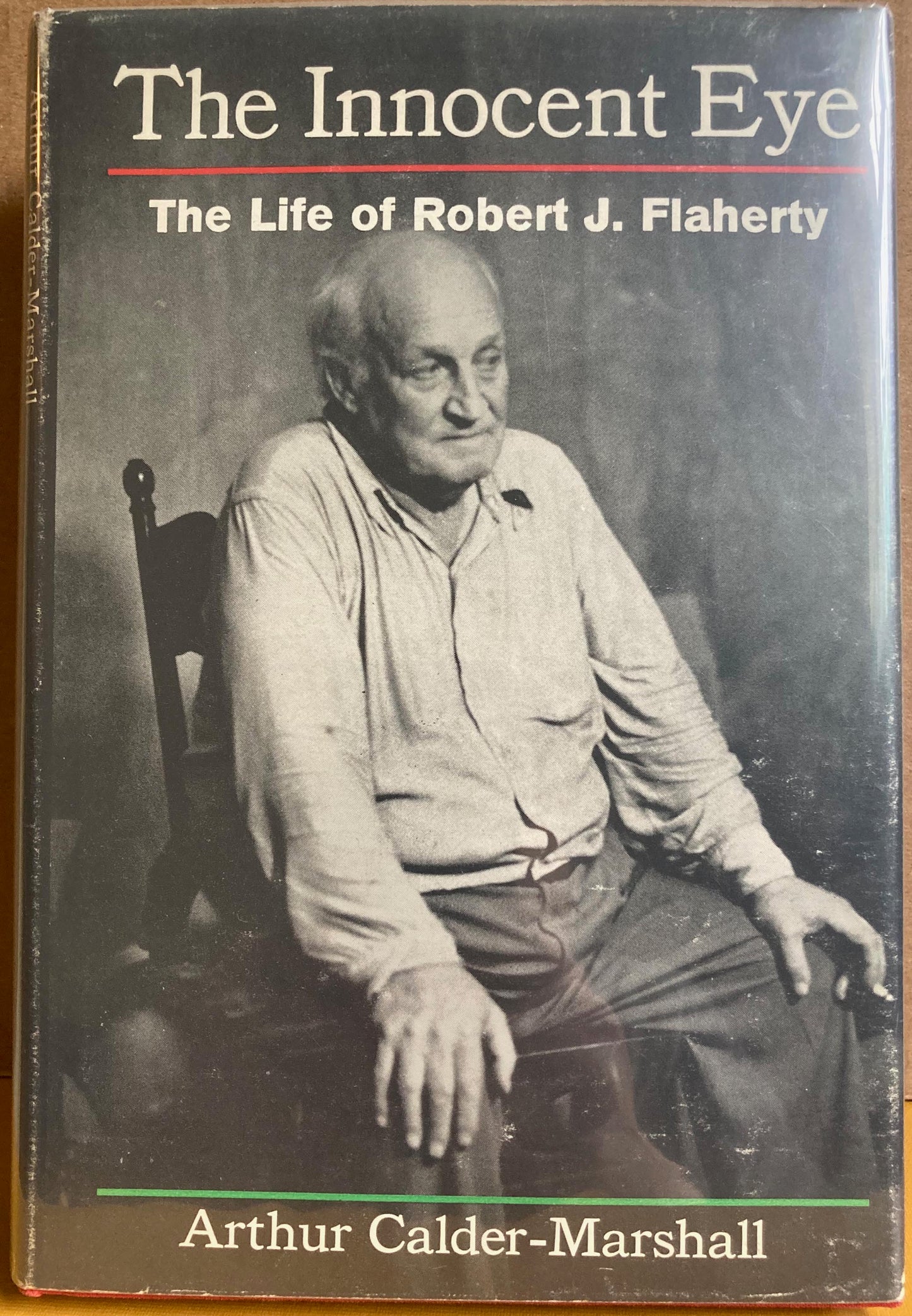
Flaherty, Robert J. The Innocent Eye: The Life of Robert J. Flaherty by Arthur Calder-Marshall.
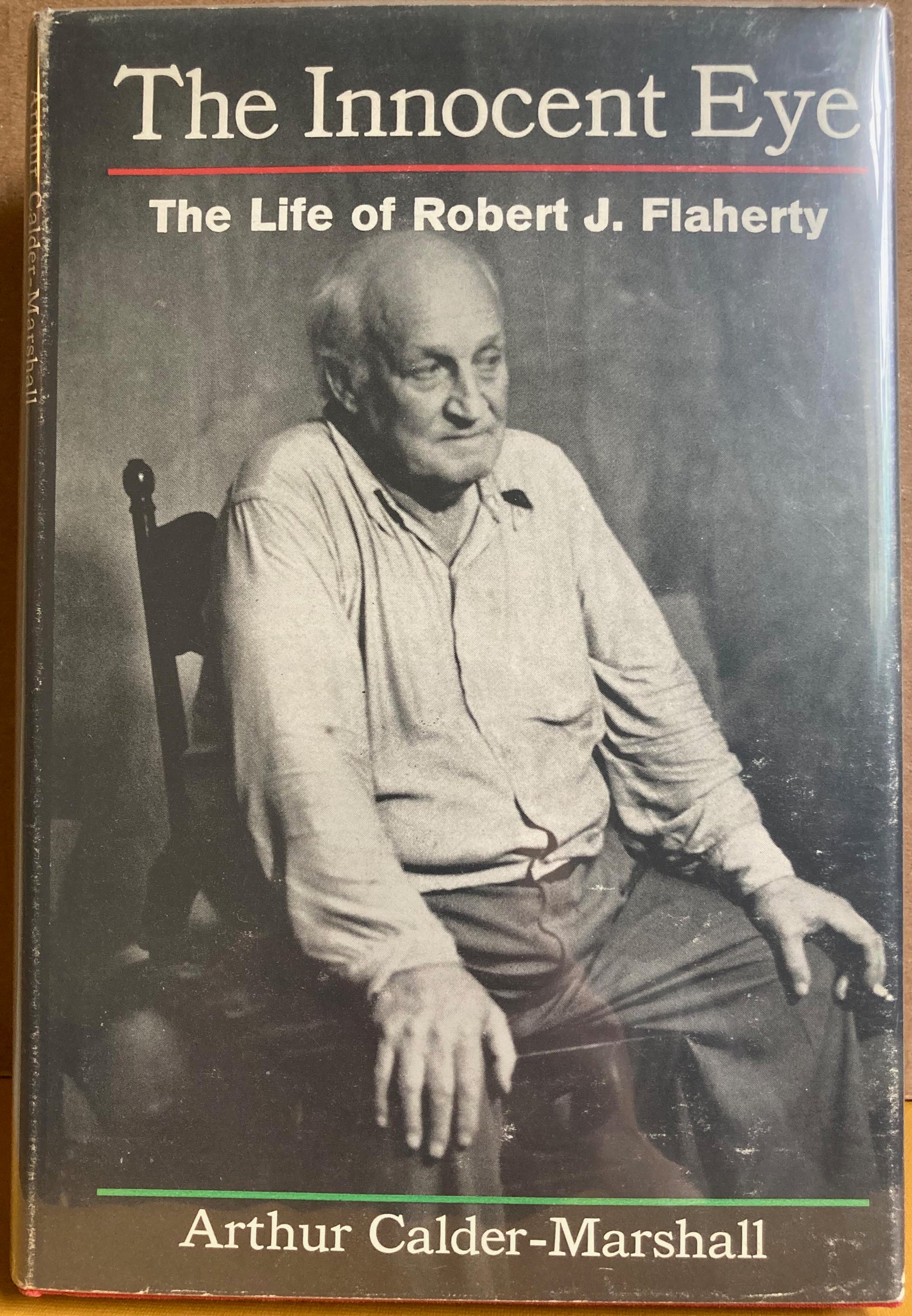
Flaherty, Robert J. The Innocent Eye: The Life of Robert J. Flaherty by Arthur Calder-Marshall.
Couldn't load pickup availability
Harcourt Brace & World, 1963. First American Edition, 1966. 304 pages. Biography of the pioneering documentary filmmaker, also a photographer. Known for his films such as Nanook of the North, Moana, Man of Aran, Elephant Boy, The Land, and Louisiana Story. Cover photo by Henri Cartier-Bresson. Frontispiece photo by Suchitzky. Illustrated with stills from Flaherty's films and photos of and related to Flaherty. Fine in red cloth with signatures of two previous owners on front flyleaf. Corner of one page creased during production. Very good protected dust jacket with moderate wear at extremities. Summary:
The Innocent Eye: The Life of Robert J. Flaherty (1963) by Arthur Calder-Marshall is the definitive biography of the "father of the documentary film." Based on extensive research and the personal papers of Flaherty’s wife and collaborator, Frances, the book explores the life of a man who transitioned from a rugged prospector and explorer to a cinematic visionary who changed how the world "sees" indigenous cultures.
Core Themes and Narrative
-
The Explorer-Artist: Calder-Marshall tracks Flaherty’s early years as a mineral prospector in the Canadian sub-arctic. It was during these expeditions that Flaherty first took a camera into the field, eventually leading to the creation of Nanook of the North (1922).
-
The "Innocent Eye" Philosophy: The title refers to Flaherty’s method of "non-preconception." He did not go into a project with a script; instead, he lived with his subjects for months or years, letting the story emerge from the "spirit" of the place.
-
The Creation of Narratives: The book candidly addresses the controversies of Flaherty’s work—specifically his tendency to "stage" or reconstruct traditional practices (such as the walrus hunt in Nanook or the shark hunting in Man of Aran) that had already vanished. Calder-Marshall argues that Flaherty wasn't seeking "literal" truth, but an "essential" poetic truth.
Visual and Technical Scope
-
The Camera as Survival Tool: The biography details the immense mechanical challenges of early filmmaking in extreme environments—from hand-cranking cameras in sub-zero temperatures to developing film in "igloo laboratories" using melted snow.
-
Cinematic Milestones: The book provides deep dives into his major works: the Arctic of Nanook, the South Seas of Moana, the rugged Irish coast of Man of Aran, and the industrial bayous of Louisiana Story.
- Robert J. Flaherty (1884–1951) was an American filmmaker, cinematographer, and prospector widely regarded as the father of narrative documentary cinema. Born in Iron Mountain, Michigan, Flaherty spent his early career exploring and mapping northern Canada for railway expansion, during which he began using a motion picture camera to record the daily lives of indigenous peoples. His groundbreaking film Nanook of the North (1922)—shot in the Arctic subzero wilderness—established a new cinematic vocabulary by combining non-fiction ethnographic observation with dramatic narrative structure, visual lyricism, and staged re-enactments. Often working alongside his wife and creative collaborator Frances H. Flaherty, he continued his poetic visual exploration of human resilience against nature in celebrated works like Moana(1926) in Samoa, Man of Aran (1934) off the Irish coast, and the Academy Award-nominated Louisiana Story (1948). Though modern scholars debate his use of romanticized staging, Flaherty’s mastery of natural lighting, location cinematography, and observational storytelling profoundly shaped the development of documentary film.