Gary Saretzky Photo Books
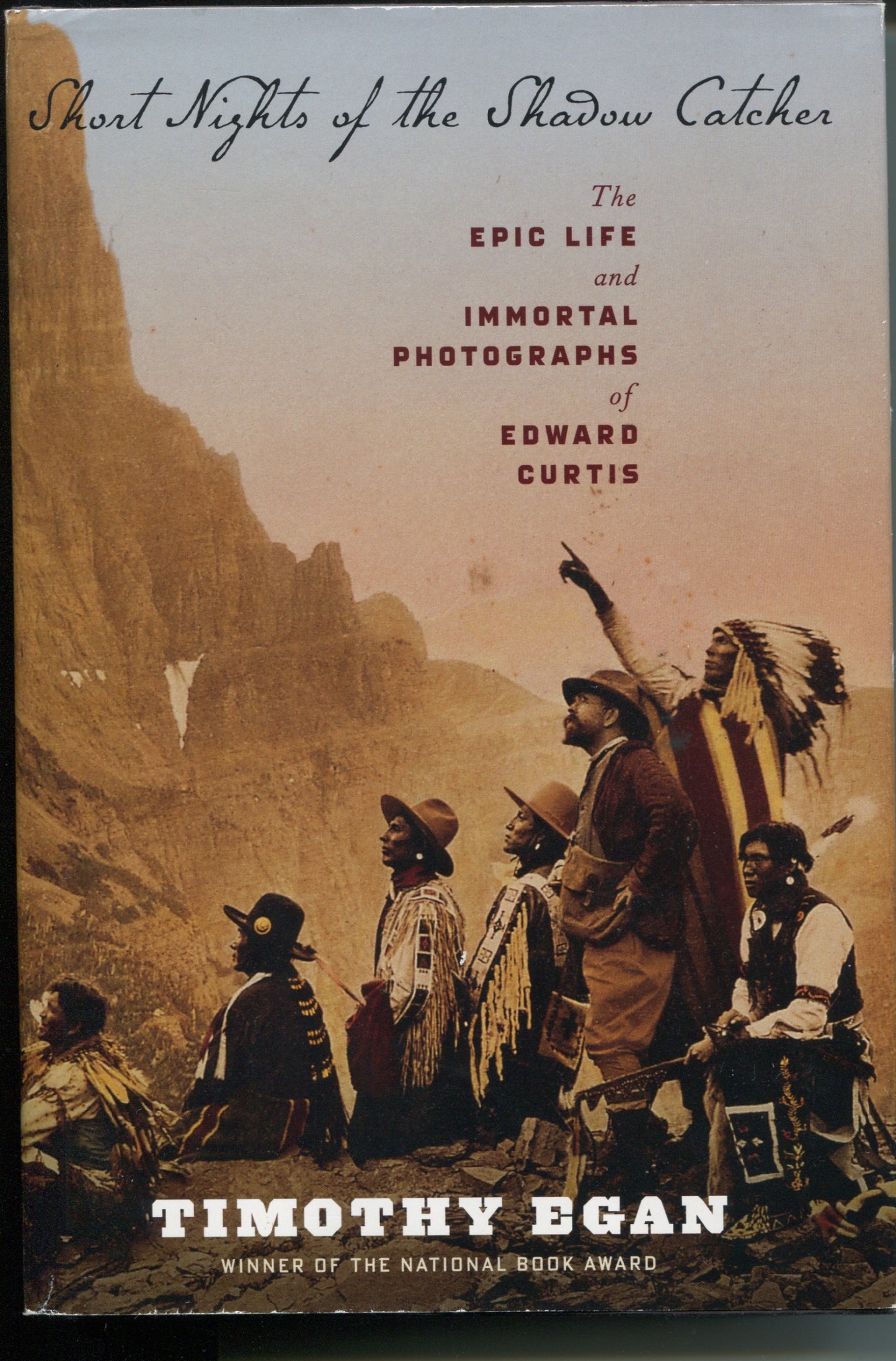
Curtis, Edward Sherriff. Short Nghts of the Shadow Catcher: The Epic Life and Immortal Photographs of Edward Curtis by Timothy Egan.
Curtis, Edward Sherriff. Short Nghts of the Shadow Catcher: The Epic Life and Immortal Photographs of Edward Curtis by Timothy Egan.
Couldn't load pickup availability
Houghton Mifflin, 2012. 370 pages. 4th printing. Hardcover, fine with near fine dust jacket. Biography of the photographer known for his thirty some odd year project of photographing Native Americans, Curtis gave up his successful career as a studio photographer in Seattle to pursue his passion at the cost of his marriage and financial security. Written by Timothy Egan, a past winner of the National Book Award, this account of Curtis' life is very readable. Includes information about his brother, the photographer Asahel Curtis, and other members of his family. Summary:
Short Nights of the Shadow Catcher by Timothy Egan is a biography of photographer Edward Sheriff Curtis and his lifelong effort to document the lives and cultures of Native Americans before they disappeared under the pressures of modern American expansion.
The book follows Curtis from his early career as a successful portrait photographer in Seattle to the moment he abandons fame and financial stability around 1900 to pursue a massive project: photographing and recording the traditions of Native American tribes across North America. Over the next three decades, Curtis travels widely, living among more than eighty tribes and creating over 40,000 photographs and thousands of recordings of songs, languages, and ceremonies.
Egan shows both Curtis’s achievements and the personal costs of his obsession. Supported at times by figures like Theodore Roosevelt and J. P. Morgan, Curtis still struggles financially and sacrifices his family life to complete his monumental 20-volume work, The North American Indian.
Overall, the book portrays Curtis as a driven and complicated figure whose determination preserved an invaluable record of Native American cultures, even though he died largely unrecognized. It is both an adventure story and a reflection on ambition, cultural preservation, and the price of pursuing a great idea.
Edward S. Curtis (1868–1952) was an American photographer and ethnologist best known for his monumental endeavor to document the traditions and lives of Indigenous peoples of the American West. After establishing a successful portrait studio in Seattle in the 1890s, Curtis turned his focus toward Native American cultures, driven by the contemporary belief that these communities represented a "vanishing race" whose customs needed urgent preservation. Backed by prominent figures including financier J.P. Morgan and President Theodore Roosevelt, he spent over thirty years traveling the country to produce The North American Indian (1907–1930), a landmark 20-volume publication featuring ethnographic descriptions alongside more than 2,200 photogravures and thousands of audio recordings. While his artfully staged, large-format imagery faced modern criticism for occasionally idealizing or romanticizing his subjects by removing modern influences, Curtis's vast archive remains one of the most extensive and visually striking historical records of Native American heritage ever compiled.