Gary Saretzky Photo Books
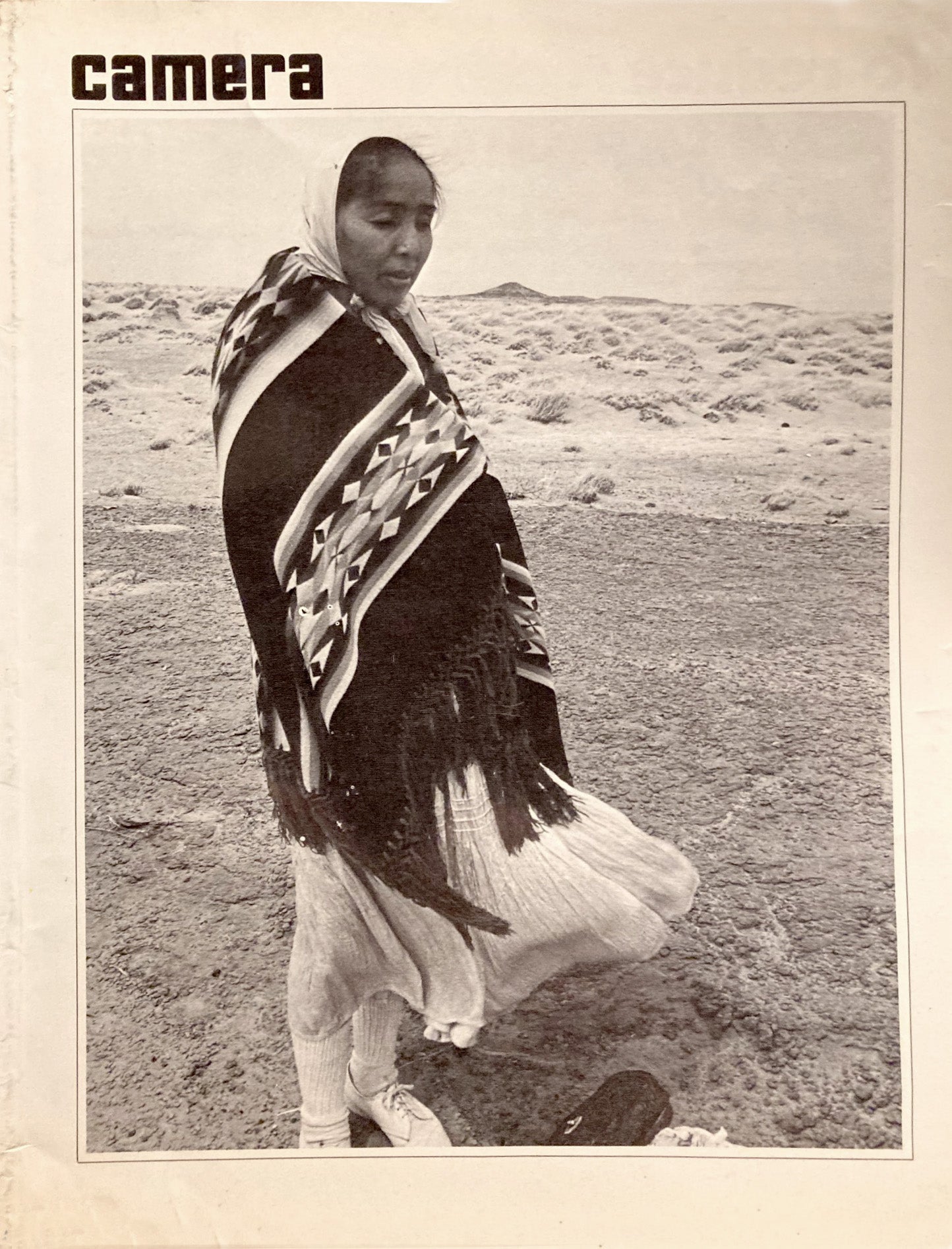
Camera, Volume 49, No. 7, July 1970. Potpourri. Hiroshi Hamaya, et al.
Camera, Volume 49, No. 7, July 1970. Potpourri. Hiroshi Hamaya, et al.
Couldn't load pickup availability
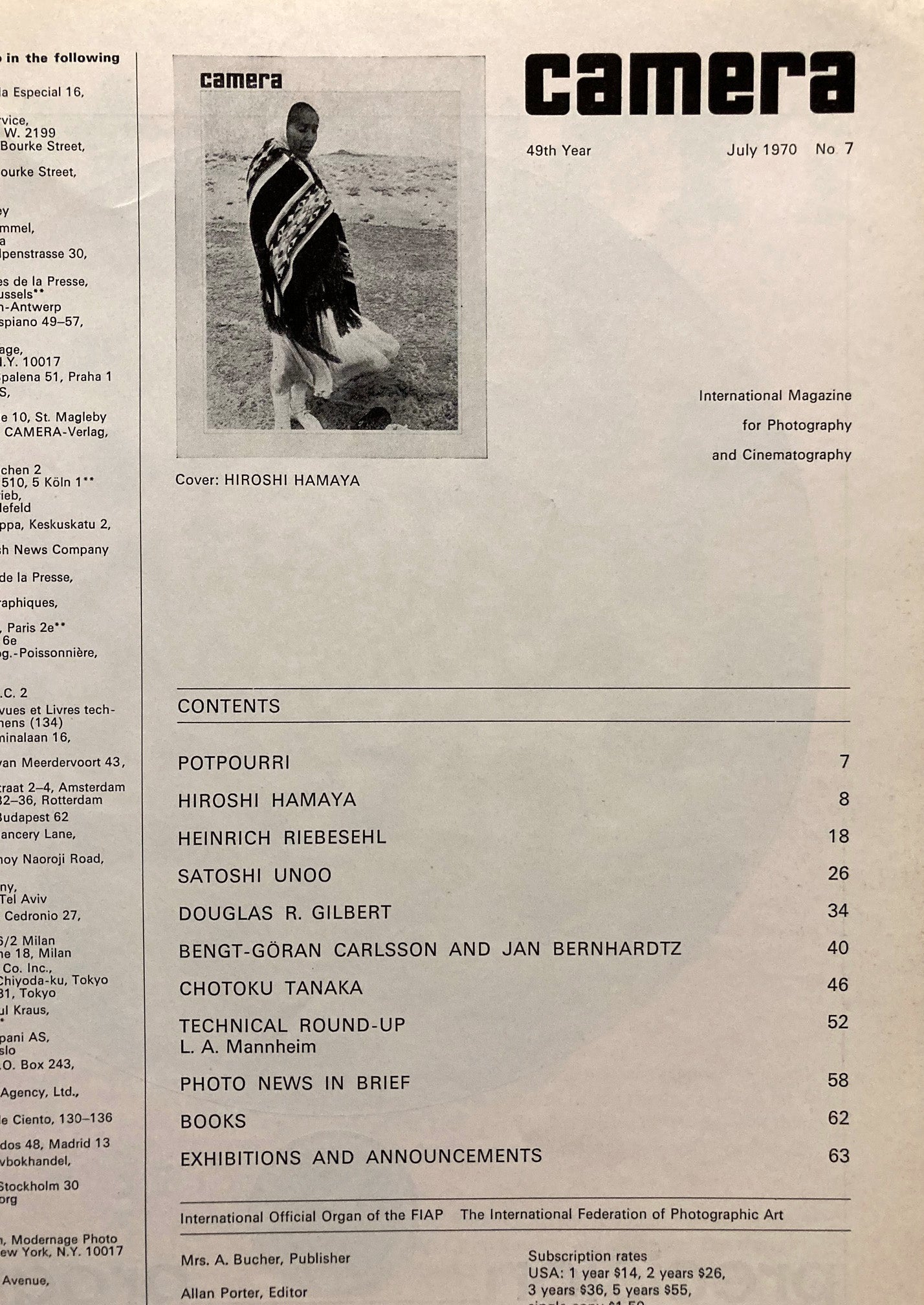
English edition. Edited by Allan Porter. Photographers: George Silk (ad); Hiroshi Hamaya; Heinrich Riebesehl; Unoo, Satoshi; Douglas R. Gilbert; Bengt-Goran Carlsson; Jan Bernhardtz and Chotoku Tanaka. Very good with a few crimps on covers and slight wear along spine. Summary:
The July 1970 issue of Camera, the prestigious Swiss magazine edited by Allan Porter, serves as a sophisticated cross-section of international photography at the turn of a decade. During this period, Camera was influential for moving away from traditional pictorialism toward a more rigorous, experimental, and sometimes sociological approach to the image.
Featured Photographers and Portfolios
The issue is structured as a series of distinct portfolios, showcasing a mix of established masters and emerging avant-garde voices:
1. Hiroshi Hamaya: "Landscapes of Japan"
The centerpiece of the issue is the work of Hiroshi Hamaya, one of Japan's most celebrated photographers. Hamaya presents a vision of the Japanese landscape that is both powerful and stark. Unlike traditional scenic views, his work explores the primal relationship between the land and the elements, characterized by deep blacks and a high-contrast graphic quality that emphasizes texture and form over sentiment.
2. Heinrich Riebesehl: "Situations"
Representing the German "Subjective Photography" lineage, Heinrich Riebesehl contributes images from his Situations series. His work captures mundane, often industrial or urban environments with a detached, clinical precision. These photographs reflect the burgeoning "New Topographics" style—finding interest in the unremarkable "non-places" of modern life.
3. Satoshi Unoo: "People of the World"
Unoo’s contribution leans toward humanistic photojournalism. His portfolio captures the diversity of human experience with an empathetic eye, focusing on candid moments and the cultural markers that define global populations during the 1960s and 70s.
4. Douglas R. Gilbert: "Chicago"
An American perspective is provided by Douglas R. Gilbert, whose work in this issue often deals with the urban social landscape. His images are noted for their sophisticated composition and their ability to capture the energy and tension of life in the American Midwest.
5. The Swedish Contingent: Bengt-Göran Carlsson & Jan Bernhardtz
The issue highlights the "Swedish School" of the era, which was known for its dark, gritty, and deeply atmospheric style.
-
Bengt-Göran Carlsson: Focuses on the stark, often lonely relationship between individuals and their immediate surroundings.
-
Jan Bernhardtz: His work often experiments with grain and high contrast to create a mood of existential introspection.
6. Chotoku Tanaka: "European Observations"
Tanaka provides a Japanese "outsider's" view of Europe. His work is characterized by a wandering, street-photography style that focuses on the strange, the ironic, and the incidental details of European city life.
Editorial Theme and Design
Under Allan Porter’s direction, this issue exemplifies Camera’s high production standards:
-
The Gravure Printing: The magazine was famous for its high-quality gravure printing, which gave the photographs a depth and tonal richness that few other publications could match.
-
Curation: The July 1970 issue is curated to show the globalization of photography—how Japanese, European, and American photographers were all moving toward a more subjective, personal way of "witnessing" the world.
Summary Takeaway
The July 1970 issue of Camera is a landmark document of post-war modernism. It captures a moment when the world’s leading photographers were shifting away from clear-cut journalism toward a more ambiguous, poetic, and intellectually rigorous form of photography. It is particularly valuable for its focus on the Japanese avant-garde and the emerging topographic sensibilities in Europe and America.