Gary Saretzky Photo Books
Color Photography by Eliot Elisofon. First edition.
Color Photography by Eliot Elisofon. First edition.
Couldn't load pickup availability
Viking, 1961. Hardcover, near fine with very good dust jacket that has some wear at extremities. 156 pages. Most photographs by Eliot Elisofon, with a few by Edward Weston, Gordon Parks, William Klein, et al. Summary:
Published in 1961 by Viking Press, Color Photography by Eliot Elisofon is a seminal work that bridges the gap between technical manual and artistic manifesto. Elisofon, a legendary LIFE magazine staff photographer and Hollywood color consultant, argues that color should be used as a psychological tool rather than just a descriptive one.
The Philosophy of "Controlled Color"
The book’s core premise is that the photographer must be a "master of the palette" rather than a slave to reality. Elisofon famously rejected the idea that color film should merely replicate what the eye sees.
-
Subjective Color: He advocates for using color to evoke specific moods—using "warm" tones for intimacy or "cool" blues for detachment.
-
Filters as Brushes: Elisofon was a pioneer in using heavy filtration (often custom-made) to "paint" light, a technique he famously applied to the film Moulin Rouge (1952) to give it a post-impressionist feel.
Key Sections and Content
The book is structured to guide the photographer through both the mechanics and the aesthetics of the medium:
-
Technical Mastery: While dated by modern digital standards, his deep dives into Kelvin temperatures, film speeds, and the chemical behavior of Kodachrome and Ektachrome provide a fascinating look at the "Golden Age" of analog color.
-
Light as a Variable: He categorizes light not just by intensity, but by its emotional quality, analyzing how light changes from dawn to dusk and how artificial light can be manipulated.
-
The Photo-Essay: Drawing on his LIFE experience, he explains how to maintain color continuity across a series of images to tell a cohesive story.
Visual Impact and Legacy
The book is celebrated for its high-production value, featuring 80 pages of color reproductions of Elisofon’s own global assignments—ranging from African landscapes to celebrity portraits and still lifes.
-
Influence on Cinema: His theories on color control heavily influenced both still photography and cinematography, pushing the industry away from "postcard-perfect" colors toward a more expressive, cinematic style.
-
Artistic Independence: Elisofon’s ultimate message was one of creative bravery; he encouraged photographers to "break the rules" of the film manufacturers to achieve a personal vision.
"The camera is a tool, but color is the language. One must learn to speak it with intent, not by accident." — Eliot Elisofon
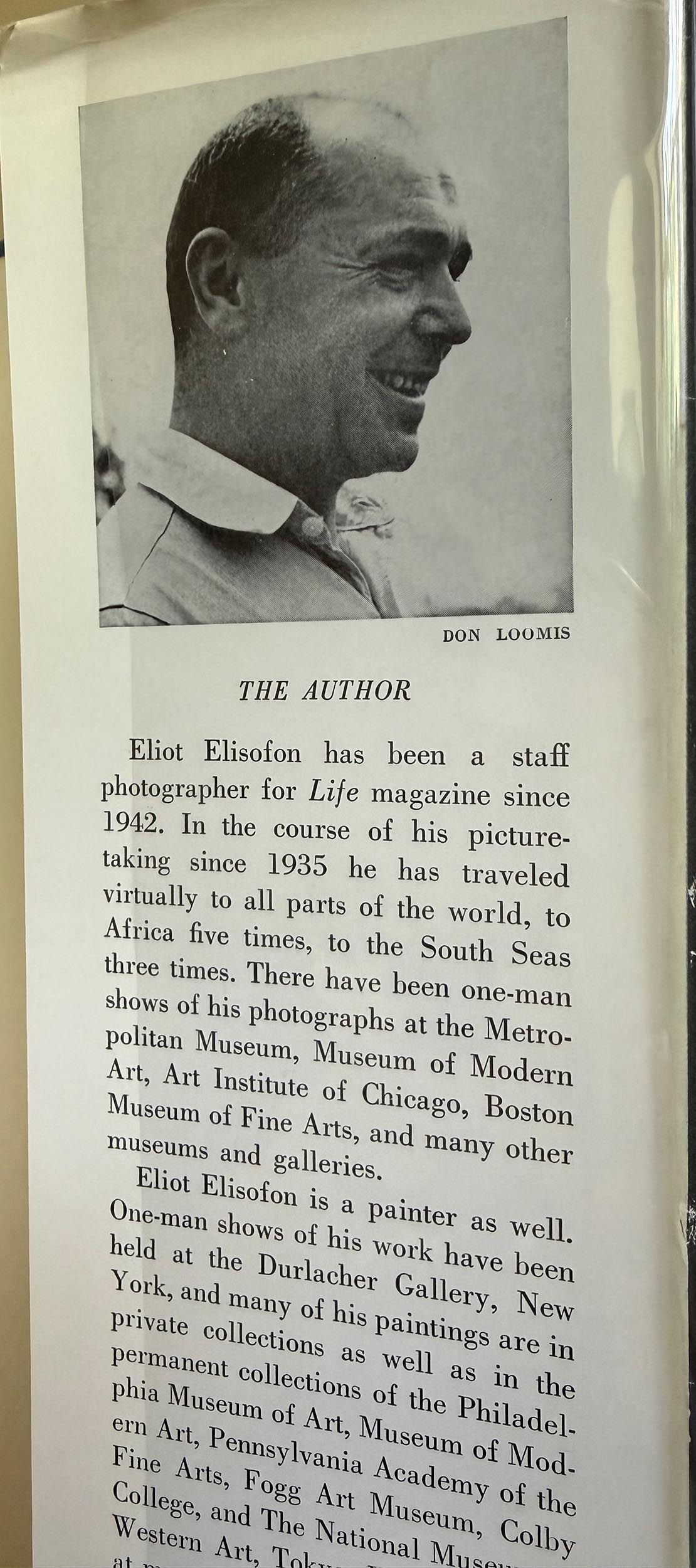
Eliot Elisofon (1911–1973) was a influential American documentary photographer, photojournalist, author, and art collector who captured global cultures across six continents over a career spanning four decades. Born in New York City and educated at Fordham University, he began his career focusing on socially conscious street photography with the Photo League and served as the first staff photographer for the Museum of Modern Art in 1939. As a celebrated staff photographer and war correspondent for Life magazine from 1942 to 1964, Elisofon covered major World War II conflicts—including General Patton’s North African campaign—and produced wide-ranging photo essays on topics from Hollywood stars to global architecture. An innovator in color photography, he also worked as a cinematic color consultant on major films such as Moulin Rouge (1952) and Bell, Book and Candle (1958). Deeply passionate about the arts and cultures of Africa, Elisofon published pioneering photobooks like The Sculpture of Africa (1958) and served as a founding trustee of what became the Smithsonian Institution's National Museum of African Art, to which he bequeathed his massive collection of African art and an archive of over 80,000 photographic images upon his death.