Gary Saretzky Photo Books
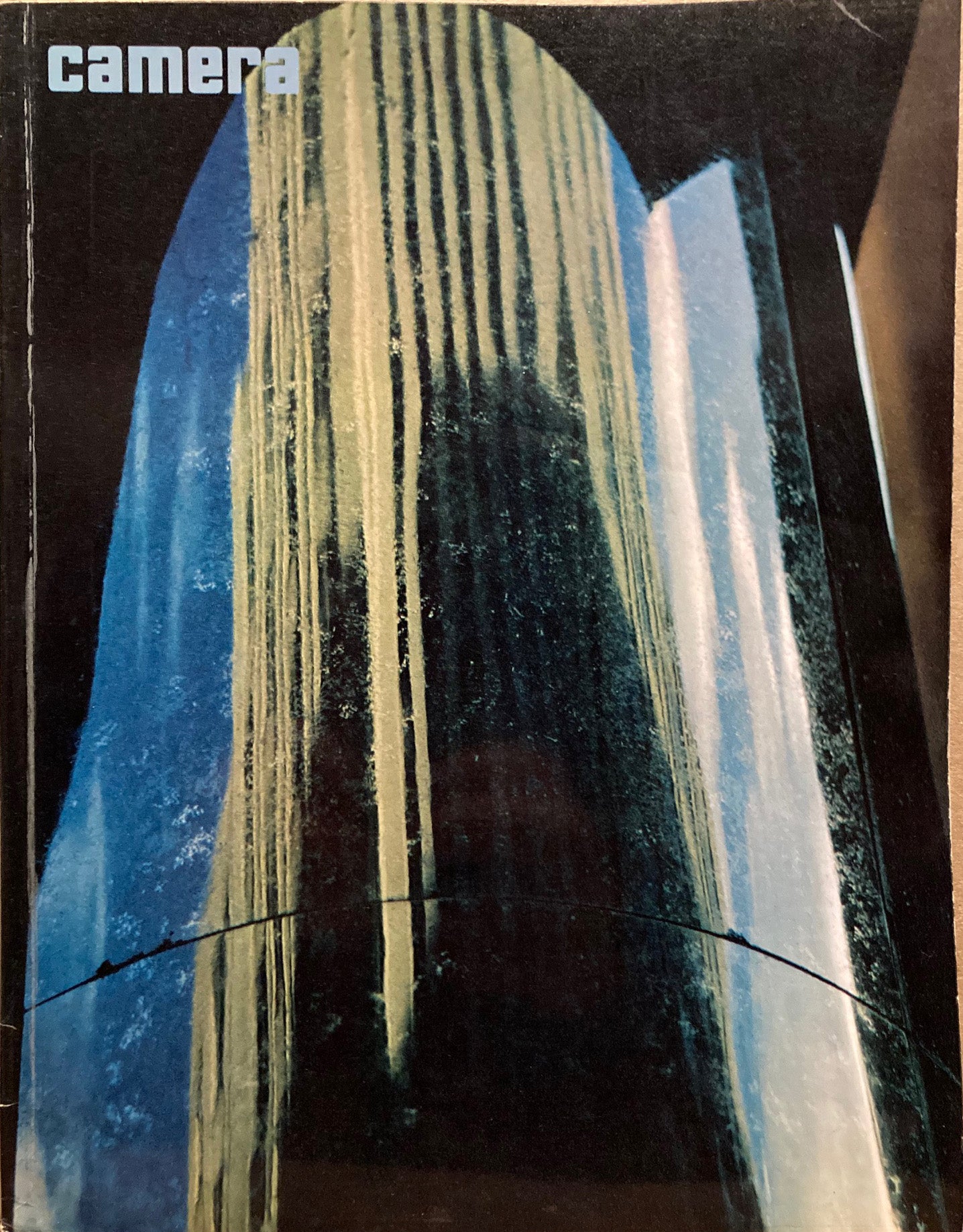
Camera, Volume 49, No. 10, October 1970. Photography as a Literary Art. Ernst Haas, Eikoh Hosoe, et al.
Camera, Volume 49, No. 10, October 1970. Photography as a Literary Art. Ernst Haas, Eikoh Hosoe, et al.
Couldn't load pickup availability
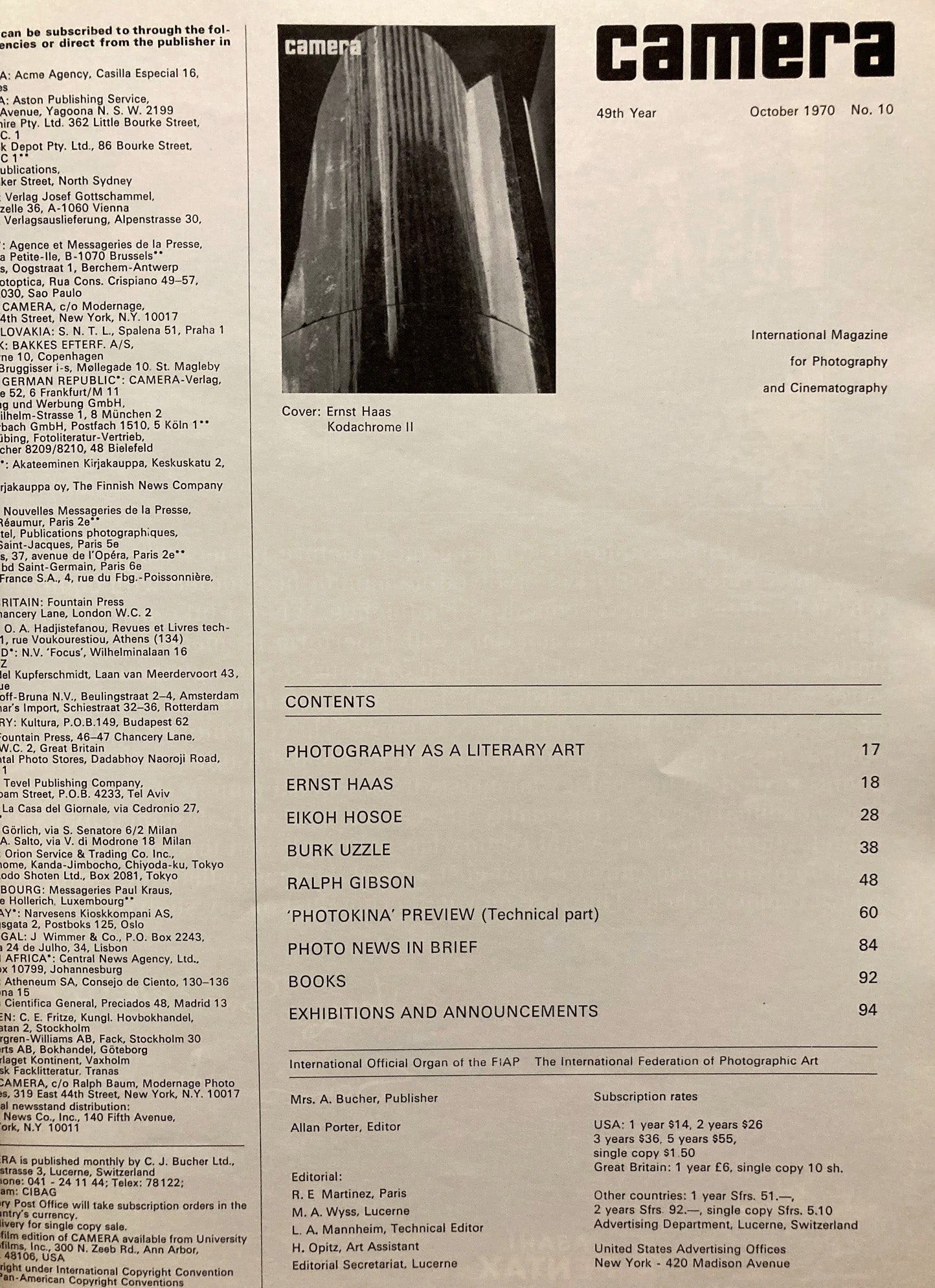
Edited by Allan Porter. Photographers: Ernst Haas, Eikoh Hosoe, Burk Uzzle, Ralph Gibson. Entire issue, about 100 pages. Also includes Photokina Preview (Techical Part), Photo News in Brief, Books,and Exhibitions and Announcements. Near fine with minor evidence of use on covers. Summary:
The October 1970 issue of Camera (Volume 49, No. 10) is a seminal edition that explores the conceptual bridge between visual imagery and narrative structure. Titled "Photography as a Literary Art," editor Allan Porter curated this issue to argue that a sequence of photographs can function like a poem, a short story, or an essay, possessing its own syntax and "literary" weight.
Core Theme: The Narrative Image
The issue posits that photography had moved beyond mere documentation into the realm of metaphor and fiction. Rather than individual "masterpieces," the focus is on how images interact with one another to create a cohesive, non-linear story.
Featured Portfolios
1. Ernst Haas: "The Creation"
The issue features a segment of Haas’s legendary color work. Moving away from his photojournalism, Haas uses abstract, blurred, and intensely vibrant color photography to "re-tell" the biblical story of Genesis. His work exemplifies the "literary" theme by using visual lyricism to interpret a classic text.
2. Eikoh Hosoe: "Kamaitachi"
This portfolio is one of the most celebrated examples of photographic storytelling. Hosoe collaborated with the founder of Butoh dance, Tatsumi Hijikata, to create a mythic narrative in a Japanese village.
-
The Narrative: It depicts a spontaneous, disruptive spirit (the Kamaitachi) interacting with the landscape and its people.
-
Literary Connection: It functions as a visual folk tale, blending performance art with surrealist documentation.
3. Ralph Gibson: "The Somnambulist"
The issue includes work from Gibson’s groundbreaking book The Somnambulist.
-
The Style: High-contrast, minimalist, and dreamlike.
-
Literary Connection: Gibson’s sequences are often compared to the "nouveau roman" (new novel) in French literature, where the meaning is found in the gaps between images and the subconscious associations of the viewer.
4. Burk Uzzle: "Social Landscapes"
Uzzle, a member of Magnum Photos, provides a more contemporary, observational "prose." His work captures the oddities and ironies of American life, functioning like a collection of short, observational vignettes that comment on the human condition.
Editorial Impact
-
Sequence over Snapshot: This issue was instrumental in popularizing the concept of the "photographic sequence" as a legitimate art form.
-
Interdisciplinary Approach: By framing photography through the lens of literature, Camera encouraged photographers to think of themselves as authors rather than just observers.
-
Technical Excellence: As with all 1970s Camera issues, the gravure printing provided a depth of tone that supported the "atmospheric" and "mood-driven" requirements of literary photography.
Summary Takeaway
The October 1970 issue is a manifesto for Visual Metaphor. It remains a vital reference for understanding how the 20th-century avant-garde moved photography into the world of subjective, symbolic storytelling, forever changing the way photographic books and series are constructed.
