Gary Saretzky Photo Books
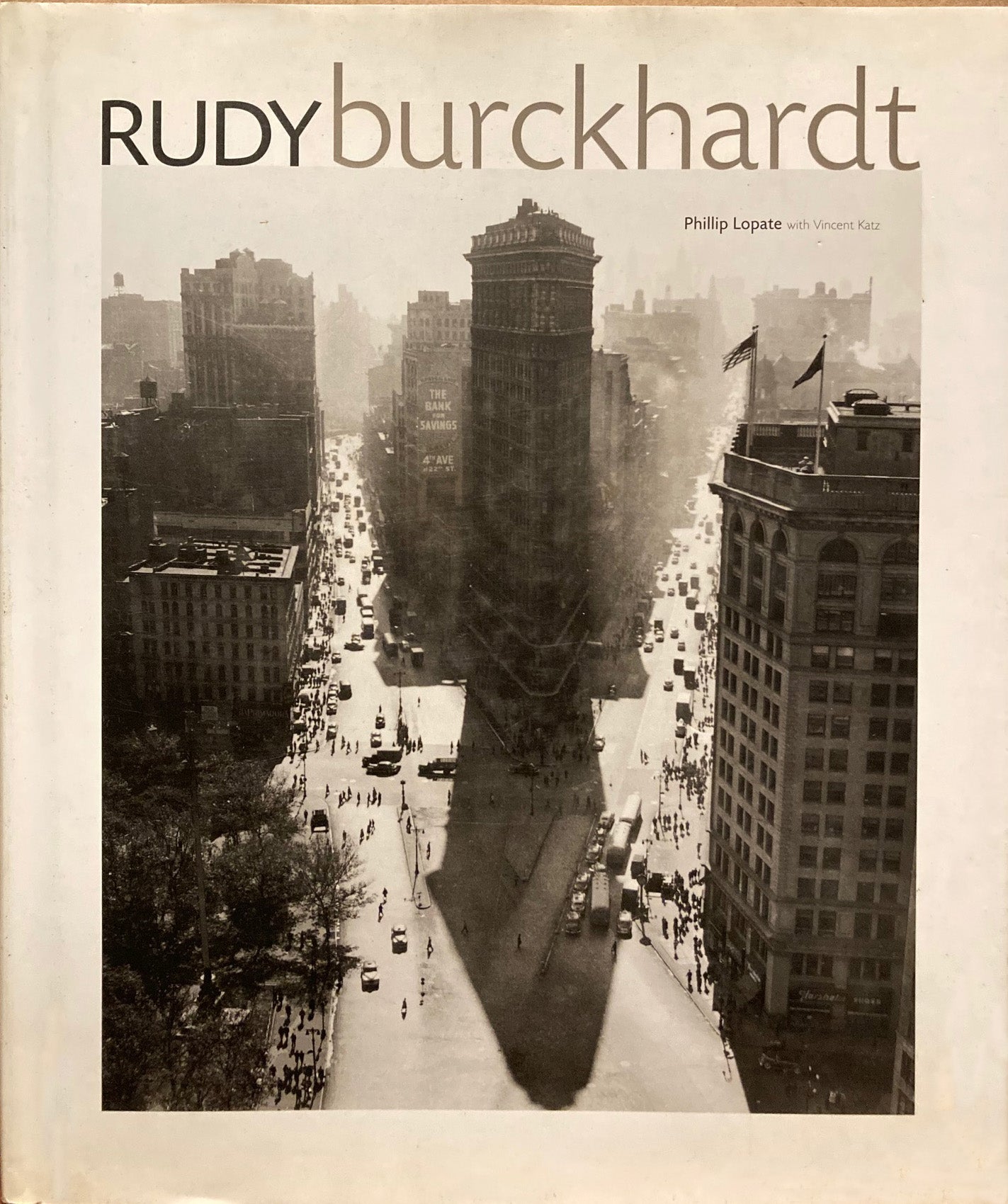
Burckhardt, Rudy. Rudy Burckhardt by Phillip Lopate and Vincent Katz.
Burckhardt, Rudy. Rudy Burckhardt by Phillip Lopate and Vincent Katz.
Couldn't load pickup availability
Abrams, 2004. 1st edition, 1st printing, fine in hard cover with good protected dust jacket that has a stain along top edge of back cover, otherwise near fine. A large monograph that provides a retrospective of Burkhardt's work, including photographs of New York, Venice, artists, and nudes.
Rudy Burckhardt (April 6, 1914 – August 1, 1999) was a Swiss-American filmmaker and photographer, known for his photographs of the hand-painted billboards that began to dominate the American landscape in the nineteen-forties and fifties. Burckhardt, who emigrated to New York in 1935, became a member of the Photo League in 1947. (Wikipedia). Summary:
Rudy Burckhardt (2004) is a comprehensive monograph and critical appreciation of the multi-talented Swiss-American artist who became a quintessential figure in the mid-century New York art scene. Featuring essays by Phillip Lopate and Vincent Katz, the book explores Burckhardt’s prolific sixty-year career as a photographer, filmmaker, and painter.
The Collaborative Perspective
The book benefits from the distinct viewpoints of its two main contributors, who provide context for Burckhardt’s understated but influential presence:
-
Phillip Lopate’s Essay: The noted essayist focuses on Burckhardt’s "street level" sensibility. He explores Burckhardt’s unique ability to capture New York City without the aggression or "toughness" typical of his contemporaries, highlighting instead his wit, curiosity, and appreciation for the mundane.
-
Vincent Katz’s Contribution: Katz (son of painter Alex Katz) provides an intimate look at Burckhardt’s role within the "New York School." He details Rudy's friendships and collaborations with giants like Willem de Kooning, Frank O’Hara, and Edwin Denby, positioning him as a quiet glue that held various artistic circles together.
Core Artistic Themes
1. The Poetry of the Commonplace
Burckhardt’s photography is defined by its lack of pretension. He famously focused on "the bottom of things"—sidewalks, fire escapes, feet, and the backs of signs. The book showcases how he found a formal, almost classical beauty in the visual clutter of the city.
2. The City as a Stage
Whether in his photography or his short, quirky 16mm films, Burckhardt viewed the city as a grand, unscripted theater. His work documents:
-
The rush of midtown pedestrians.
-
The architectural "accidents" of the urban landscape.
-
The shifting light on limestone and brick.
3. Portraits of the New York School
The volume includes Burckhardt’s legendary portraits of artists in their studios. These images are noted for their naturalism and lack of artifice, capturing the giants of Abstract Expressionism as working craftsmen rather than distant icons.
Visual Style and Philosophy
-
Understatement: Burckhardt avoided the "decisive moment" drama. Instead, he practiced a "non-judgmental" photography that accepted the world as it was.
-
Versatility: The book bridges the gap between his black-and-white street photography and his later experiments in color and filmmaking, showing a consistent "eye" that remained playful and observant across all media.
-
European Sensibility in an American Context: The authors discuss how his Swiss background gave him a detached, slightly ironic perspective on American consumerism and urban density.
Summary Takeaway
Rudy Burckhardt is an essential retrospective of a "photographer’s photographer." It rescues Burckhardt from being a "minor" figure, arguing that his modest, joyful, and rigorously composed work is a foundational pillar of New York’s cultural history. The book is a celebration of an artist who chose to look at the world with affection rather than angst.
