Gary Saretzky Photo Books
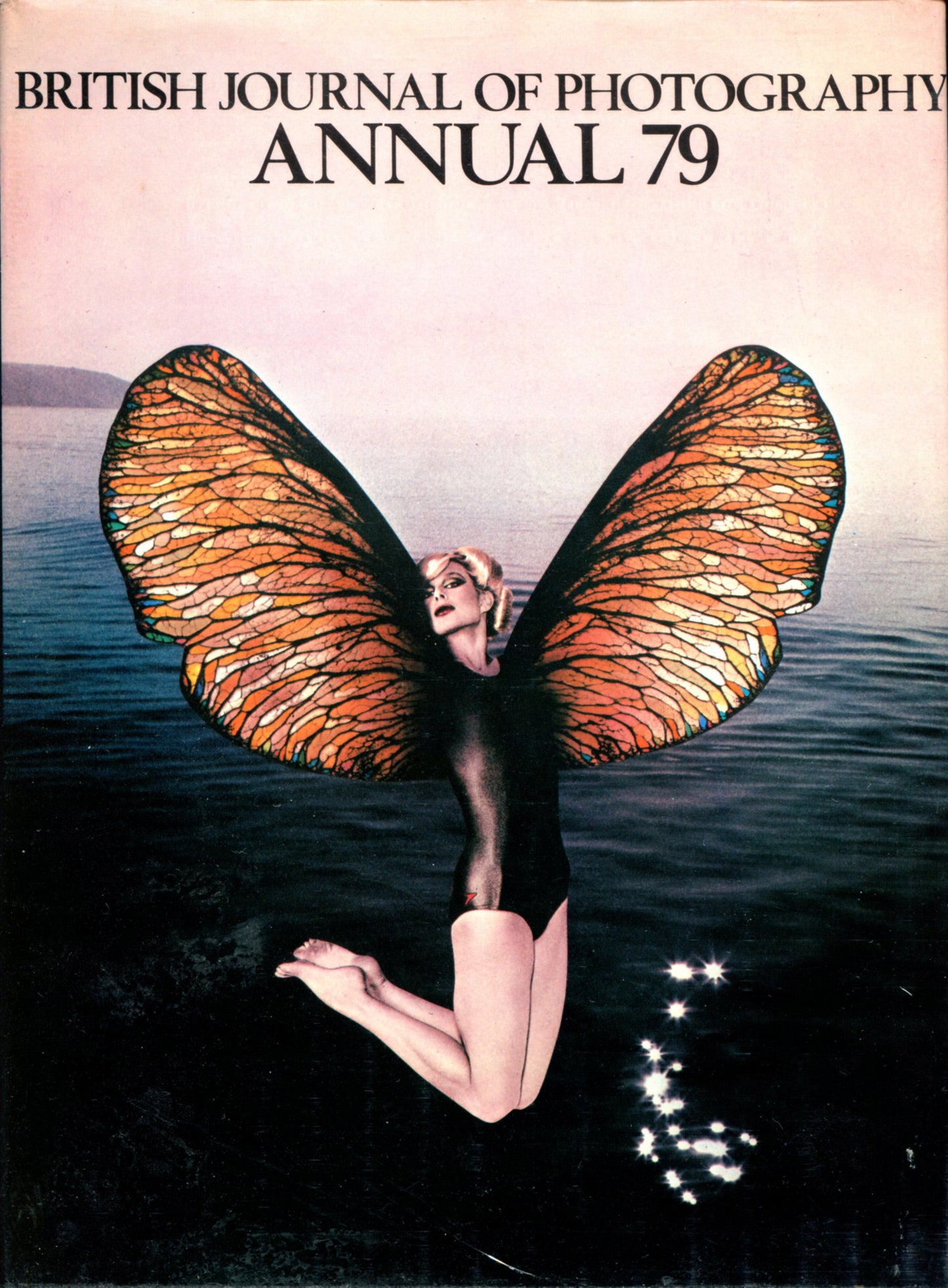
Annuals. British Journal of Photography Annual 1979. U.K. edition, signed.
Annuals. British Journal of Photography Annual 1979. U.K. edition, signed.
Couldn't load pickup availability
Henry Greenwood & Co., 1978. Inscribed and signed by editor Geoffrey Crawley to Ed Meyers, editor of Popular Photography. Hardcover fine with very good dust jacket with a few nicks, including a short tear at top of rear panel. This is the British edition; there was also a Focal Press edition for U.S. distribution. British edition includes ads not in U.S. edition. Articles about Alvin Langdon Coburn by David Reed, Exposure Meters by Neville Maude, John Thomas and the Objective Documentary Photograph by Alistair Crawford, International Directory of Photographic Information Sources, detailed instructions for processing film and paper, et al. Photographers include: John Thomas (1838-1905); Alvin Langdon Coburn; Douglas Corrance; Brian Fanning; Franco Fontana; Steven Johnston; Michael Kenna; Jurgen Schadeberg; Marcus Lempka; Yogish Sahota; Philip Fraser-Betts; Leo Mason; Sarah King; Ken Baird; Dick Jones; Jurgen Schadeberg; Nick Hedges; Len Dance; Jill Stinchcombe; Franco Frezzato; Marilyn Stern; Denis Thorpe; Jeffrey Veitch; Chris Wroblewski; Paul Wakefield, Bob Carlos Clarke, et al. Summary:
The British Journal of Photography (BJP) Annual 1979, edited by Geoffrey Crawley, is a hallmark volume that balances historical scholarship with the rigorous technical instruction characteristic of the Henry Greenwood & Co. era. This edition serves as both a high-art portfolio and a practical manual for the working photographer.
Key Historical and Biographical Articles
-
Alvin Langdon Coburn by David Reed: A scholarly look at the American-British Pictorialist. Reed examines Coburn’s journey from soft-focus Symbolism to his pioneering "Vortographs"—often cited as the first truly abstract photographs—and his deep connection to the London literati.
-
John Thomas and the Objective Documentary Photograph by Alistair Crawford: This chapter highlights the 19th-century Welsh photographer John Thomas. Crawford argues that Thomas’s work predates the modern concept of "objective" social documentation, capturing the people and architecture of Wales with a clarity that was ahead of its time.
-
The International Directory of Photographic Information Sources: A massive logistical undertaking for the pre-internet age, this directory provided a comprehensive global guide to museums, galleries, associations, and archives, making the 1979 Annual an indispensable reference tool for researchers.
Technical Mastery and Education
The 1979 edition is particularly prized for its "how-to" depth, reflecting the peak of the analog darkroom era.
-
Exposure Meters by Neville Maude: A definitive technical survey exploring the physics and practical application of light metering. Maude breaks down the evolution of selenium, CdS, and silicon cells, helping photographers achieve precision in difficult lighting.
-
Processing Instructions: The volume contains dense, step-by-step instructions for film development and paper processing. This includes "formulae of the year" for various developers (D-76, Rodinal, etc.) and guidance on maintaining archival standards in the darkroom.
-
The "Technical Year": As is tradition, the book concludes with an exhaustive review of the year’s hardware, focusing on the refinement of the electronic shutter and the growing dominance of the 35mm SLR system.
Visual and Artistic Impact
The Picture Section of the 1979 Annual features a blend of British and international portfolios. While the historical essays look back at masters like Coburn and Thomas, the contemporary selections highlight the "New British Documentarist" movement, characterized by a shift toward more personal, subjective viewpoints in street and landscape photography.
Significance
The 1979 Annual is a "bridge" volume. It honors the 19th-century roots of the medium through Thomas and Coburn while providing the hardcore technical data required for 20th-century professional practice. It captures a moment when the darkroom was still a sanctuary of chemical precision before the digital shift began to appear on the horizon.