Gary Saretzky Photo Books
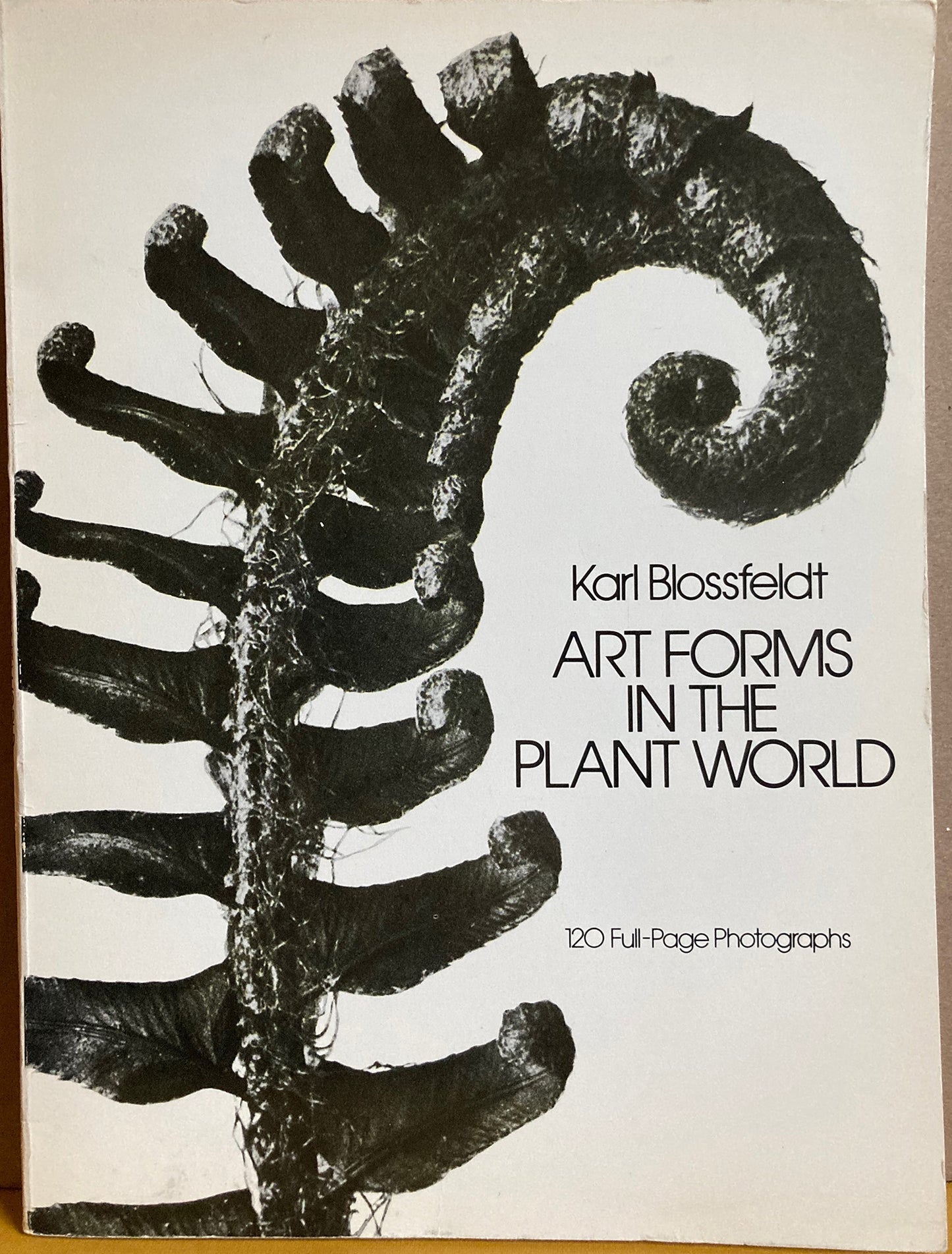
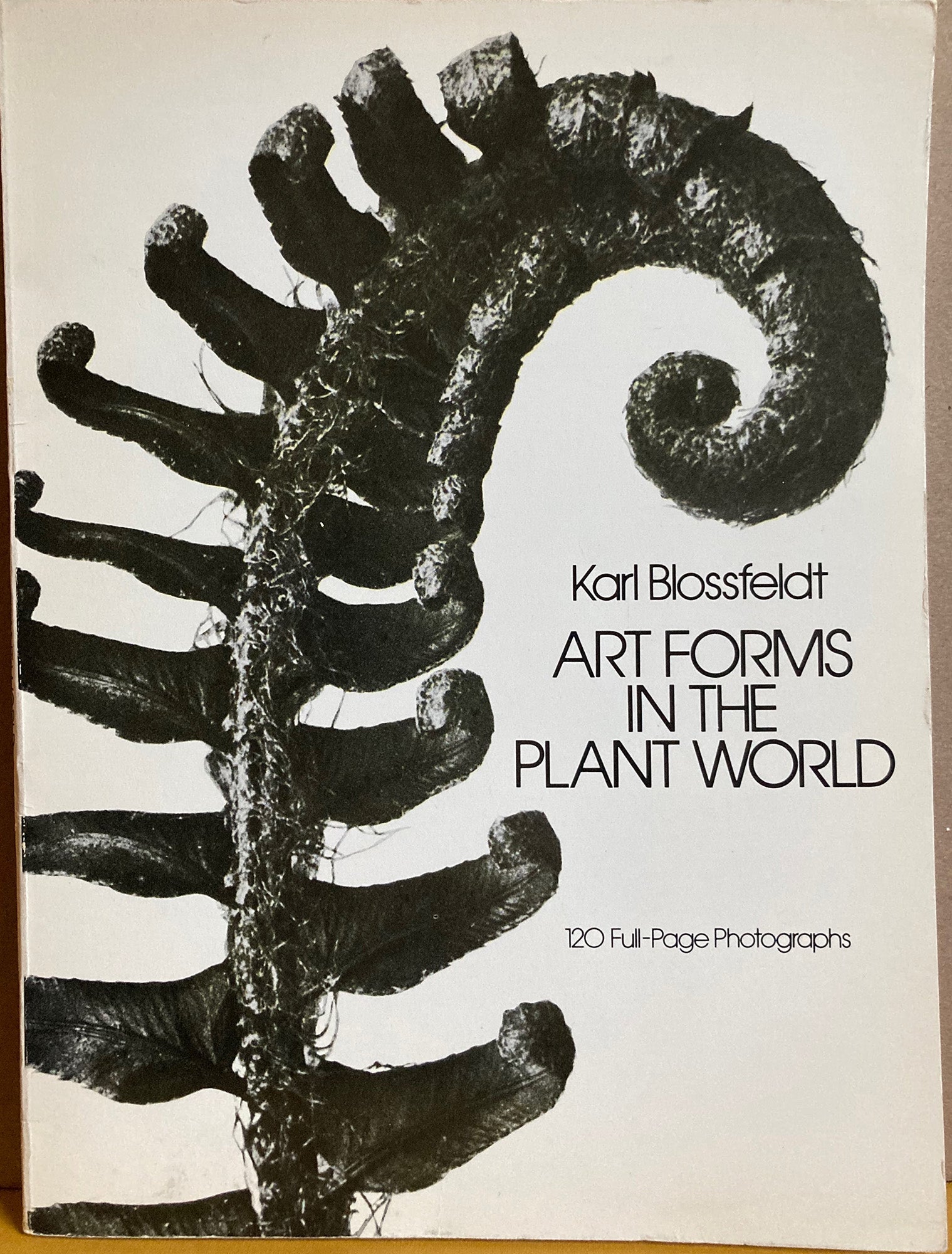
Blossfeldt, Karl. Art Forms in the Plant World by Karl Blossfeldt. 120 Full-Page Photographs.
Blossfeldt, Karl. Art Forms in the Plant World by Karl Blossfeldt. 120 Full-Page Photographs.
Couldn't load pickup availability
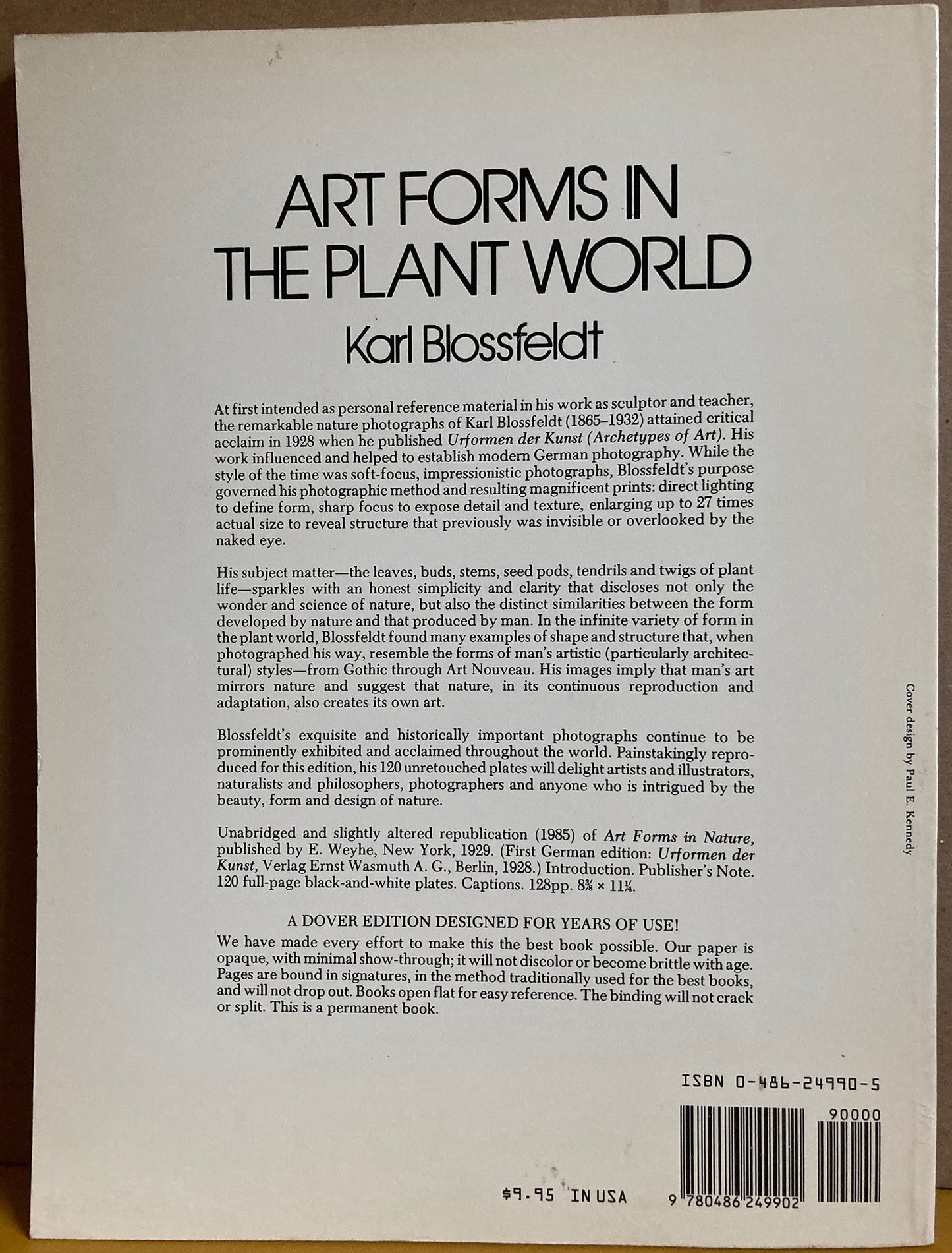
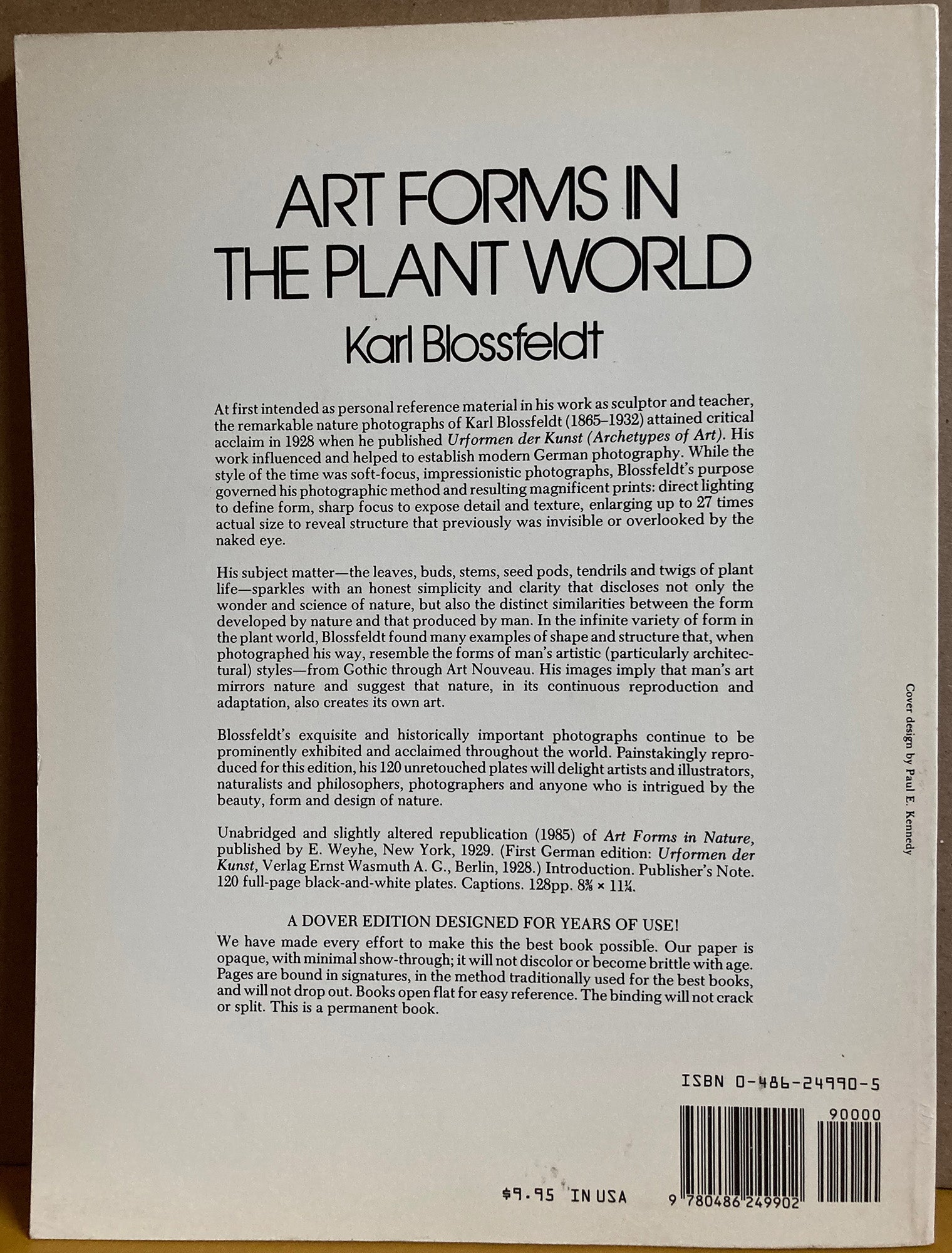
Introduction by Karl Nierendorf. Dover, 1985. Wraps, near fine with slight shelf wear at edges. Reissue of Art Forms in Nature (1929), unabridged and slightly altered with a Publisher's Note that places Blossfeldt's work in historical context. Blossfeldt's extraordinary close-up photos of plants were an influential component of Neue Sachlichkeit (New Objectivity), the German modern realist movement in the 1920s. Summary:
Art Forms in the Plant World (Dover, 1985) is a high-fidelity reproduction of Karl Blossfeldt’s groundbreaking work, originally published in 1928 as Urformen der Kunst. A self-taught photographer and professor of sculpture, Blossfeldt used a handmade camera capable of 30x magnification to document botanical specimens, revealing the "totalitarian" architectural logic hidden within nature.
Core Themes and Narrative
-
The "Original Forms" (Urformen): Blossfeldt’s central thesis was that nature had already invented every architectural and artistic motif used by humans—from the Corinthian column to Gothic tracery. He presented plants not as biological organisms, but as engineered structures.
-
Nature as Designer: The book argues that there is no "accidental" beauty; every curve of a fern and every spike of a thistle is a result of structural necessity and mathematical rhythm.
-
The "New Objectivity" (Neue Sachlichkeit): Blossfeldt became an accidental hero of the modernist movement. By stripping plants of their color and environment, he forced the viewer to see them as "Industrial Art," bridging the gap between the organic and the mechanical.
Visual and Technical Notes
-
The "Sculptural" Finish: The 120 full-page photographs are characterized by a monumental, stone-like quality. Against neutral, flat backgrounds, common weeds like horsetails and umbels are rendered with the gravity of cast iron or carved marble.
-
Macro-Precision: The style is extraordinarily sharp, highlighting microscopic textures—fine hairs, geometric seeds, and the serrated edges of leaves—that were invisible to the naked eye before his custom-built lenses.
- Karl Blossfeldt (1865–1932) was a German sculptor, photographer, and professor celebrated for his pioneering, highly objective close-up photographs of plants and flora that bridges 19th-century botanical illustration and 20th-century modernist art. Born in Schwerkten, Germany, Blossfeldt originally trained in sculpture and iron casting before studying at the Kunstgewerbeschule (School of Arts and Crafts) in Berlin, where he spent over three decades teaching modeling from live plants. Utilizing custom-built cameras equipped with long lenses capable of magnifying plant structures up to thirty times their actual size, he systematically photographed buds, seed pods, stems, and leaves against plain, neutral backdrops. Initially created purely as pedagogical teaching aids to demonstrate that all architectural, sculptural, and ornamental forms originate in nature, his extreme close-ups revealed startling geometric patterns, gothic arches, and totem-like structures hidden within organic specimens. When published in his landmark 1928 photobook Urformen der Kunst (Archetypes of Art), his work caused an immediate international sensation, championed by Walter Benjamin and the Surrealists as a supreme masterpiece of the Neue Sachlichkeit (New Objectivity) movement and establishing Blossfeldt as a crucial link between natural morphology and avant-garde photography.