Gary Saretzky Photo Books
Aristotle, Volume 2 of 2 by George Grote. 1st ed. with interesting provenance.
Aristotle, Volume 2 of 2 by George Grote. 1st ed. with interesting provenance.
Couldn't load pickup availability
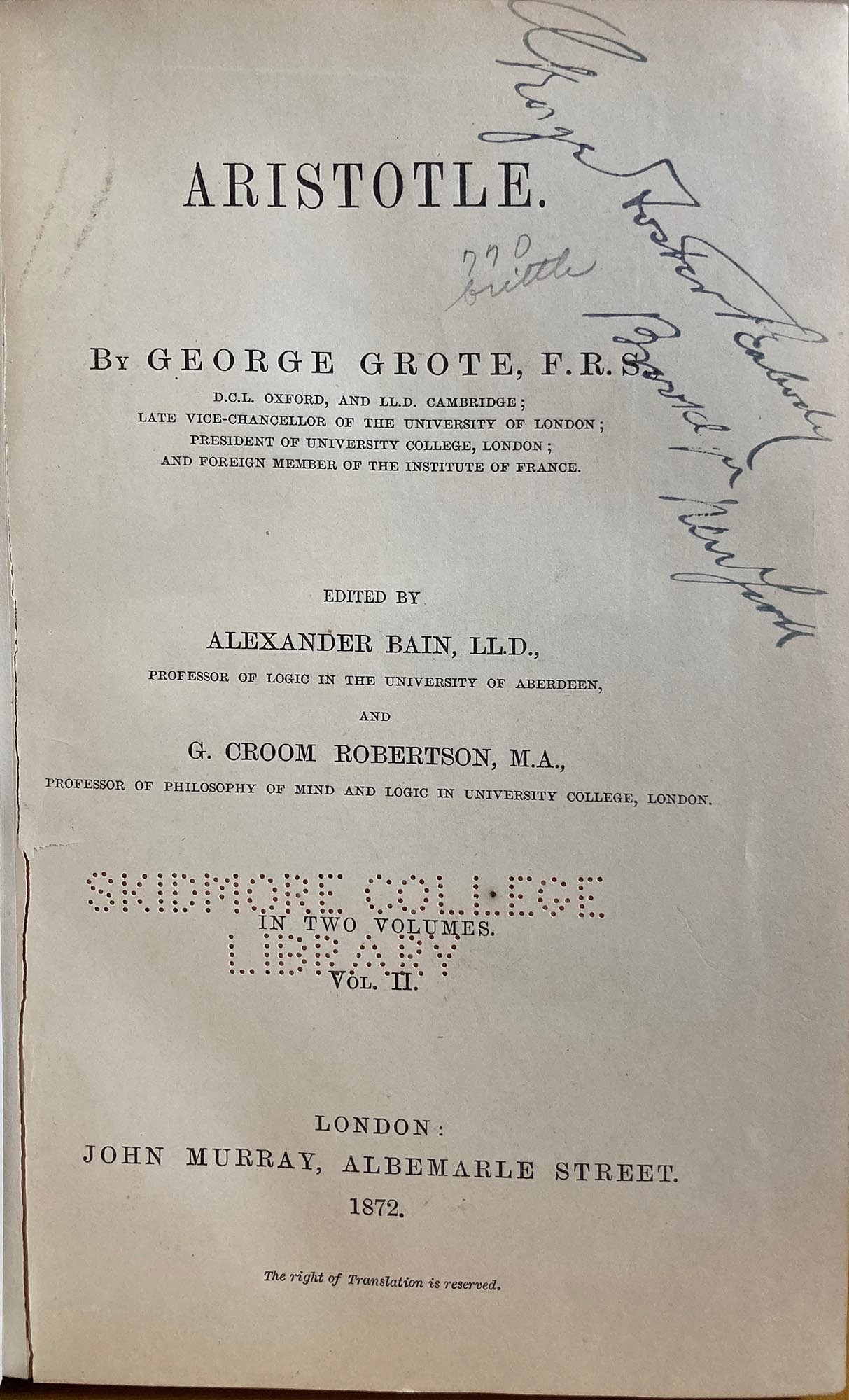
John Murray, London, England, 1872. Ex-library in blue library binding. Signed on title page by George Foster Peabody (1852-1938), American banker (Federal Reserve Bank of New York), and philanthropist about whom the Peabody Award for journalism was named. His home at Yaddo in Saratoga Springs became an artist’s colony. Usual library evidence, title page partially detached, corners missing on a few pages, but otherwise in very good condition. 468 pages plus 20 pages of ads. Not a photography book like most of my other items for sale. Summary:
Aristotle, Volume 2 of 2 by George Grote, published in 1872 by John Murray, completes Grote’s extensive study of Aristotle’s philosophy. Written from the standpoint of a nineteenth-century liberal historian and classicist, the volume offers detailed analysis of Aristotle’s logical, metaphysical, ethical, and political writings.
Scope and Focus
While Volume I concentrates heavily on Aristotle’s logical works and methodology, Volume II turns more fully to his substantive philosophy, including:
-
Metaphysics – Grote examines Aristotle’s theory of substance, form and matter, causation, and potentiality versus actuality. He carefully reconstructs difficult arguments and evaluates their coherence and originality in relation to earlier Greek thinkers, especially Plato.
-
Physics and Natural Philosophy – The treatment addresses Aristotle’s conception of motion, change, and teleology, emphasizing how his explanations sought systematic order in the natural world.
-
Ethics – Grote analyzes the Nicomachean Ethics, focusing on virtue as habit, the doctrine of the mean, deliberation, and the concept of eudaimonia (human flourishing). He highlights Aristotle’s empirical orientation and practical reasoning.
-
Politics – Considerable attention is given to Aristotle’s classification of constitutions, his defense of the polis as the natural framework of human life, and his reflections on citizenship, slavery, and education.
Method and Interpretation
Grote approaches Aristotle as a rigorous analyst rather than as a dogmatic system-builder. He emphasizes:
-
The importance of dialectical reasoning
-
The provisional and investigative character of Aristotle’s inquiries
-
The philosopher’s engagement with earlier Greek thought
Unlike some earlier commentators, Grote resists portraying Aristotle as merely a corrective to Plato. Instead, he situates him within the broader intellectual debates of classical Greece, stressing continuity as well as divergence.
Historical Significance
Published shortly after Grote’s death, the second volume reflects Victorian-era classical scholarship at its most detailed and philological. It contributed to renewed English-language engagement with Aristotle’s texts at a time when German scholarship dominated classical studies.
Overall Assessment
Aristotle, Volume 2 of 2 stands as a dense, scholarly examination of Aristotle’s mature philosophy. It combines historical contextualization with close textual reading, offering nineteenth-century readers—and later historians of philosophy—a systematic account of Aristotle’s metaphysics, ethics, and political theory.