Gary Saretzky Photo Books
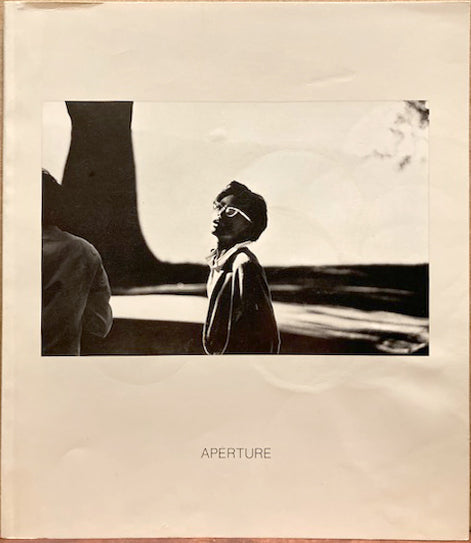
Aperture, Vol. 16. No 2 (16:2), 1971. Fred Sommer, Nathan Lyons, Emmet Gowin, Aaron Siskind, et al.
Aperture, Vol. 16. No 2 (16:2), 1971. Fred Sommer, Nathan Lyons, Emmet Gowin, Aaron Siskind, et al.
Couldn't load pickup availability
Includes Frederick Sommer, “An Extemporaneous Talk at the Art Institute of Chicago”; Nathan Lyons, "Notations in Passing"; Emmet Gowin; Aaron Siskind; Doris Ullman, et al. Good with circular indentations on cover, interior fine. Summary:
Aperture Vol. 16, No. 2 (1971) is a high-water mark for the magazine’s "Minor White era," focusing heavily on the philosophical and poetic dimensions of the photographic image. This issue moves away from literal documentation, instead exploring photography as a language of metaphor, abstraction, and deep personal introspection.
Key Features and Portfolios
1. Frederick Sommer: “An Extemporaneous Talk”
The issue features the transcript of Sommer’s legendary talk at the Art Institute of Chicago. Sommer, a polymath and Surrealist-leaning photographer, challenges the audience to view photography as a rigorous intellectual pursuit.
-
The Philosophy: He discusses the "logic of images" and the idea that "display is the only way that nature can be known."
-
The Impact: This text remains one of the most influential pieces of photographic theory, emphasizing that the photographer must be as much a philosopher as a technician.
2. Nathan Lyons: "Notations in Passing"
Aperture highlights Lyons’ influential series that would eventually become a landmark book.
-
The Style: These are quick, observational snapshots of the American social landscape—signs, storefronts, and odd juxtapositions.
-
The Concept: Lyons argues for photography as a form of "visual literacy," where the sequence of images creates a syntax that comments on the irony and surrealism of everyday life.
3. Emmet Gowin: The Intimate Family
The issue includes a significant portfolio by Gowin, then a rising star in the field.
-
Focus: These are his celebrated early portraits of his wife, Edith, and her family in Danville, Virginia.
-
Aesthetic: Using a circular mask (the result of using a lens that didn't fully cover the film plane), Gowin creates a "fish-eye" or "tunnel" effect that makes the domestic scenes feel both mythic and claustrophobically intimate.
4. Aaron Siskind: The Abstract Gaze
Siskind’s work in this issue represents the bridge between photography and Abstract Expressionism.
-
Focus: His photographs of peeling paint, graffiti, and weathered stone strip away the identity of the object to focus entirely on line, texture, and gesture.
5. Doris Ulmann: The Historical Soul
The inclusion of Ulmann’s work provides a historical anchor.
-
Content: Her soft-focus, pictorialist portraits of the people of the Appalachian highlands and the Sea Islands.
-
Theme: Her work is presented not just as a record of a disappearing culture, but as a study in the "inner light" and dignity of her subjects.
Editorial Theme: The Internal Landscape
Under the guidance of Michael E. Hoffman and the lingering influence of Minor White, this issue champions Subjective Photography. The recurring theme is that the camera does not look at the world, but through it to find a deeper, universal truth. Whether it is Siskind’s abstractions or Gowin’s family portraits, the photographs are presented as "equivalents" for the artists' internal states.
Summary Takeaway
Aperture 16:2 is a quintessential 1970s "art-photography" document. It is essential for its inclusion of Frederick Sommer’s theoretical insights and for showcasing the evolution of Emmet Gowin, marking a moment when photography was firmly asserting itself as a medium of high art and complex philosophy.