Gary Saretzky Photo Books
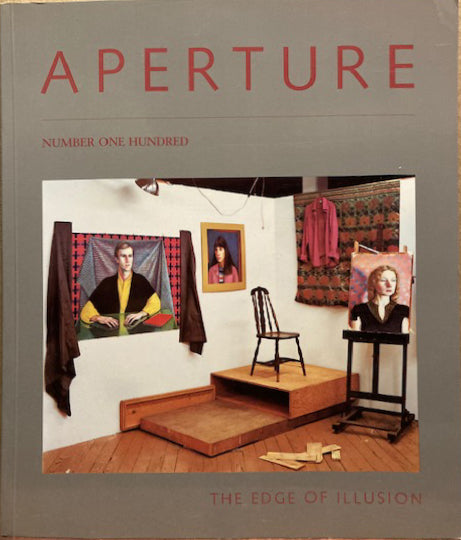
Aperture No. 100. The Edge of Illusion
Aperture No. 100. The Edge of Illusion
Couldn't load pickup availability
Aperture magazine, 1985. VG+ with some light crimps. Photographers and subjects include Richard Prince (interview with illustrations), Robert Cumming, John Baldessari, Joel-Peter Witkin, David Graham, Nic Nicosia, Lejaren á Hiller, Hiroshi Sugimoto, Latin America, Fidel Castro, Cuba, Nicaragua, Appalachia, Ray Metzger, James Agee, Clarence John Laughlin (obit), and Photojournalist Bill Stewart (death) by Sarah Charlesworth. Summary:
Aperture No. 100 (Fall 1985), titled "The Edge of Illusion," is a landmark centennial issue that explores the boundary between reality and fabrication. It marks a definitive shift in the magazine’s history, moving away from "straight" photography toward the postmodern "staged" or "constructed" image, where the camera is used to create fictions rather than document facts.
The Postmodern Frontier: Fabrication and Deconstruction
The core of the issue focuses on artists who manipulate the viewer's sense of truth:
-
Richard Prince: Featuring an interview and illustrations, this section highlights Prince’s "re-photography" of advertisements. It explores his deconstruction of American myths (like the Marlboro Man) and the idea that there is no "original" truth in a media-saturated world.
-
John Baldessari & Robert Cumming: These artists use photography as a conceptual tool. Baldessari explores the absurdity of visual language, while Cumming creates elaborate, faux-scientific setups that challenge the viewer's logic.
-
Joel-Peter Witkin: Known for his macabre and highly theatrical tableaux, Witkin’s work represents the extreme "edge" of illusion, blending art history with transgressive, staged imagery.
-
Nic Nicosia: Features his "Domestic Dramas," which use staged, cinematic sets to mimic everyday life, emphasizing the artificiality of suburban normalcy.
Political and Social Realities
In stark contrast to the fabricated images, the issue also tackles heavy geopolitical transitions:
-
Latin America (Cuba & Nicaragua): The issue examines the role of photography in revolution. This includes iconic and propagandistic imagery of Fidel Castro and the Sandinista movement in Nicaragua, questioning how these "real" images also function as a form of political illusion.
-
Appalachia: A look at the persistent myths and harsh realities of the American South, referencing the legacy of James Agee and the documentary tradition.
-
The Death of Bill Stewart: A somber piece by artist Sarah Charlesworth regarding the ABC News journalist murdered in Nicaragua. It serves as a brutal reminder of the high stakes of "witness" photography in an age of political theater.
Historical Echoes and Obituaries
-
Hiroshi Sugimoto: Features his celebrated "Theaters" and "Dioramas" series. These long-exposure images turn movie screens into glowing voids and museum displays into "living" scenes, perfectly embodying the "edge of illusion."
-
Lejaren á Hiller: A retrospective look at this early 20th-century pioneer of staged commercial photography, positioning him as a forefather to the contemporary artists featured in the issue.
-
Ray Metzger: Explores his high-contrast, rhythmic cityscapes that turn the urban environment into a formalist, almost abstract illusion.
-
Clarence John Laughlin (Obituary): The issue pays tribute to the "Haunted Castle" photographer of New Orleans, recognizing his lifelong dedication to "Third Eye" photography and the surrealism of the American South.
Summary Takeaway
Aperture No. 100 is a manifesto for the "Directorial Mode." By placing the conceptual fictions of Prince and Baldessari alongside the violent political realities of Latin America, the issue argues that all photography—whether staged in a studio or captured on a battlefield—exists on a spectrum of illusion. It remains one of the most influential issues for its embrace of postmodernism and its critical look at the power of the image to both reveal and deceive.