Gary Saretzky Photo Books
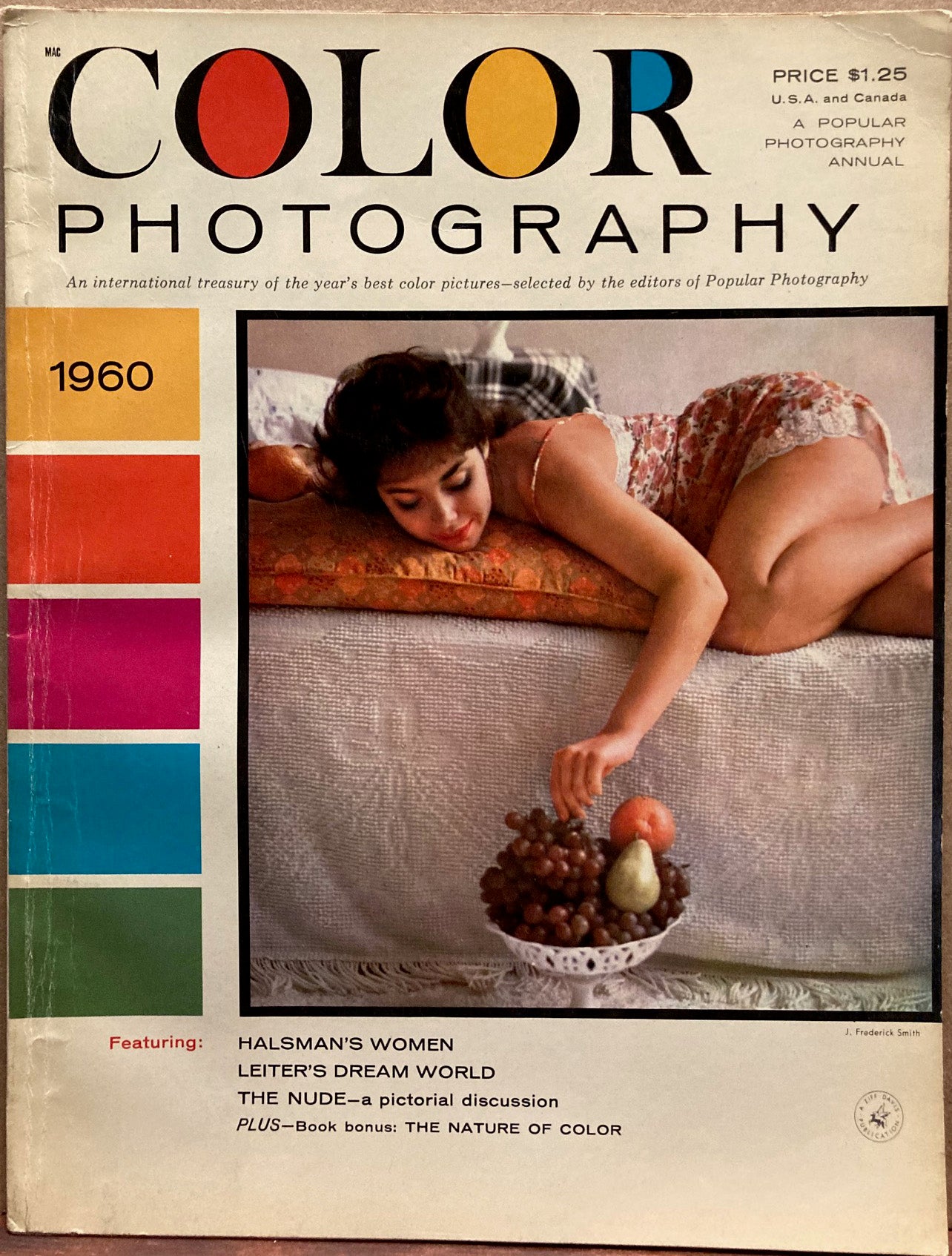
Annuals. Color Photography 1960. An international treasury of the year's best color pictures--selected by the editors of Popular Photography.
Annuals. Color Photography 1960. An international treasury of the year's best color pictures--selected by the editors of Popular Photography.
Couldn't load pickup availability
Edited by Bruce Downes. Ziff-Davis, 1960. Featuring Philippe Halsman's Women, Saul Leiter's Dream World (mostly photos of women); and The Nude--A Pictorial Discussion. Color, including early 20th century autochromes, and black and white photos. Photographers include: Erich Locker; Bert Stern; Saul Leiter; Syl Labrot; Arnold Newman; Inger Abrahamsen; Archie W. Akers; Gene Anderegg; Bo A. Appeltofft; Marty Bauman; Ferenc Berko; Frank Bez; Sonja Bullaty; Peter Bunnell (better known as curator and photohistorian); Michael Ciavolino; R.M. Clermont; Rosa De Loz-Biard; Leif Eliasson; Phil Fahs; Ho Fan; Andreas Feininger; Fernand Fonssagrives; Al Francekevich; Rene Groebli; Walt Hartlage; Dave Heath; Ken Heyman; Gerald Hochman; R.C. Holden; Hisae Imai; Lennart Jansson; Marguerite Johnson; Carter Jones; Earl Jones; Peggy Jordan; Art Kane; Akira Kawasaki; Eugene Kovner; Margery Lewis; Jane Lougee; Chobei Matsuki; Susan McCartney; Dick McGraw; John Murello; Masaya Nakamura; Tatsuyuki Nakamura; Wayne Olson; Guido Organschi; Giorgina Reid; Charles Reynolds; Min Sapir; Louis Sauer; Lawrence Schiller; Peter Scolamiero; Carroo Seghers, II, Carl K. Shiraishi; George Silano; J. Frederick Smith; John Lewis Stage; Dennis Stock; Bud Thuener; Commandant Tournassoud; Vytas Valaitis; David Vestal; Ed Wallowitch; Juliana Wang; Jerry White; Bob Willoughby; Steven Wilson; John Zimmerma. Very good with crimps along spine. Softcover. Summary:
Published in 1960 by Ziff-Davis, Color Photography 1960 is a high-fidelity "treasury" that captures a transformative year for the medium. Curated by the editors of Popular Photography, the annual functions as both a prestigious gallery and a critical dialogue on the evolving aesthetics of color film.
Key Featured Portfolios
-
Philippe Halsman’s "Women": Known for his technical precision and psychological depth, Halsman contributes a series of portraits that move beyond simple glamour. The collection emphasizes his ability to use color to highlight personality and the "inner essence" of his female subjects.
-
Saul Leiter’s "Dream World": This section showcases Leiter’s pioneering "painterly" approach. Using Kodachrome and often shooting through windows or around abstractions, Leiter transforms everyday scenes and figures into soft, impressionistic compositions that redefined color street photography.
-
"The Nude—A Pictorial Discussion": A significant and sophisticated feature for the era, this section treats the human form as a landscape of color and light. It serves as a technical and artistic debate on how color film can either enhance or distract from the classic lines of figure photography.
Historical and Technical Depth
The 1960 Annual is particularly noted for its bridge between the past and the future of the medium:
-
The Heritage of Color: The book includes a retrospective on early 20th-century Autochromes, acknowledging the grainy, dyed-potato-starch origins of color. This historical context provides a "then-and-now" perspective against the sharp, saturated emulsions of the 1960s.
-
International Scope: True to its "International Treasury" title, the volume pulls work from across the globe, illustrating how different cultures and light conditions were being interpreted through the burgeoning color industry.
-
The Editorial Lens: Throughout the book, the editors provide a "Pictorial Discussion," offering critiques on why certain images succeed. They tackle the then-controversial shift from "realistic color" to "expressive color."
Legacy and Production
At the time of its release, this volume was a high-water mark for printing technology. By utilizing premium paper stocks and advanced engraving techniques, it aimed to replicate the transparency of a slide on the printed page—a feat that made it a mandatory reference for professionals and serious amateurs alike.
Significance: This edition arrived exactly as color photography was shedding its reputation as a "vacation snapshot" medium and beginning to gain acceptance in the hallowed halls of fine art, although full acceptance would not happen until the following decade.