Gary Saretzky Photo Books
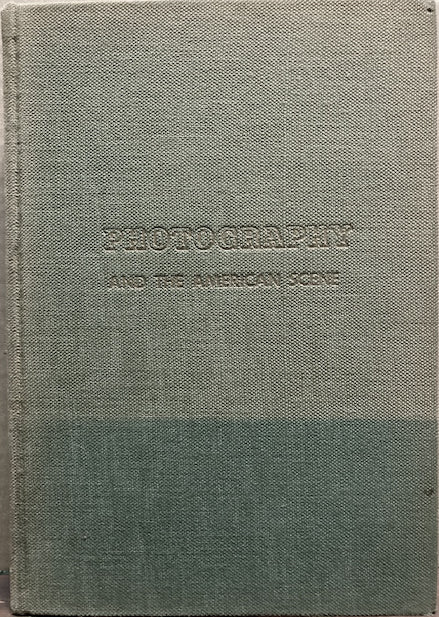
History of Photography. Photography and the American Scene: A Social History, 1839-1889 by Robert Taft. 1st edition.
History of Photography. Photography and the American Scene: A Social History, 1839-1889 by Robert Taft. 1st edition.
Couldn't load pickup availability
Macmillan, 1938. 546 pages. 1st printing. Two rubber stamps of "Clarence White School of Photography," the important school in New York founded by the close associate of Alfred Stieglitz. After White's death, it was continued by his son Clarence Jr. Much better quality reproductions than in reprints. Green cloth faded unevenly on spine, cover, and edges. End papers darkened, as usual, from binder's glue. Binding tight, short tear at top of spine, internally fine. Summary:
Photography and the American Scene: A Social History, 1839–1889 (originally published in 1938 and widely circulated via later editions, including a prominent 1984 reprint) is a seminal work by chemist and historian Robert Taft. Spanning over 500 pages with more than 300 early illustrations, the volume is considered a foundational cornerstone of American photographic historiography. Unlike aesthetic histories that analyze photography strictly as a fine art, Taft’s work approaches the medium as an indispensable recording form and a powerful shaper of national identity, tracing its trajectory across the first 50 years of its existence in the United States.
Taft maps out the evolution of image-making by framing technical breakthroughs as direct drivers of social change. The chronological narrative thoroughly documents the early era of the daguerreotype, its public reception, and the subsequent technological shifts to the ambrotype, tintype, and stereoscope, culminating in the rise of portable film cameras and modern mass-reproduction illustration techniques. Rather than focusing solely on elite studios, the book investigates how photography democratized portraiture through the family album and altered public consciousness by visually chronicling landmark historical events, including the Civil War and the physical expansion of the Western frontier. Through extensive archival research and rigorous factual compilation, Taft establishes photography not as an isolated artistic movement, but as a critical, reflecting lens of nineteenth-century American reality.
