Gary Saretzky Photo Books
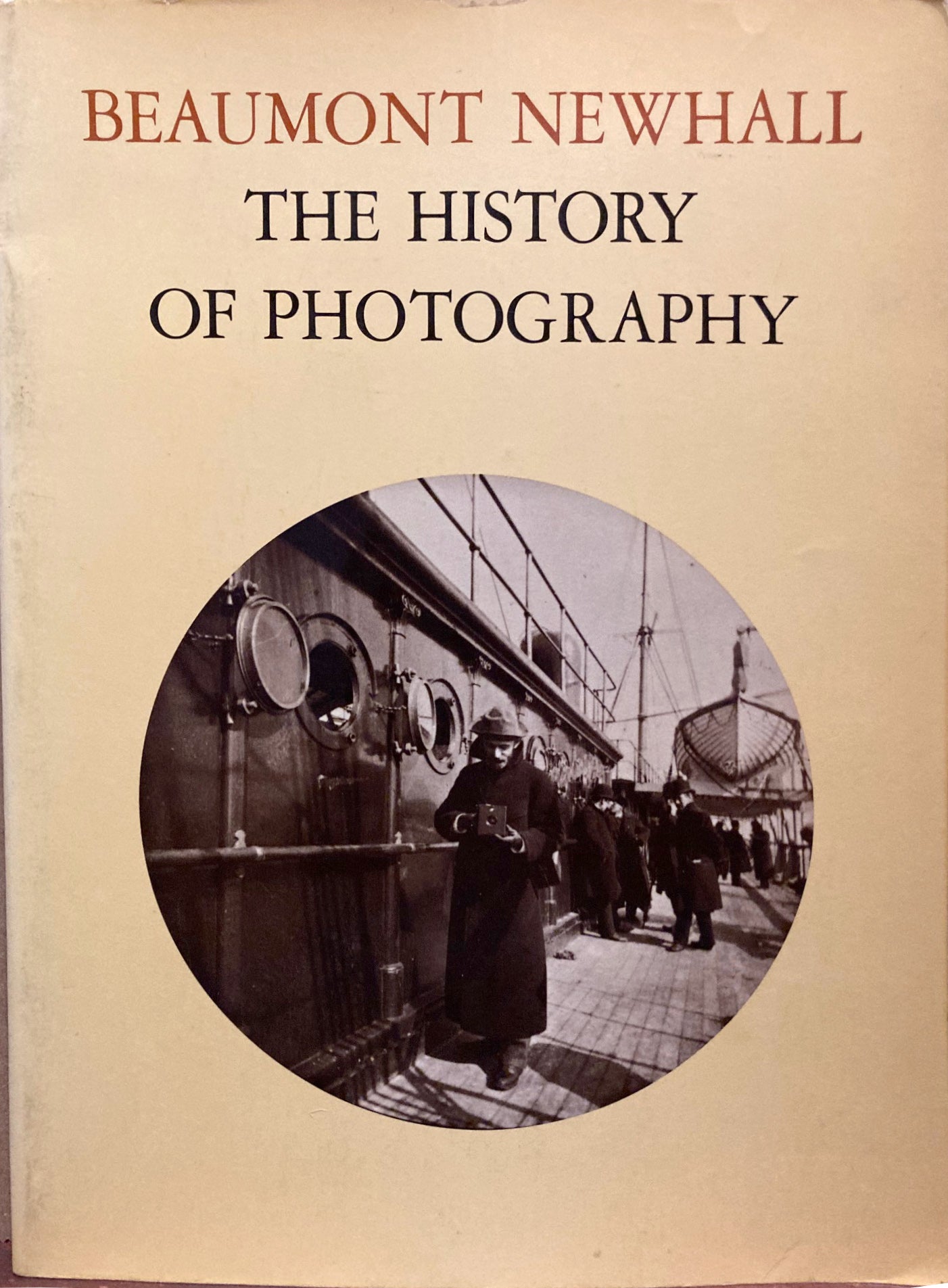
History of Photography. The History of Photography from 1839 to the Present Day. Revised and Enlarged Edition by Beaumont Newhall. 1964.
History of Photography. The History of Photography from 1839 to the Present Day. Revised and Enlarged Edition by Beaumont Newhall. 1964.
Couldn't load pickup availability
NY: Museum of Modern Art, 1964. Fourth edition. Wraps, very good with pencil signature of previous owner on front flyleaf. Summary:
The 1964 Revised and Enlarged Edition (the fourth edition) of Beaumont Newhall’s The History of Photography: From 1839 to the Present Day marks a crucial phase in the life of this foundational text. Published by the Museum of Modern Art (MoMA), this volume significantly expanded upon Newhall’s original 1937 exhibition catalog, solidifying his "technologistic" framework: the belief that the aesthetic evolution of photography is directly shaped by its mechanical and chemical breakthroughs. Featuring over 200 high-quality black-and-white illustrations, the 1964 edition synthesizes a mid-century perspective on photography, firmly establishing it as a fine art form while celebrating the masters who defined its first century.
1. The Elusive Image & Twin Inventions
The book establishes the technical ancestry of photography by looking at optical precursors like the camera obscura and camera lucida. It chronicles the watershed moment of 1839 when independent experiments across Europe went public:
-
The Daguerreotype: Louis Daguerre's French process that captured crisp, incredibly detailed, single-print images on silver-plated copper sheets.
-
The Calotype: William Henry Fox Talbot's English paper negative-to-positive process, which allowed for multiple reproductions and laid the groundwork for modern film chemistry.
2. Portraits for the Million & The Wet Plate Era
Newhall outlines the rapid commercialization and democratization of the medium during the mid-19th century.
-
The Portrait Boom: Innovations in brighter lenses and shorter exposure times transformed photography from an elite oddity into a thriving mass-market industry.
-
The Collodion Process: The introduction of wet-plate glass negatives, which combined the sharpness of the daguerreotype with the reproducibility of the calotype. Newhall explores how this allowed early photographic teams to document frontiers, expeditions, and wars in the field.
3. The Great Aesthetic Debate: Pictorialism vs. Straight Photography
A substantial portion of the text is dedicated to photography's internal battle to define itself apart from traditional painting:
-
Pictorialism: Early artistic movements where photographers like Julia Margaret Cameron or Oscar Rejlander intentionally used soft focus, staged allegorical scenes, and heavy darkroom manipulation to make their photos look like classical paintings or sketches.
-
Straight Photography: The counter-movement spearheaded by Alfred Stieglitz and the Photo-Secession, later advanced by artists like Paul Strand and Edward Weston. This philosophy argued that photography should look purely like photography, utilizing sharp focus, crisp compositions, and unmanipulated printing to let the camera claim its own distinct visual authority.
4. The Conquest of Speed and Form
Newhall details how the medium altered human perception by slicing time into fractions of a second:
-
Chronophotography: High-speed mechanical shutters and dry plates allowed Eadweard Muybridge and Étienne-Jules Marey to capture frozen human and animal motion, altering both science and art forever.
-
The New Vision: The early-20th-century avant-garde explosion where artists like Man Ray and László Moholy-Nagy used photograms, radical angles, and close-ups to turn photography into an abstract, experimental medium.
5. Truth, Reporting, and the Decisive Moment
The book emphasizes the rise of the camera as an unmatched tool for social change and real-time news gathering:
-
Documentary Roots: Socially conscious work by Jacob Riis, Lewis Hine, and the Farm Security Administration (FSA) photographers like Dorothea Lange and Walker Evans, who utilized the camera's raw clarity to document poverty and labor exploitation.
-
Photojournalism: The 1964 edition deeply values the rise of portable 35mm cameras (like the Leica) and artificial flashbulb lighting. This birthed modern magazine journalism and the philosophy of Henri Cartier-Bresson, who championed capturing the unposed, organic "decisive moment."
The 1964 edition is highly regarded for its balance of historical thoroughness and concise narrative arc. It is uniquely characterized by its inclusion of early scientific and industrial applications of photography—such as light metering and basic physics—which Newhall ironically trimmed from later, more purely art-centric editions. Ultimately, this version of the text acts as a definitive mid-20th-century canon, cementing names like Stieglitz, Weston, Adams, Lange, and Evans into the permanent pantheon of art history.
