Gary Saretzky Photo Books
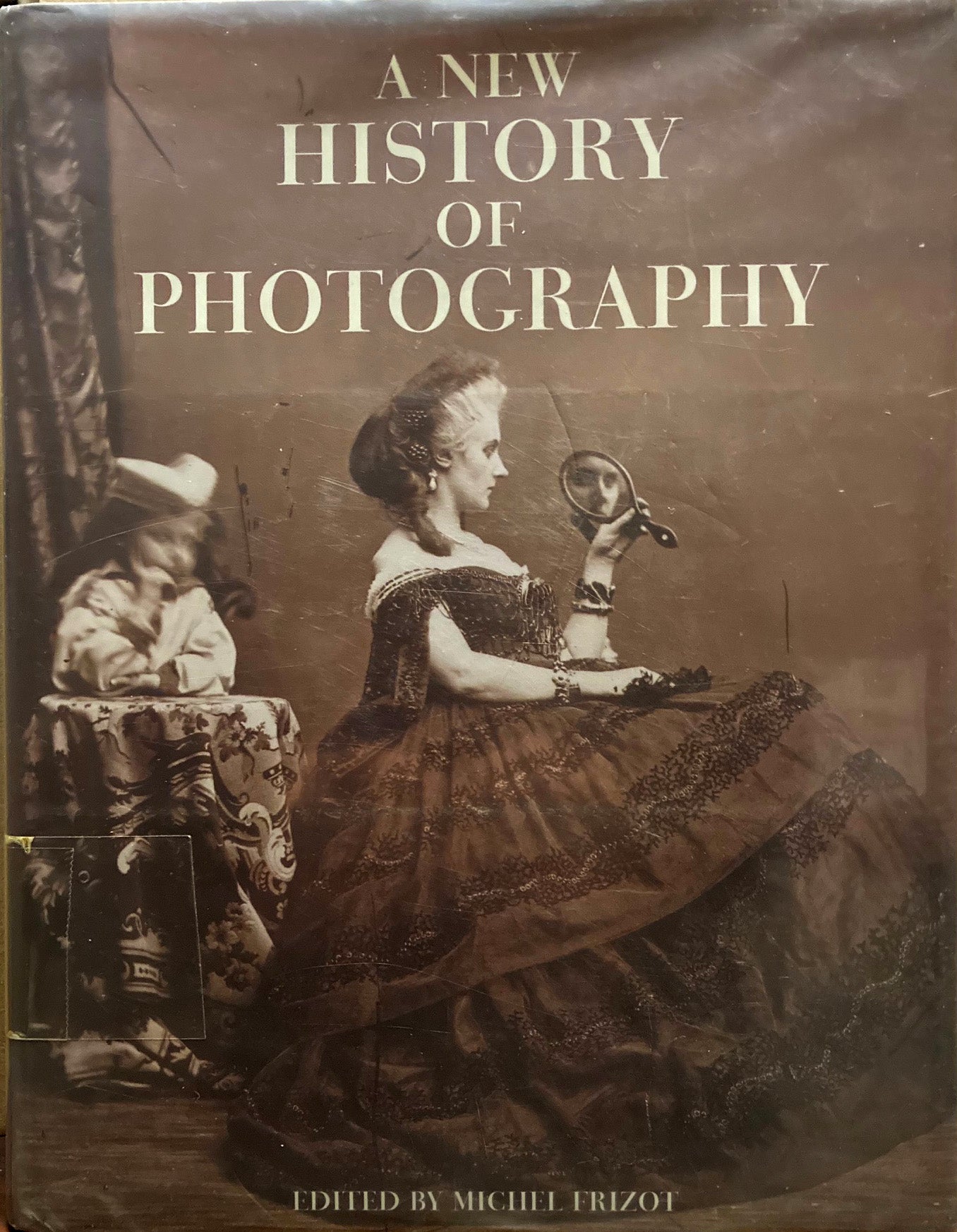
History of Photography. A New History of Photography by Michel Frizot, ed.
History of Photography. A New History of Photography by Michel Frizot, ed.
Couldn't load pickup availability
Konemann, 1998. [Large, 776 pages, profusely illustrated detailed history, often used as a textbook for college courses. First edition in English, previously published in French in 1994. Contributing chapter authors include many leading authorities such as Peter C. Bunnell, Molly Nesbit, John Pultz, Shelly Rice, Colin Westerbeck, Mike Weaver, Anne Cartier-Bresson, Anne Hammond, et al.] Fine, hardcover with dust jacket. Also available in ex-library, fine, at lower price. Unusually heavy book, requires more postage than most items in my store. Summary:
Originally published in French in 1994 and translated into English in 1998, A New History of Photography, edited by prominent French art historian Michel Frizot, is an encyclopedic, globally minded rethink of photographic history. Spanning over 700 pages with contributions from 30 international scholars, the book breaks away from traditional "masterpiece" narratives. Instead of treating photography strictly as a branch of fine art, Frizot presents it as a complex social, technological, and cultural phenomenon.
Frizot’s overarching thesis is that photography is not a singular medium with a linear evolution, but a diverse set of practices tied to the human desire to capture, analyze, and manipulate reality.
1. Deconstruction of the Linear Narrative
Unlike earlier canonical histories that chart a neat progression from invention to fine art, this volume handles history as an overlapping web. It treats scientific imaging, amateur snapshots, police mugshots, and high-art gallery prints with equal historical and analytical weight.
2. The Multiplicity of Invention
The book moves past the classic "Daguerre vs. Talbot" rivalry to explore a broader mid-19th-century context of experimentation. It frames the birth of the medium as a collective response to a broader industrial and chemical age, examining how various international figures independently raced to fix the shadow cast by the camera obscura.
3. The Camera as a Tool of Social & State Control
A major focus of the text is how photography quickly became an instrument of institutional power. Contributors trace its deployment in:
-
Anthropology and Colonialism: Mapping, classifying, and subjugating foreign cultures under the guise of objective science.
-
Criminology and Medicine: The rise of Alphonse Bertillon’s standardized mugshots to track criminals, and the use of photography in psychiatric wards to catalog mental illnesses.
4. Expanding the Spectrum of "Art"
Rather than limiting the discussion of art photography to distinct movements like Pictorialism or Modernism, the book analyzes the friction between the camera's mechanical nature and human creative intent. It examines how avant-garde movements (like Dada and Surrealism) used the medium's inherent distortions—like photomontage and solarization—to mirror a fragmented post-war world.
5. Media, Mass Reproduction, and Perception
Frizot dedicates significant real estate to the "printed image"—how photography functioned once it left the darkroom and entered newspapers, magazines, and advertisements. The text analyzes how the rapid evolution of photogravure and half-tone printing in the 20th century permanently altered public perception, transforming global politics, warfare, and celebrity culture through instant visual dissemination.
A New History of Photography remains a monumental text because it shifted the paradigm of photographic historiography. By examining the vernacular, scientific, and industrial uses of the camera alongside its artistic achievements, Frizot and his contributors successfully argued that the history of photography is, fundamentally, the history of modern human sight.
