Gary Saretzky Photo Books
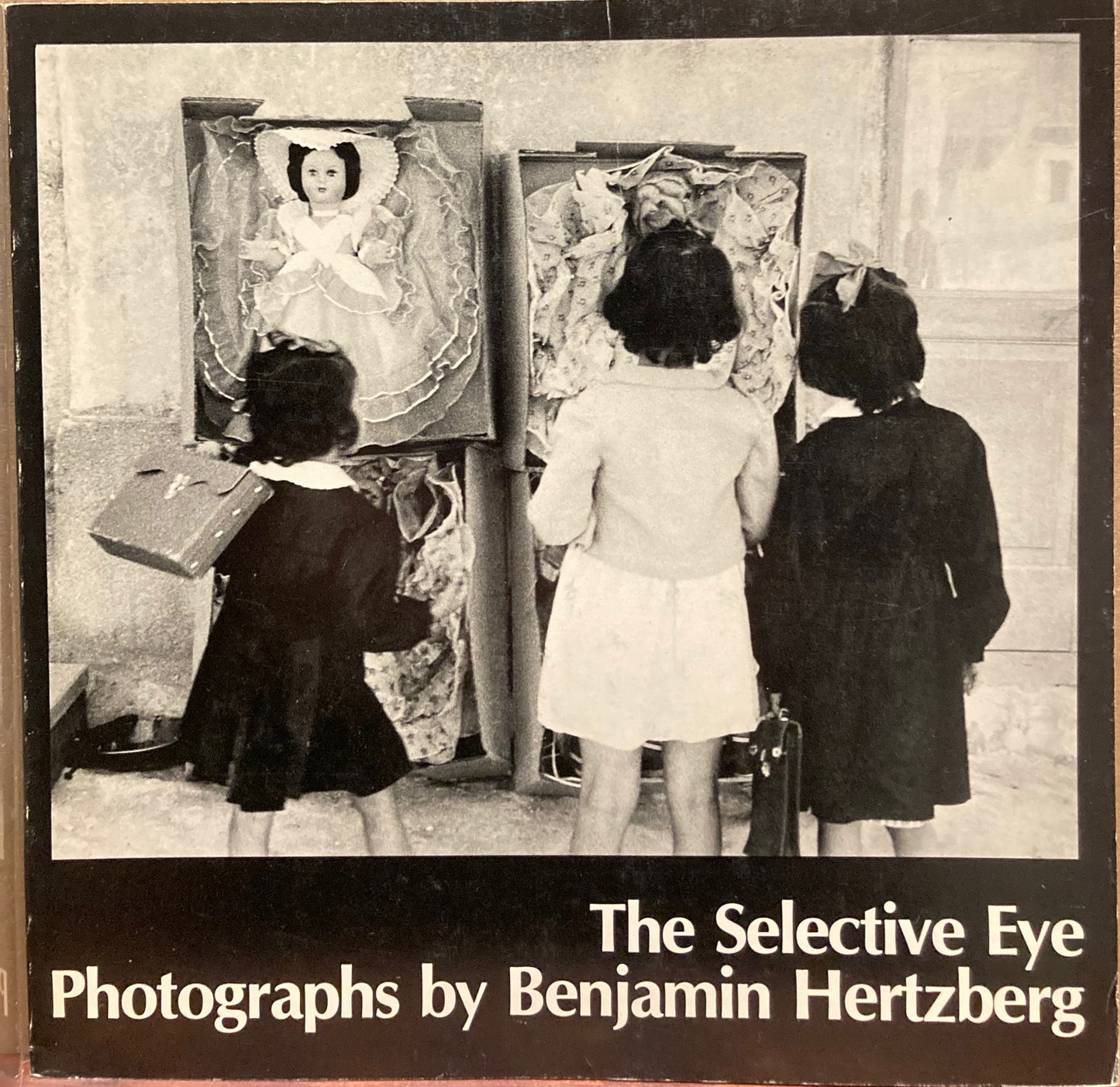
Hertzberg, Benjamin. The Selective Eye: Photographs by Benjamin Hertzberg.
Hertzberg, Benjamin. The Selective Eye: Photographs by Benjamin Hertzberg.
Couldn't load pickup availability
October 5 through November 20, 1977. Herbert F. Johnson Museum of Art, Cornell University, 1977. Exhibition catalog, very good in wraps with custom made polyester jacket, 86 pages. Introduction by Mary Black. [Street photography captured in many different countries in Europe and the U.S. Photos reproduced one to a page.]
Benjamin Hertzberg (1910–2004) was a New York-based photographer, art collector, and philanthropist celebrated for his formalist, high-contrast black-and-white street and architectural photography. Working across the United States and Europe during the mid-to-late twentieth century, Hertzberg cultivated a disciplined, minimalist aesthetic—characterized by sharp geometric abstraction, dramatic chiaroscuro shadows, and quiet human moments isolated from everyday urban and natural environments. His photographic body of work was showcased in the 1977 solo exhibition and accompanying monograph The Selective Eye: Photographs by Benjamin Hertzberg at Cornell University’s Herbert F. Johnson Museum of Art. Alongside his photographic practice, Hertzberg and his wife, Lilian, were prominent patrons of the arts and medicine—assembling a major collection of modern artworks by artists such as Paul Klee and Alexej von Jawlensky that was later bequeathed to the National Gallery of Art, and establishing the Lilian and Benjamin Hertzberg Palliative Care Institute at Mount Sinai in New York.
Published in 1977 by the Office of University Publications at Cornell University, The Selective Eye: Photographs by Benjamin Hertzberg is an exhibition catalog documenting a solo retrospective held at the Herbert F. Johnson Museum of Art in Ithaca, New York, from October 5 to November 20, 1977. This square-format, 100-page softcover volume serves as a curated overview of Hertzberg's photographic portfolio, featuring a comprehensive series of striking black-and-white plates that define his creative trajectory.
1. The Philosophy of the "Selective Eye"
The central conceptual framing of the book explores the photographer's role as an editor of reality. Rather than capturing expansive, uncritical views, Hertzberg's work relies on a highly disciplined, isolating gaze. The text and sequencing emphasize how the "selective eye" extracts specific geometries, patterns, and isolated moments from the broader chaos of the everyday environment, transforming mundane scenes into deliberate visual statements.
2. High-Contrast Monochromatic Graphic Form
A defining artistic element showcased throughout the plates is Hertzberg’s mastery of traditional black-and-white print medium. The curated exhibition pieces prioritize strong formal qualities:
-
Geometric Abstraction: Finding sharp, architectural lines and unexpected intersections in both urban and natural landscapes.
-
Chiaroscuro and Shadow: Utilizing harsh light and deep, ink-black shadows to alter the viewer's perception of spatial depth and object texture.
3. Mid-Century Humanist and Structural Documentation
The publication organizes Hertzberg's imagery into a cohesive visual narrative that balances structural precision with mid-century street portraiture. By focusing on intimate micro-scenes—ranging from quiet urban corners to the interplay of people within manufactured spaces—the catalog serves as an exploration of human presence, architecture, and isolation in the latter half of the 20th century.
The Selective Eye stands as an important historical record of the Herbert F. Johnson Museum of Art’s early photographic programming under Cornell University. By gathering Hertzberg's minimalist and graphic mid-century photography into a single monograph, the volume highlights a specific era of American academic curation that sought to elevate formalist, sharp-focus black-and-white photography within the fine art museum space.