Gary Saretzky Photo Books
Goldblatt, David. David Goldblatt: South Africa. 1 April to 17 May 1986.
Goldblatt, David. David Goldblatt: South Africa. 1 April to 17 May 1986.
Couldn't load pickup availability
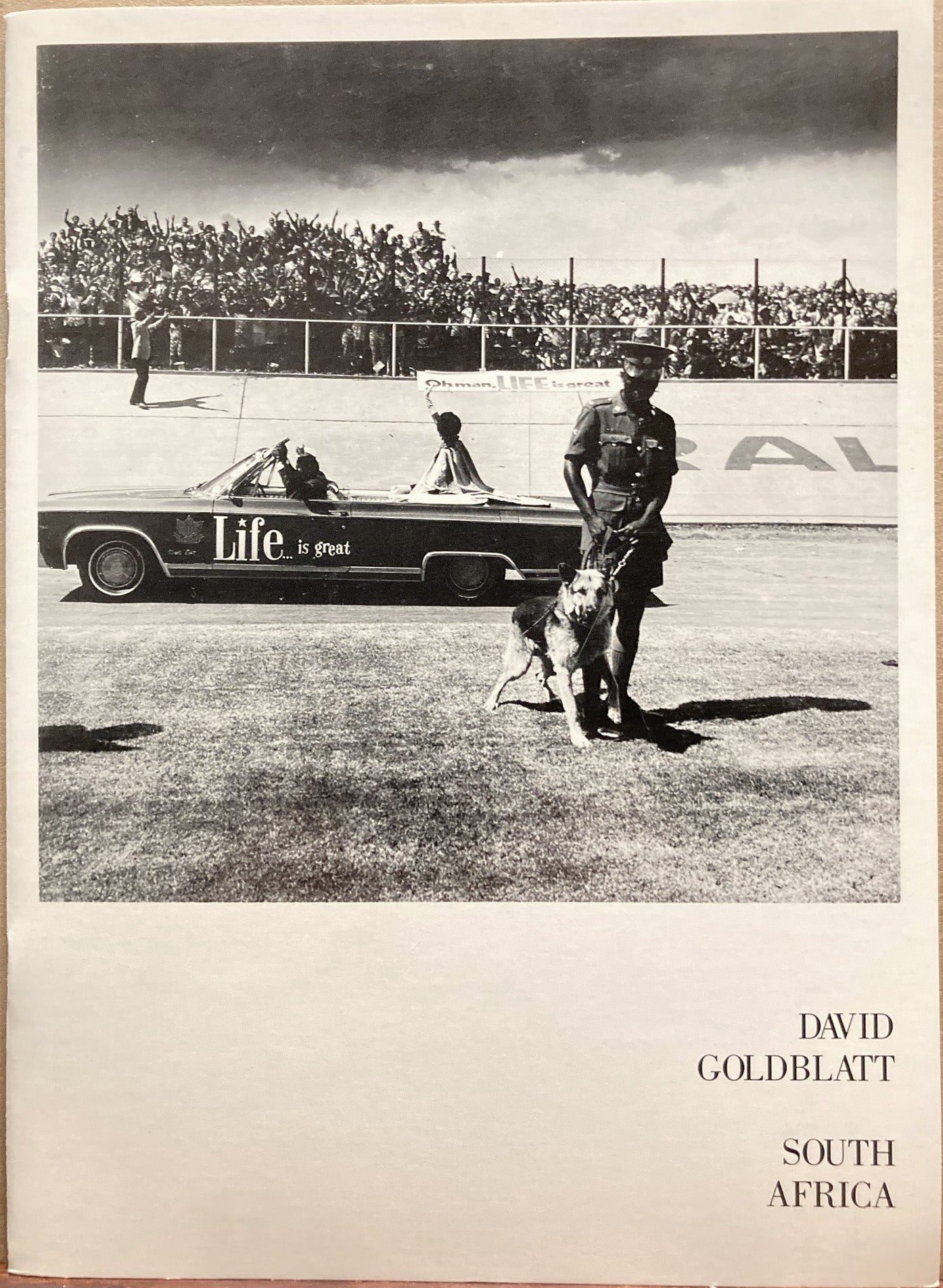
Photographers' Gallery, London, 1986. Texts by Sue Davies, Nadine Gordimer, and Roger Omond. (Omond's essay is on apartheid.) [Photographs of people from different ethnic groups in a variety of contexts, showing the contrasts that existed in South Africa.] Wraps, exhibit catalog, 24 pages, fine. Scarce. Summary:
David Goldblatt: South Africa (1 April – 17 May 1986) was a landmark solo exhibition of the acclaimed South African photographer's work held at The Photographers' Gallery in London. Running alongside The Cordoned Heart—a group exhibition documenting poverty and development in South Africa—this show marked Goldblatt's first major solo exhibition in the United Kingdom and was a pivotal moment in bringing his critical vision of apartheid to an international audience.
-
Documenting the Conditions, Not the Clashes: Unlike the dominant media of the mid-1980s, which focused heavily on riots and overt state violence, Goldblatt’s work examined the quiet, systemic reality of apartheid. He trained his lens on the underlying social, architectural, and economic structures that allowed such a system to persist.
-
A Portrait of Coexistence and Exclusion: The exhibition juxtaposed the stark, daily realities of South Africa’s segregated communities. Through precise black-and-white images of workplaces, suburban homes, and impoverished townships, Goldblatt illustrated both the severe deprivation of the Black majority and the insulated, paternalistic privilege of the white minority.
-
The Power of Architecture and Landscape: A central element of the show was Goldblatt’s interest in how ideology manifests physically. By photographing structures—ranging from concrete miner hostels to affluent suburban estates—he revealed how the built environment was actively used as a tool of racial and spatial control.
-
A Critical Mirror for the West: The exhibition challenged international viewers, particularly British audiences, to move past easy condemnation of apartheid and instead confront the deeply rooted racial and class prejudices within their own societies. It positioned photography not merely as a tool of reportage, but as a medium for rigorous social and moral criticism.
- David Goldblatt (1930–2018) was a preeminent South African photographer whose career spanned more than six decades, best known for his unflinching yet deeply nuanced documentation of his country before, during, and after apartheid. Born to Jewish immigrant parents in the gold-mining town of Randfontein, Goldblatt eschewed the sensationalism of typical news photography, choosing instead to capture the quiet, insidious ways racial segregation and ideology became etched into South Africa’s people, landscapes, and everyday architecture. Through landmark projects like Some Afrikaners Photographed and The Structure of Things Then, he examined the complex moral landscape of the white middle class and the systemic oppression of the Black majority with immense precision and restraint. Beyond his own camera work, Goldblatt was a passionate advocate for future artists, founding Johannesburg's Market Photo Workshop in 1989, which served as a crucial, accessible training ground for generations of socially conscious photographers. His profound contribution to visual culture was recognized globally, culminating in the prestigious Hasselblad Award in 2006.
