Gary Saretzky Photo Books
Andrews, Orville. Camera Across America by Orville Andrews.
Andrews, Orville. Camera Across America by Orville Andrews.
Couldn't load pickup availability
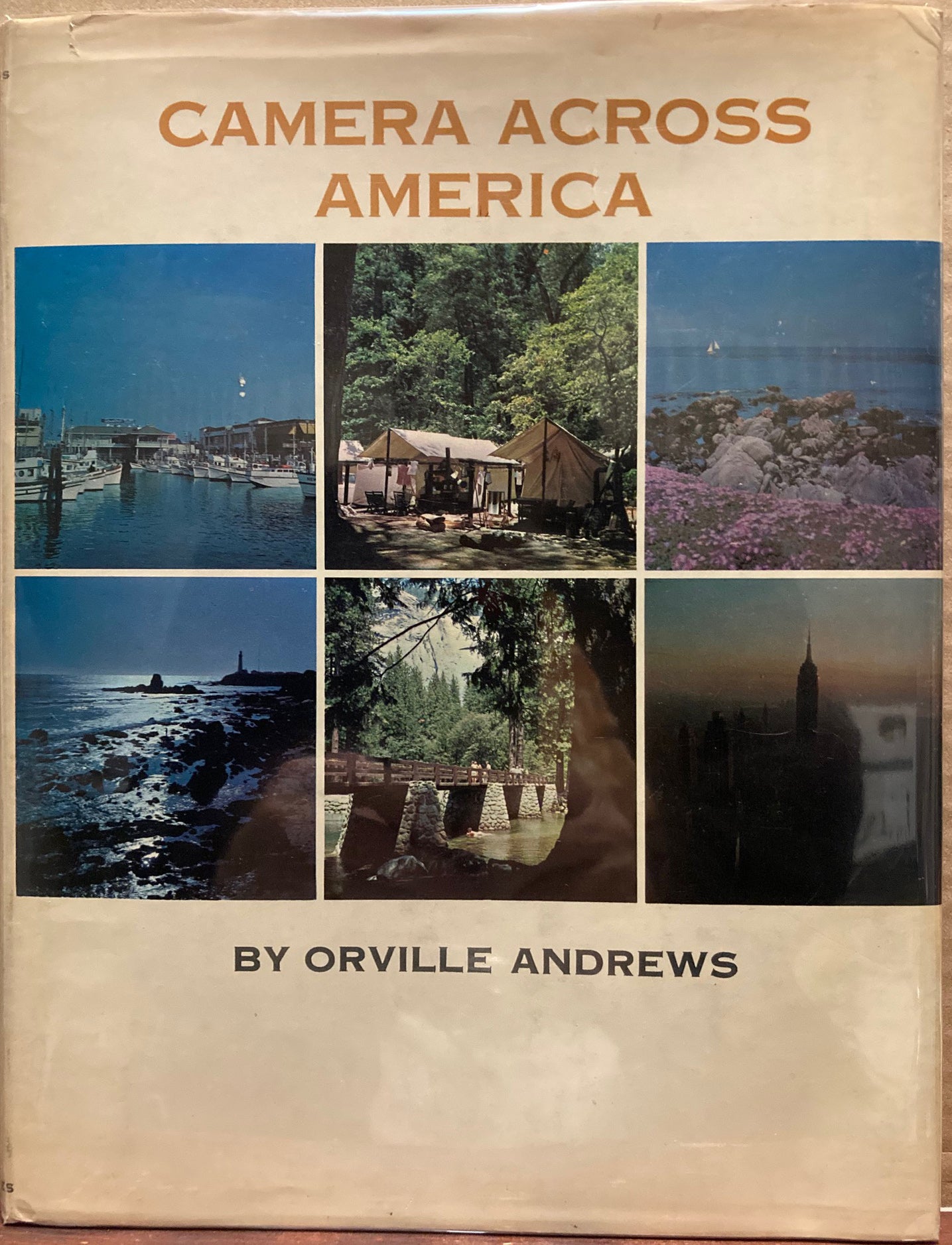
South Brunswick, NJ: A.S. Barnes, 1966. New York, Washington, Chicago, and California in well-composed and printed black-and-white photos, one to a page on glossy paper. Fine with very good dust jacket. Summary:
Camera Across America, published in 2002, is a contemporary photographic travelogue by Orville Andrews that captures the enduring character of the American landscape. The book is a visual record of a multi-year journey across the "Lower 48" states, focusing on the intersection of natural beauty and the quiet, often overlooked remnants of human history.
In Camera Across America (2002), Orville Andrews used the classic 6x6 square format of the Rolleiflex twin-lens reflex camera. This choice of equipment fundamentally dictates the aesthetic and "feel" of the entire book.
Core Concept: The Square Vision
By using a Rolleiflex, Andrews stepped away from the wide, sweeping vistas typically associated with American road photography. The square format ( cm) creates a much more disciplined, formal, and stable composition, although sometimes he cropped to create rectangular compositions.
-
Centripetal Composition: Unlike a rectangle, which pulls the eye side-to-side, the square format pulls the viewer’s eye toward the center. This gives Andrews’ images of barns, crossroads, and lone trees a sense of "monumentality" and quiet permanence.
-
The Waist-Level Perspective: Because a Rolleiflex is typically held at chest or waist height, the perspective in these photos is slightly lower than eye level. This lends a heroic, grounded quality to the American subjects he documents.
Key Themes
-
Geometry and Order: The square frame forces a focus on geometry. Andrews uses this to highlight the clean lines of rural architecture—the peak of a roof, the circle of a silo, or the perfect grid of a plowed field.
-
Intimacy over Scale: While he is still documenting the breadth of the country, the Rolleiflex creates a more intimate "portrait" of the land. It feels less like a cinematic travelogue and more like a series of formal encounters with the American spirit.
-
Medium Format Detail: The use of 120 roll film provides a level of tonal richness and fine grain that allows for exquisite textures—weathered wood, rusted metal, and the soft gradients of a prairie sky.