Gary Saretzky Photo Books
Daguerreotypes. Image, the Journal of the George Eastman House of Photography. Volume 5, Number 1, January 1956.
Daguerreotypes. Image, the Journal of the George Eastman House of Photography. Volume 5, Number 1, January 1956.
Couldn't load pickup availability
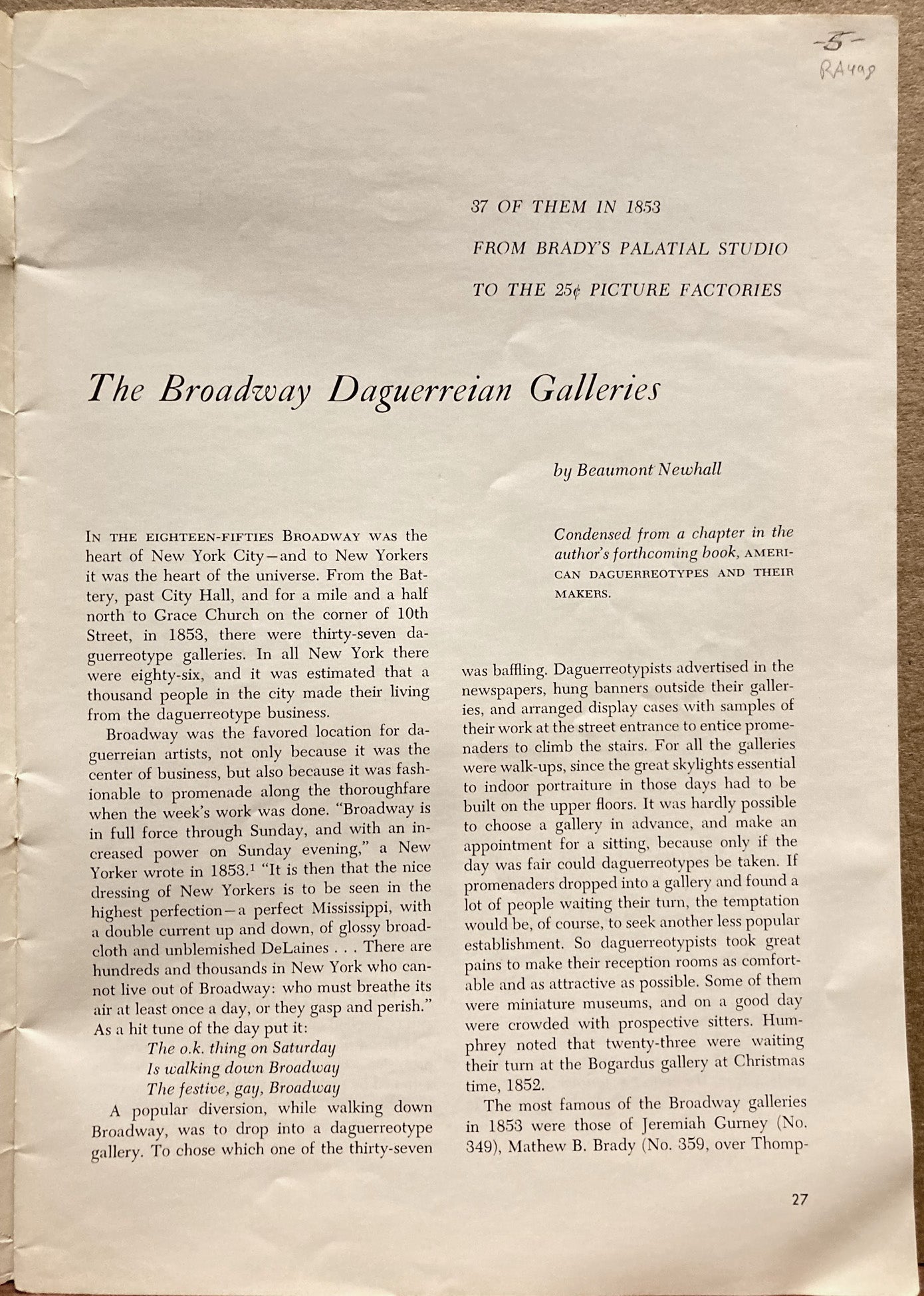
Edited by Minor White. Includes Beaumont Newhall, "The Broadway Daguerreian Galleries," pages 27-37. [Discusses the leading galleries owned by Mathew Brady, Martin M. Lawrence, Rufus Anson, and Jeremiah Gurney, and mentions the operators who actually took the daguerreotypes for them such as James A. Brown, Polycarp von Schneidau, and Gabriel Harrison. Well illustrated with views of galleries, portraits of daguerreotypists, etc.] Complete issue, 45 pages, also includes book review by Newhall of Mathew Brady, Historian with a Camera by James D. Horan. Good with some crimps and other signs of use, no internal marks other than old price in pencil on first page. Summary:
Volume 5, Number 1 (January 1956) of Image: The Journal of the George Eastman House of Photography centers on the commercial and cultural explosion of early American portrait photography, anchored by Beaumont Newhall's feature article, "The Broadway Daguerreian Galleries."
Key Summary & Highlights
-
Broadway as Photography’s Capital: Newhall examines how New York City’s Broadway became the epicenter of the American daguerreotype industry during the 1840s and 1850s, hosting dozens of competing, high-end studios within a few city blocks.
-
Studio Opulence and Marketing: To overcome public skepticism and elevate photography into a respectable art form, prominent proprietors like Mathew Brady, Jeremiah Gurney, Martin M. Lawrence, and John Plumbe designed lavish reception parlors fitted with skylights, velvet draperies, fine furniture, and public galleries of celebrity portraits.
-
Social and Cultural Impact: The galleries served not only as portrait studios but as trendy cultural gathering spots for tourists, social elites, and prominent public figures seeking immortality through the silver-plated medium.
-
Evolution of the Industry: The article details how technical advances—such as faster doublet lenses and chemical accelerators (quickstuff)—shortened exposure times, enabling mass commercial production just before the daguerreotype was phased out by ambrotypes and collodion glass-plate negatives in the late 1850s.