Gary Saretzky Photo Books
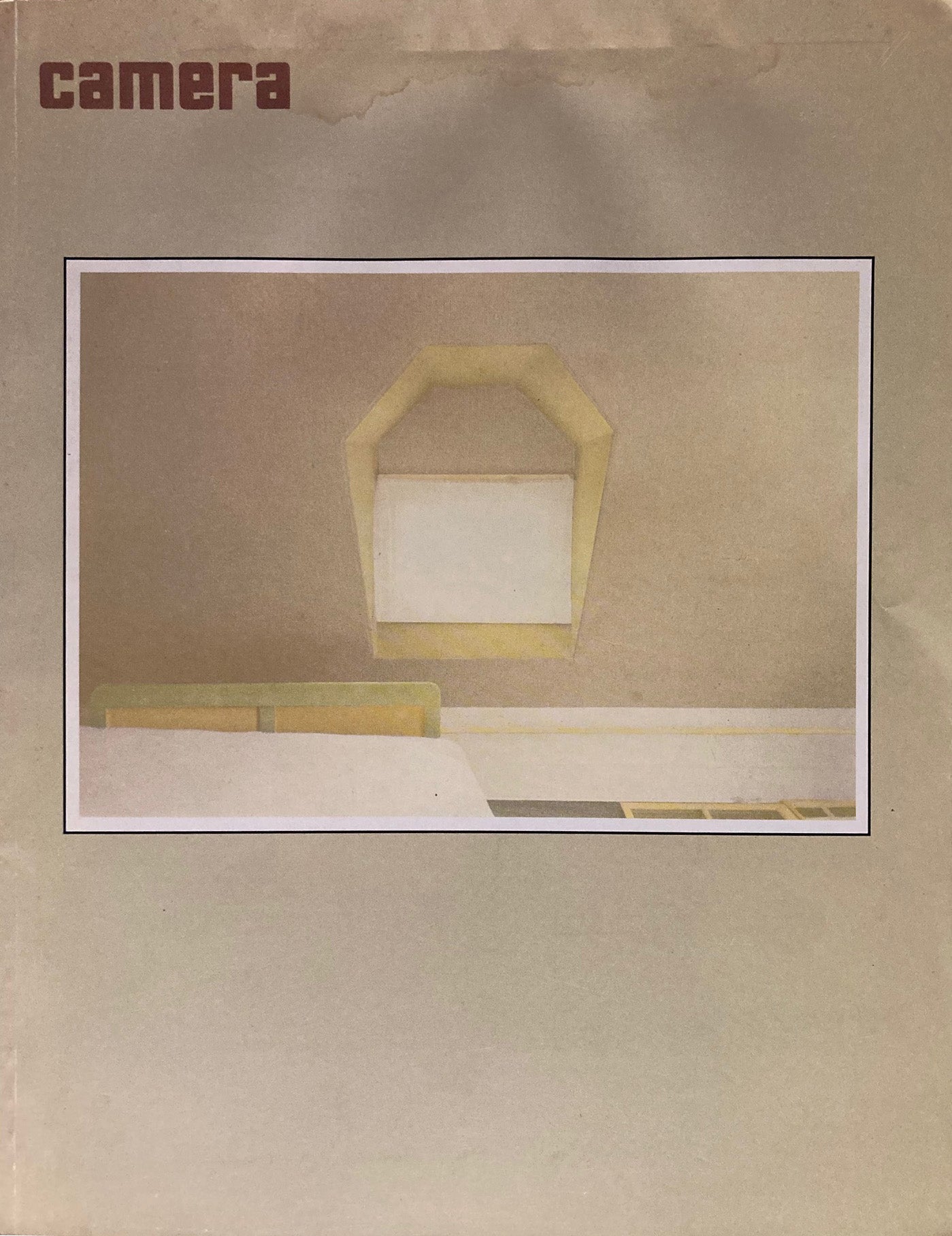
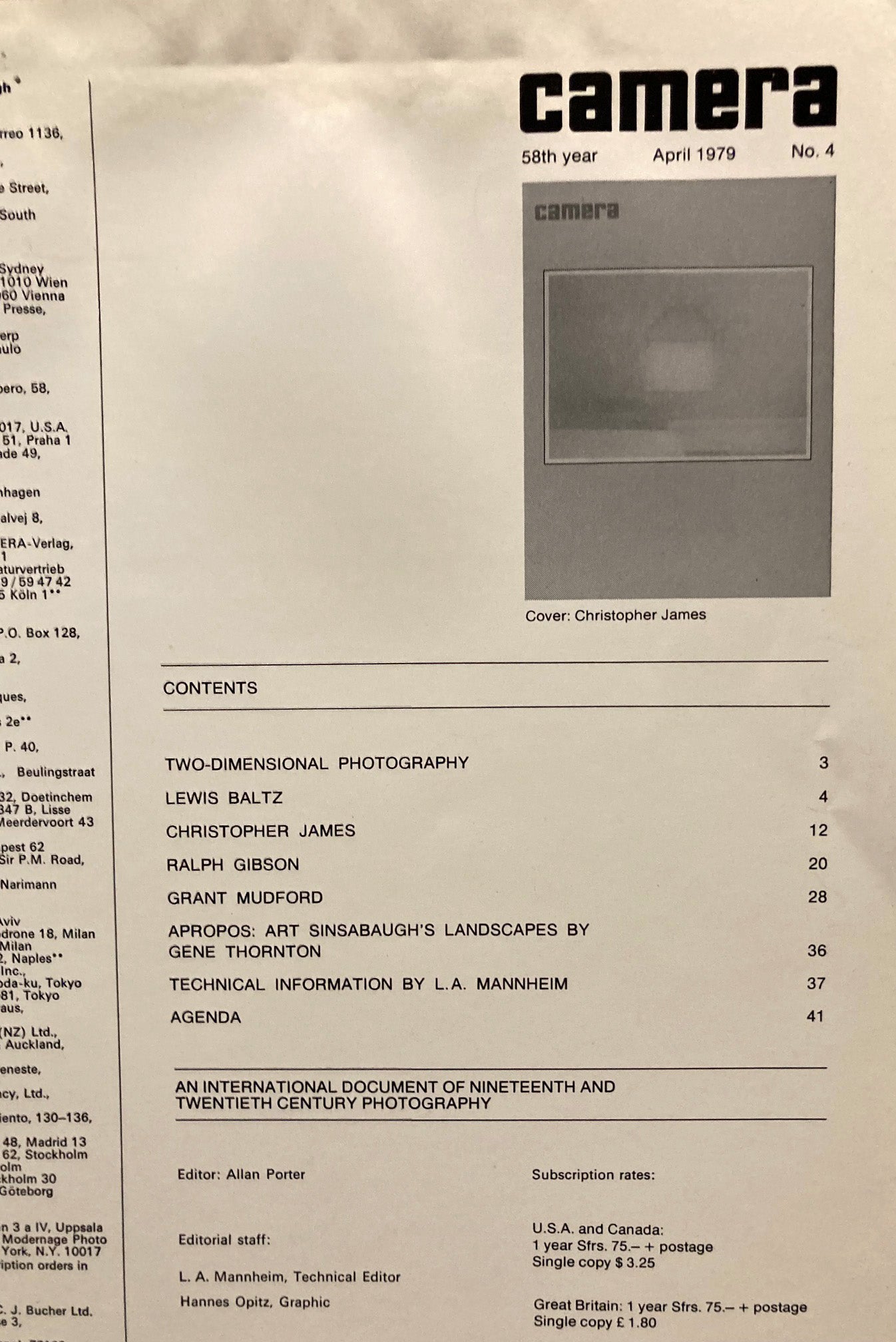
Camera, April 1979. Volume 58, Number 4. Edited by Allan Porter.
Camera, April 1979. Volume 58, Number 4. Edited by Allan Porter.
Couldn't load pickup availability
Features Lewis Baltz, Christopher James, Ralph Gibson, Grant Mudford, Art Sinsabaugh. Water stain at top of cover; top edge of pages have waviness but no other problems. Good. Summary:
The April 1979 issue of Camera (Volume 58, No. 4) is a sophisticated exploration of formalism and artifice in contemporary photography. Edited by Allan Porter, this issue moves away from the journalistic and focuses on four distinct "authors" who use the camera to manipulate space, texture, and the viewer’s perception of reality.
Featured Photographers
1. Ralph Gibson: The Surrealism of the Fragment
Gibson is featured for his high-contrast, minimalist style that defines his "Black Trilogy" era.
-
Aesthetic: His work focuses on tight crops and deep shadows, turning everyday objects or body parts into abstract, psychological symbols.
-
The Intent: The images are less about the subject and more about the cinematic tension created by what is left out of the frame.
2. Christopher James: Toning and Hand-Coloring
James represents the "painterly" side of the era's avant-garde.
-
Process: He is noted for his use of hand-dyed and enameled prints, often utilizing sepia or cyan-toning.
-
Visual Style: His images frequently feature swimmers or interiors, characterized by a dreamy, ethereal quality that challenges the "straight" documentary tradition of the medium.
3. Grant Mudford: Urban Geometry
The Australian-born photographer provides a rigorous look at the American urban landscape.
-
Architecture as Pattern: Mudford’s work in this issue focuses on the textures of concrete, corrugated iron, and stucco.
-
Style: By stripping away human presence and context, he transforms building facades into flat, geometric compositions, emphasizing the abstract beauty of industrial surfaces.
4. Art Sinsabaugh: The Panoramic Horizon
Sinsabaugh is celebrated for his unique use of the large-format banquet camera to capture the American Midwest.
-
Perspective: His photographs are characterized by an extremely wide, thin aspect ratio—often featuring a massive sky and a very low, detailed horizon line.
-
The Result: This "landscape as a strip" approach creates a monumental sense of space, documenting the relationship between the flat land and human architecture with mathematical precision.
Editorial Theme: "The Individualist"
The issue functions as an anthology of personal vision. Allan Porter’s curation suggests that by 1979, the "documentary" versus "art" debate had shifted toward individualism. Each of these four photographers represents a different way of "making" an image rather than just "taking" one—whether through Gibson's shadows, James's colors, Mudford's patterns, or Sinsabaugh's scale.
Summary Takeaway
Volume 58, No. 4 of Camera highlights a moment in photographic history when the medium was being used to deconstruct the world into lines, tones, and fragments. It remains a primary reference for the study of late-70s formalist photography and the shift toward the photograph as a self-contained art object.