Gary Saretzky Photo Books
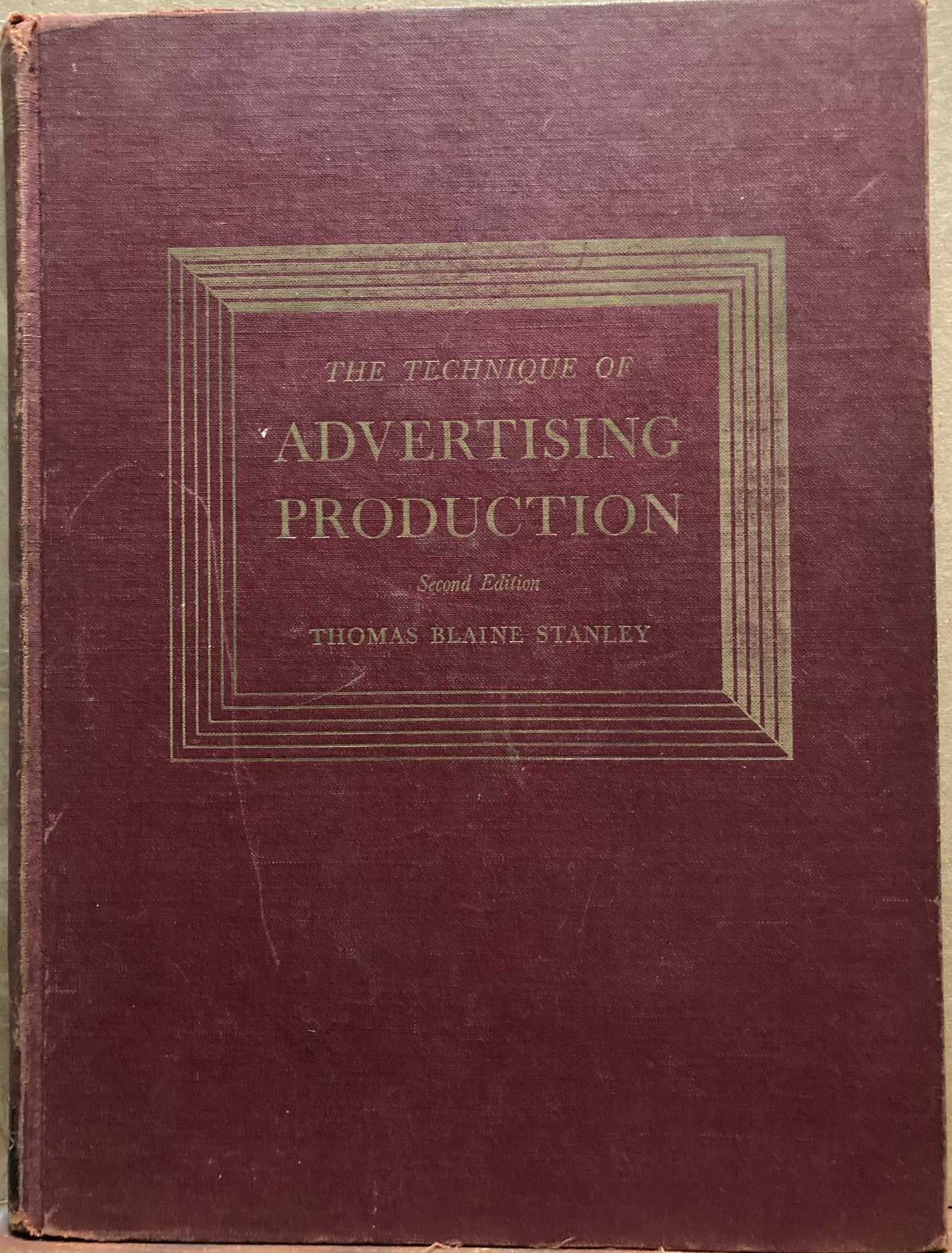
Advertising. The Technique of Advertising Production. Second Edition, by Thomas Blaine Stanley.
Advertising. The Technique of Advertising Production. Second Edition, by Thomas Blaine Stanley.
Couldn't load pickup availability
Prentice Hall, 1954. Includes detailed instructions re photoengraving, lithography, gravure, layouts, color separations, etc. Ex-library, edge worn, good, 216 pages. Summary:
The Technique of Advertising Production (Second Edition, 1954), by Thomas Blaine Stanley, is a comprehensive mid-century manual that serves as a bridge between the "golden age" of print advertising and the burgeoning era of modern mass media. Published by Prentice-Hall, it was the definitive textbook for art directors, production managers, and students during the 1950s.
Core Concept: The Synergy of Art and Industry
Stanley’s central thesis is that a great advertisement is not just a creative idea, but a feat of technical engineering. The book outlines the entire lifecycle of an ad, from the initial "thumbnail" sketch to the final high-speed press run.
-
Production as a Creative Tool: Unlike modern digital design, Stanley treats production (paper choice, ink, and plate-making) as a series of creative decisions that dictate how the consumer perceives the brand.
-
The "Rough to Finish" Pipeline: The book meticulously details the steps of visual conceptualization: Thumbnails Roughs Comprehensives Mechanicals.
Key Technical Chapters
-
Typography and Lettering: Stanley provides an exhaustive look at typefaces, explaining the psychological impact of serif vs. sans-serif and the technicalities of "copy-fitting" (calculating how much text will fit in a physical space).
-
Illustration and Photography: A deep dive into the selection of media—when to use an oil painting, a line drawing, or a photograph—and how each translates to the printed page.
-
The Photo-Engraving Process: Extensive sections on the chemistry and mechanics of creating printing plates, including the use of halftone screens to create the illusion of continuous tone in newspapers and magazines.
-
Color Theory and Reproduction: The 1954 edition expanded significantly on four-color process printing(CMYK), reflecting the post-war explosion of color in consumer magazines like Life and The Saturday Evening Post.
Layout and Design Philosophy
Stanley emphasizes the "layout" as the structural blueprint of an ad. He introduces principles of:
-
Gaze Motion: How to arrange elements to lead the reader's eye through the headline, image, copy, and logo (the "S-curve" or "Z-pattern").
-
Balance and Proportion: Using the "Golden Mean" and optical centers to create a sense of harmony or tension.
Significance
This second edition is a valuable historical document because it captures the peak of analog advertising production. It documents the era of hand-lettering, metal type, and manual retouching—skills that defined the "Mad Men" era of Madison Avenue.
For the modern reader, it offers a fascinating look at the incredible amount of physical craftsmanship and mathematical precision required to produce a single page of advertising before the advent of computer-aided design.
"The production man is the architect of the advertisement; he must understand the materials of his craft as well as the message of his client." — Thomas Blaine Stanley