Gary Saretzky Photo Books
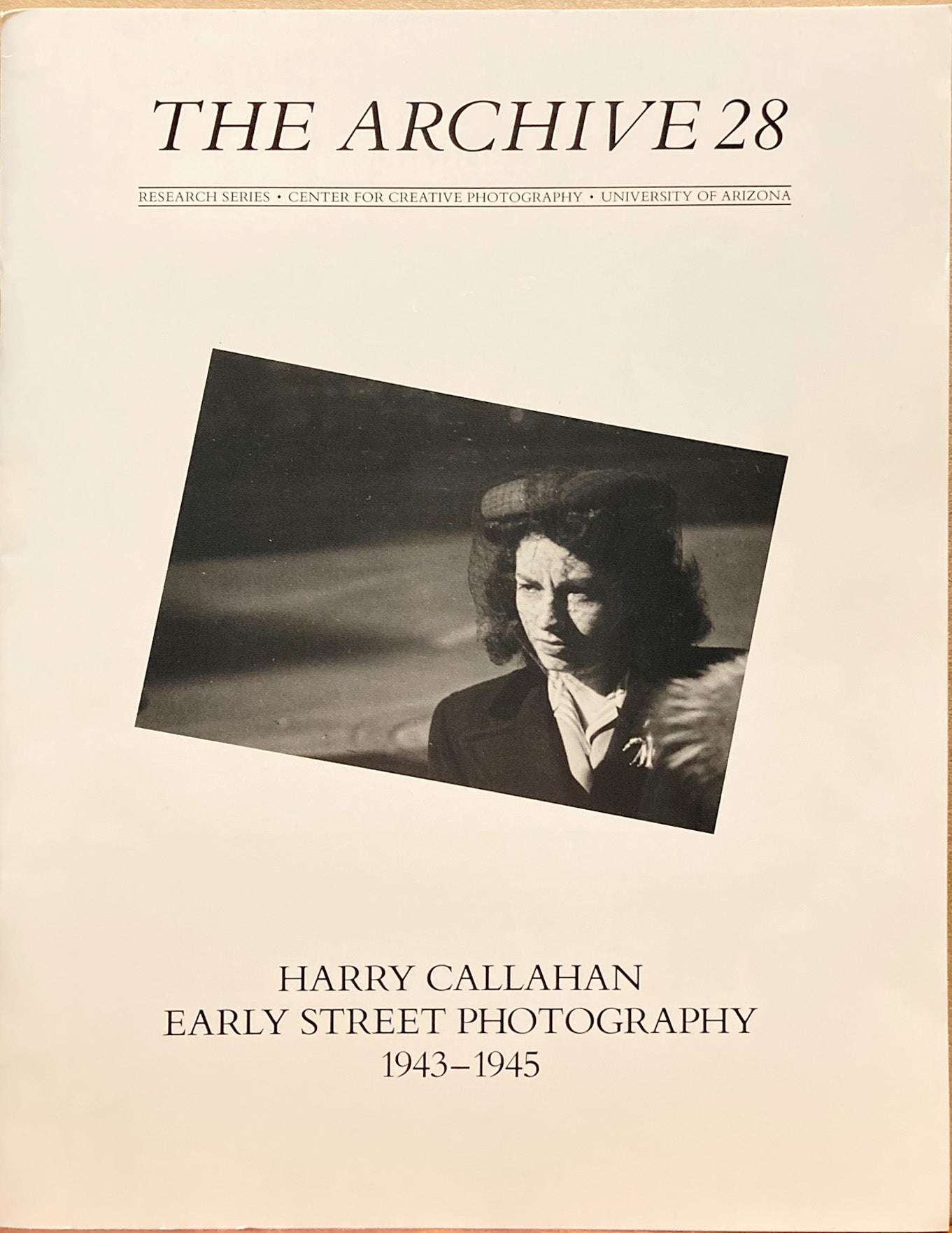
Callahan, Harry. Harry Callahan: Early Street Photography, 1943-1945.
Callahan, Harry. Harry Callahan: Early Street Photography, 1943-1945.
Couldn't load pickup availability
The Archive 28. Research Series, Center for Creative Photography, University of Arizona, 1990. Essay by John Pultz and portfolio with 24 plates. 13 additional illustrations, including self-portrait and portrait of photographer Esther Bubley. Wraps, 40 pages. Like new. Summary:
Published in 1990 by the Center for Creative Photography at the University of Arizona as Issue 28 of The Archive, Harry Callahan: Early Street Photography 1943–1945 examines the formative urban imagery of master photographer Harry Callahan. Featuring an introduction by Terence Pitts and an analytical essay by art historian John Pultz, the 44-page volume collects 24 duotone plates highlighting Callahan's earliest street studies in Detroit and Chicago. The publication explores his initial experiments with multiple exposures, high-contrast chiaroscuro, and telephoto candid portraits, showcasing how these early WWII-era street projects established the formal abstractions and intuitive visual vocabulary that defined his six-decade career.
Harry Callahan (1912–1999) was an American photographer and educator who became one of the most influential figures in modern American photography. Self-taught initially, his path transformed after attending a 1941 workshop led by Ansel Adams, which inspired him to explore strict visual formalisms and the expressive potential of the camera. Recruited by László Moholy-Nagy in 1946 to teach at the Institute of Design in Chicago, and later heading the photography department at the Rhode Island School of Design, Callahan shaped generations of artists while maintaining a intensely personal creative practice. Known for his elegant experiments with high contrast, double exposures, light trails, and intimate portraits of his wife Eleanor and daughter Barbara, his work seamlessly bridged formal abstraction with deeply felt personal narrative, establishing him as a master of 20th-century American photography.
