Gary Saretzky Photo Books
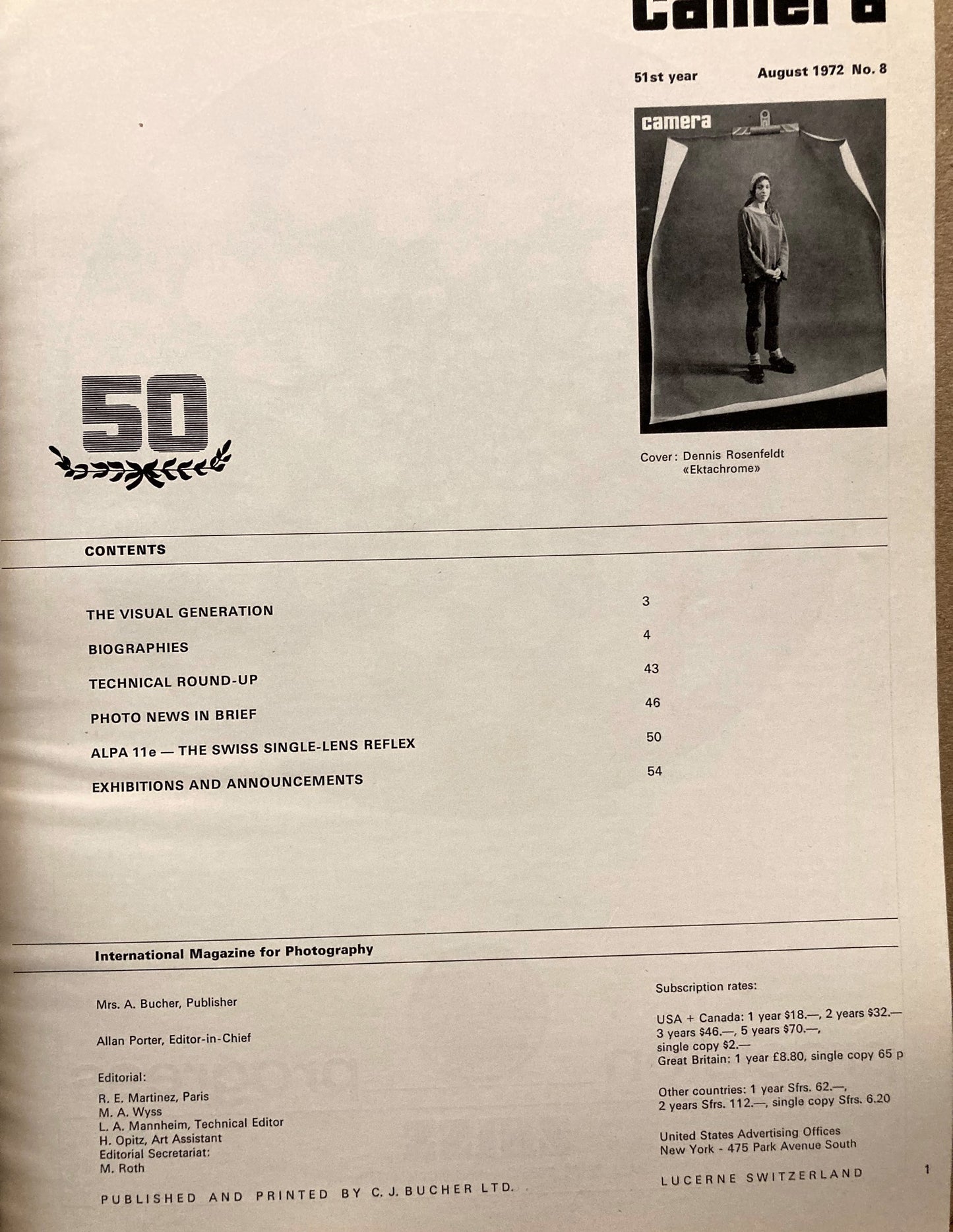
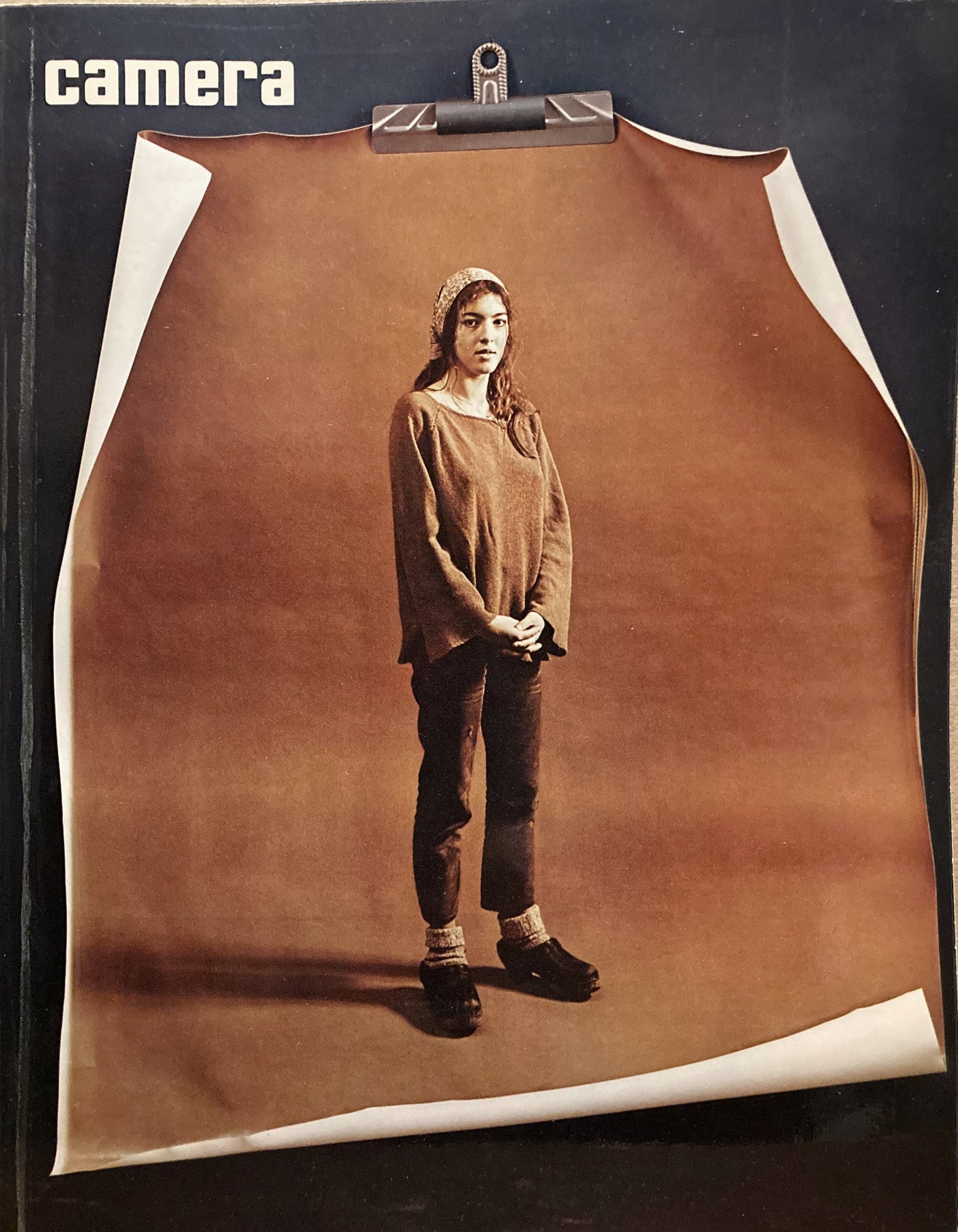
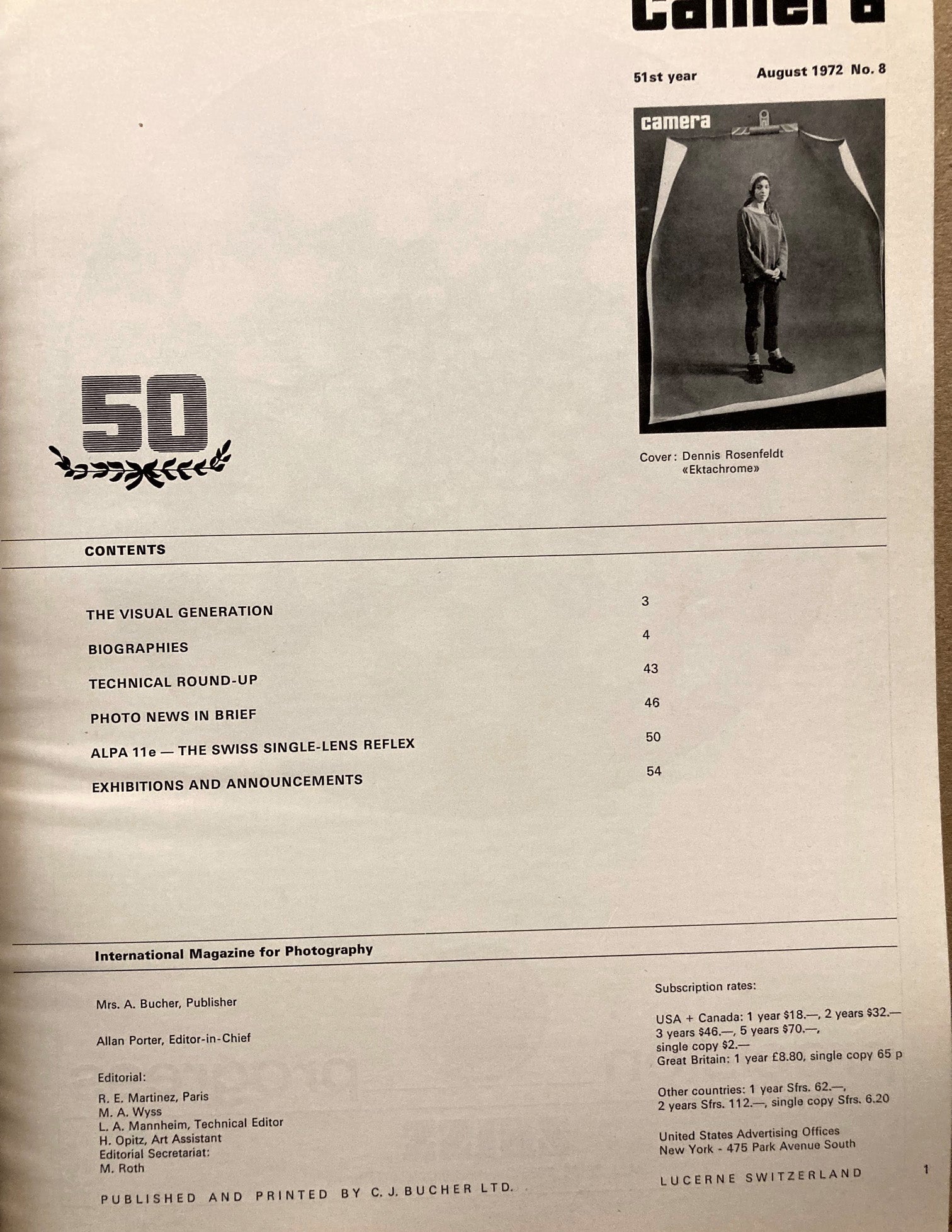
Camera, August 1972. Volume 51, No. 8. The Visual Generation.
Camera, August 1972. Volume 51, No. 8. The Visual Generation.
Couldn't load pickup availability
Features Dennis Rosenfeldt; Sally Patc, John Delacour; Antonin Kratochvil; H. Olin Smith; Dirk Raats; Jose Roberto Hofling; Leo Hetzel; Joseph Deiss; Jeff Smith; William Frank Messer; Steve Murai; Reine Turner; Bogdan Paluszynski; Robert Holmgren; Nikolaus Walter; Ronald Leighton; Sepp Seitz; Adal Maldonado; Regis Decottignies; Marc Fabre; Paul Phyfer; Harvey Stein; Vit Cimbura; Jules Landsman; Jiri Anderle; Vincent Digerlando; Horst Ludeking; Stuart L. Ferguson; Lee Redmond; Jeffrey Wanerman; Malcolm Miller; Didier Romand; Egils Kronlins. With biographies of the young photographers, several of whom like Antonin Kratochvil, Adal Maldonado, and Harvey Stein have become well known. Other articles include one on the Alpa 11e single lens reflex camera. Fine condition. Summary:
The August 1972 issue of Camera (Volume 51, No. 8), titled "The Visual Generation," functions as a predictive showcase of emerging talent. Editor Allan Porter dedicated this edition to a new wave of photographers—those born in the post-war era—who were beginning to break away from traditional documentary norms in favor of more personal, experimental, and psychologically charged imagery.
Featured Photographers
This issue is historically significant for identifying several artists at the very start of their careers who would later become major figures in the medium:
-
Antonin Kratochvil: Before becoming a founding member of VII Photo Agency and a world-renowned war photographer, Kratochvil is seen here exploring the raw, moody, and high-contrast style that would define his later work in Eastern Europe and conflict zones.
-
Adal Maldonado (ADAL): Representing the more surrealist and conceptual side of the new generation, Maldonado’s work touches on themes of identity and artifice, often using the camera to construct dreamlike or absurdist narratives.
-
Harvey Stein: Known for his long-term documentary projects and street photography, Stein’s early contribution showcases his ability to capture the eccentricities and intimate moments of urban life with a candid, humanistic lens.
Core Themes
-
The "Visual Generation": The issue posits that this new group of photographers was the first to be raised in a saturated media environment, leading to a more sophisticated, "visually literate" approach to composition and subject matter.
-
Subjectivity: A move away from the objective "truth" of photojournalism toward a "subjective" truth, where the photographer’s internal perspective is as important as the external scene.
-
Technical Freedom: The work reflects a willingness to embrace grain, motion blur, and unconventional framing—techniques that were once considered "errors" but were now being used as expressive tools.
Significance
By focusing on "The Visual Generation," Camera acted as a talent scout for the industry. This issue serves as a time capsule of the early 1970s, capturing the transition from the structured assignments of the Life magazine era to the more autonomous, art-house photography that flourished in the decades to follow.