Gary Saretzky Photo Books
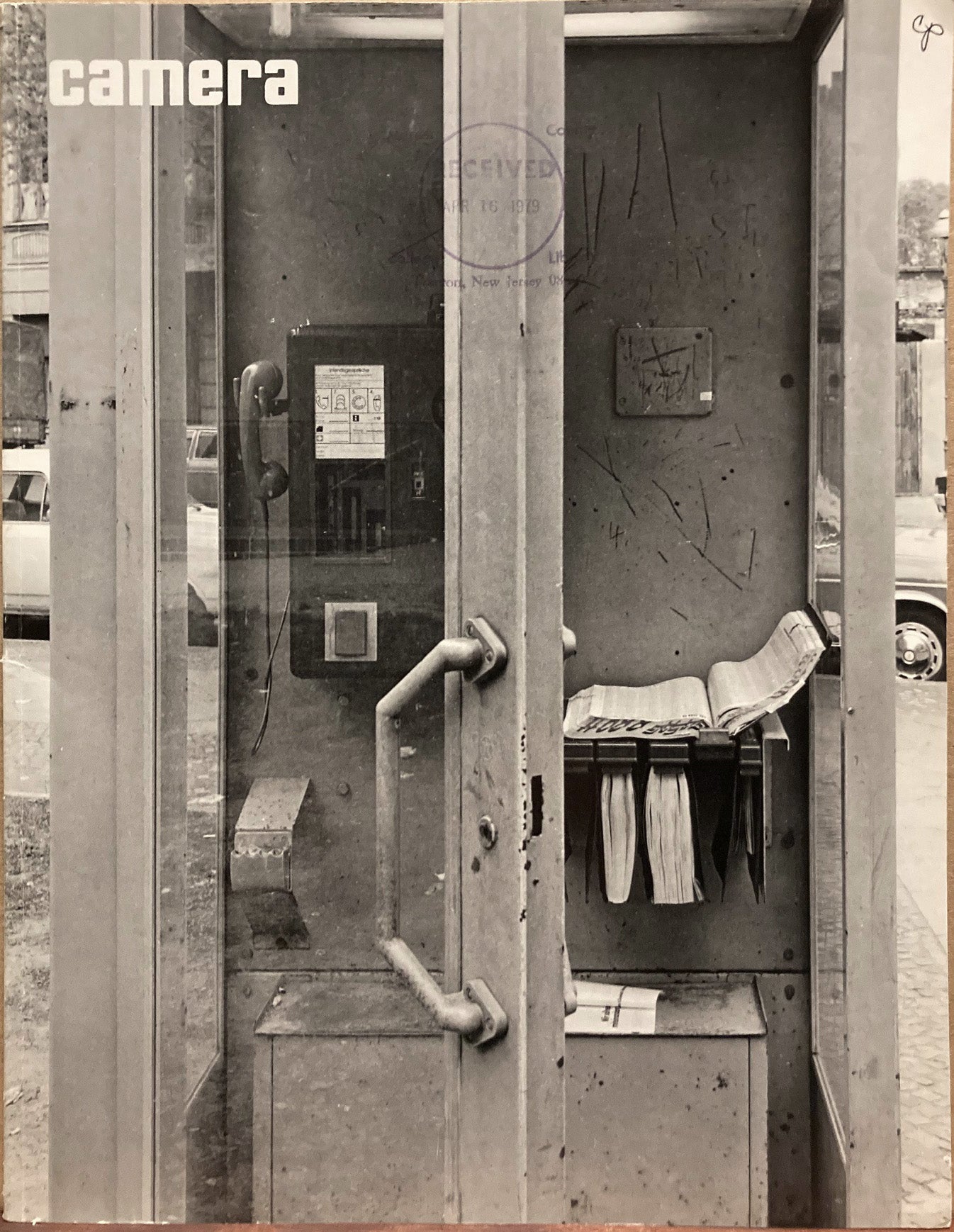
Camera, March 1979, Volume 58, Number 3. Michael Schmidt, et al.
Camera, March 1979, Volume 58, Number 3. Michael Schmidt, et al.
Couldn't load pickup availability
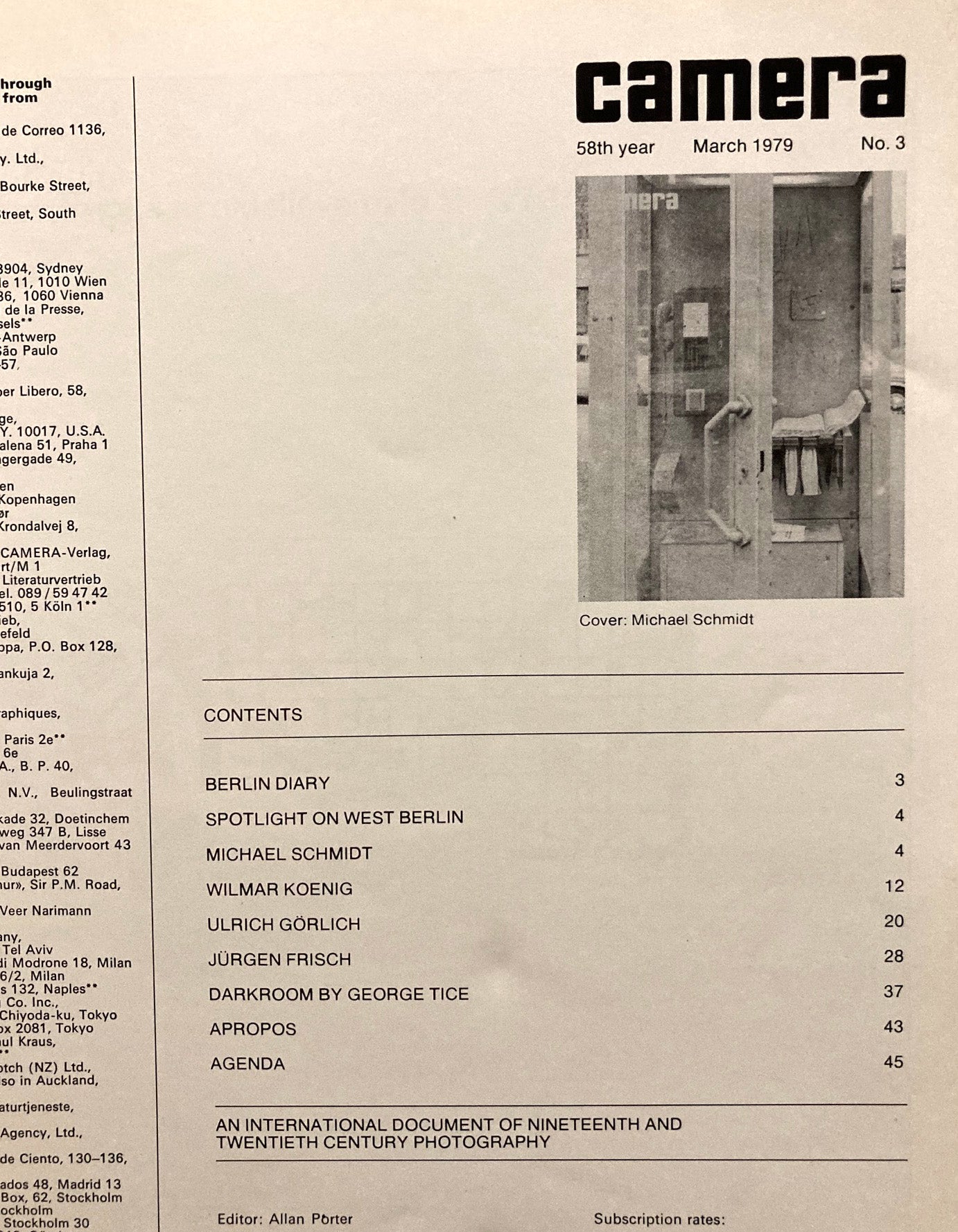
Features photographs of West Berlin, Germany, by Michael Schmidt and his students: Wilmar Koenig, Ulrich Gorlich, and Jurgen Frish, as well as an article on how to make platinum prints by George Tice and an account of the fire at the George Eastman House shed that destroyed a large quantity of nitrate movie film. High quality photography magazine published in Switzerland, English edition. Edited by Allan Porter. Library rubber stamp and initials on cover, otherwise fine. Summary:
The March 1979 issue of Camera (Volume 58, No. 7) is a seminal document in the history of German photography. Titled "Michael Schmidt and his Workshop," it focuses on the influential Werkstatt für Photographie (Workshop for Photography) in Berlin-Kreuzberg, founded by Schmidt in 1976. This issue highlights a radical shift in German visual culture toward a rigorous, unblinking style of documentary.
The Central Figure: Michael Schmidt
The issue introduces the philosophy of Michael Schmidt, who rejected the dramatic, "decisive moment" style of photojournalism. Schmidt’s work featured in this volume—notably from his series Berlin-Wedding—is characterized by:
-
The "Grey Scale": A refusal of high-contrast blacks and whites in favor of a vast range of mid-greys, which he believed more accurately reflected the drab reality of the urban environment.
-
Objective Topography: A cold, neutral gaze at the architecture and social fabric of West Berlin, treating the city as a historical and psychological document.
The Workshop Philosophy
The issue serves as a manifesto for the Werkstatt, which functioned as an alternative to traditional art academies. The workshop was the primary entry point for American "New Topographics" influences (like Robert Adams and Lewis Baltz) into the German scene. The curated selection emphasizes:
-
Photography as a Democratic Tool: Teaching photography to ordinary citizens while maintaining elite artistic standards.
-
Collective Identity: How a group of students, under Schmidt's mentorship, developed a shared visual language to describe the fractured landscape of divided Berlin.
Featured Students and Contributors
The portfolio sections showcase work by Schmidt’s students, illustrating the application of his "objective" method across different subjects:
-
Urban Documentation: Students capturing the "non-places" of the city—parking lots, social housing, and desolate street corners.
-
Social Realism: Portraits that avoid sentimentalism, presenting subjects with a direct, often uncomfortable transparency.
-
Notable Names: The issue features early work from figures who would become influential in the Berlin scene, such as Ulrich Görlich and Wilmar Koenig.
Editorial Impact
Editor Allan Porter positions this issue as a bridge between the German "New Objectivity" of the 1920s and the American "New Topographics" of the 1970s. It argues that Schmidt and his workshop were creating a "New German Photography" that was distinct from the famous Dusseldorf School (Bechers), focusing more on the gritty, lived experience of the city than on industrial typology.
Summary Takeaway
Camera, March 1979 is a vital record of the rebirth of serious German documentary photography. It captures the exact moment when Michael Schmidt began to reshape the medium, moving it away from "artistic" artifice and toward a profound, gray-toned investigation of the relationship between man and the modern urban environment.
Biographical Summary
Michael Schmidt (1945–2014) was a influential German photographer recognized for his austere, nuanced documentation of Divided Berlin, postwar urban spaces, and contemporary social realities. Born in East Berlin shortly before the end of World War II, Schmidt grew up in West Berlin, working initially as a police officer before teaching himself photography in 1965 and dedicating his life to the medium. In 1976, he founded the Werkstatt für Photographie at the Volkshochschule Kreuzberg in West Berlin, an influential educational platform that introduced American documentary traditions—such as the works of William Eggleston and Robert Adams—to West German photographers. Schmidt's artistic style evolved from straightforward documentary portraits of his home district of Kreuzberg to grim, deeply psychological black-and-white studies of the Berlin Wall and urban wasteland, culminating in his masterwork monograph Waffenruhe (Ceasefire, 1987). Following German reunification, he expanded his visual scope to explore national identity in Ein-Heit (U-ni-ty, 1996) and industrial food production in Lebensmittel (Foodstuffs, 2012), which earned him the prestigious Prix Pictet shortly before his death. Through his rigorous series, bookmaking, and pedagogical impact, Schmidt established a profound visual vocabulary that bridged West German documentary traditions with conceptual fine art photography.