Gary Saretzky Photo Books
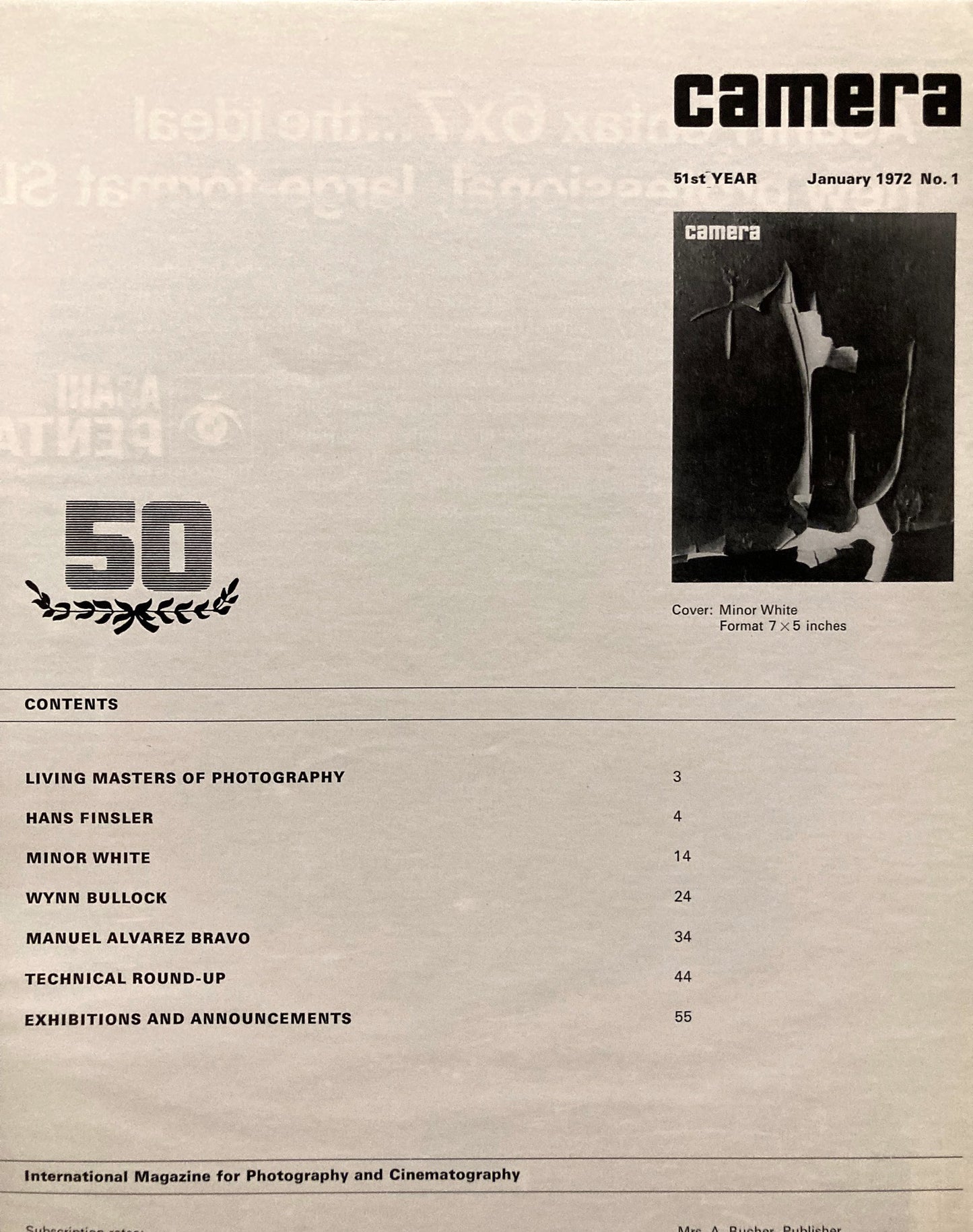
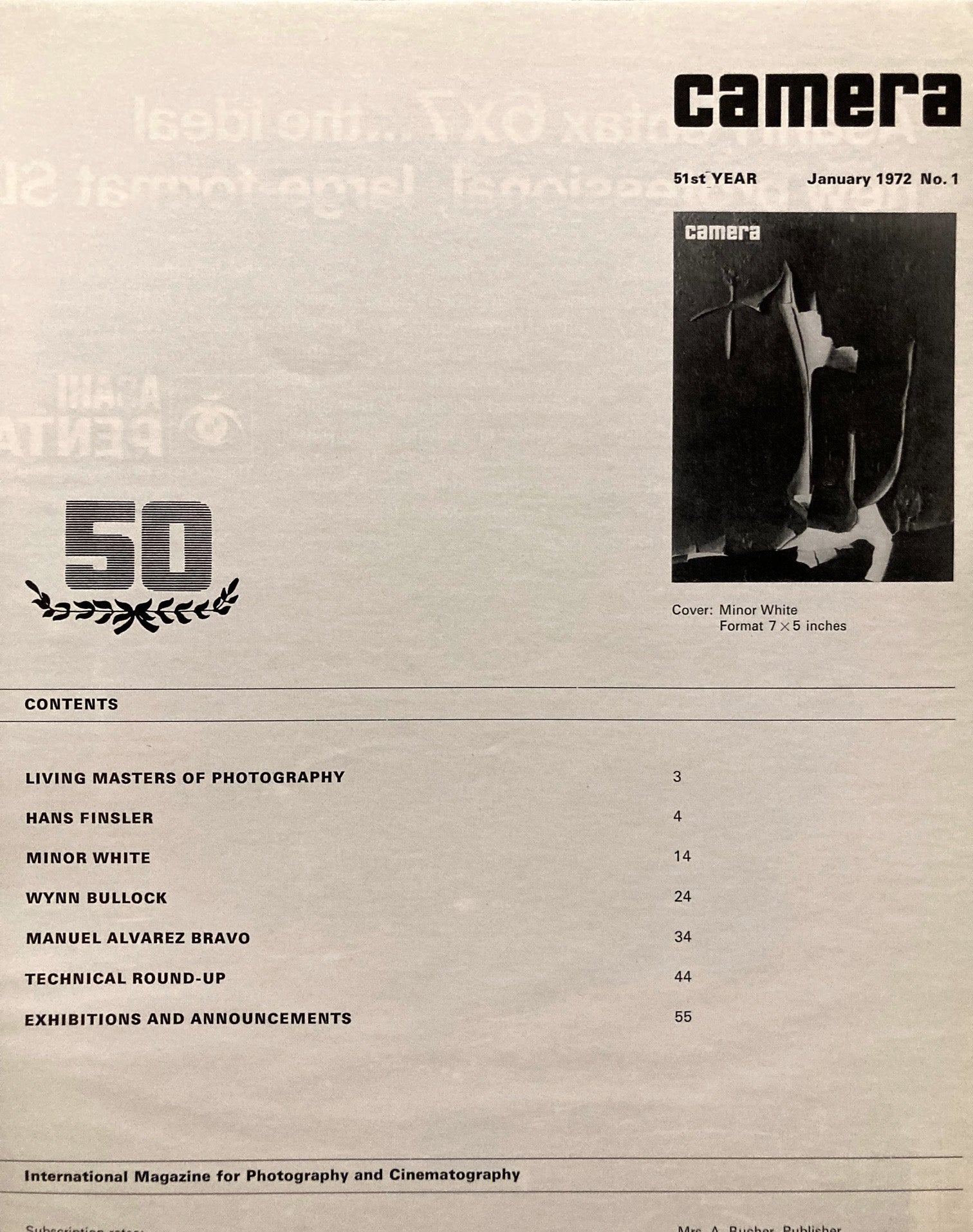
Camera, January 1972. Volume 51, Number 1. Living Masters of Photography.
Camera, January 1972. Volume 51, Number 1. Living Masters of Photography.
Couldn't load pickup availability
English edition. Hans Finsler, Minor White, Wynn Bullock, Manuel Alvarez Bravo. Fine except delamination of plastic coating, as is common with this number. Summary:
The January 1972 issue of Camera (Volume 51, No. 1), titled "Living Masters of Photography," serves as a monumental tribute to four titans of the medium. Rather than focusing on emerging trends, editor Allan Porter utilized this inaugural issue of the year to solidify the "monumental" status of artists whose work had fundamentally shaped the aesthetic and philosophical foundations of 20th-century photography.
The Masters and Their Portfolios
The issue provides a curated retrospective of four distinct approaches to the camera, ranging from strict objectivity to spiritual abstraction:
-
Hans Finsler: A pioneer of the "New Objectivity" (Neue Sachlichkeit), Finsler’s work in this issue emphasizes the beauty of industrial design and everyday objects. His precise, clean compositions highlight the texture and form of the machine age, advocating for photography as a medium of clarity.
-
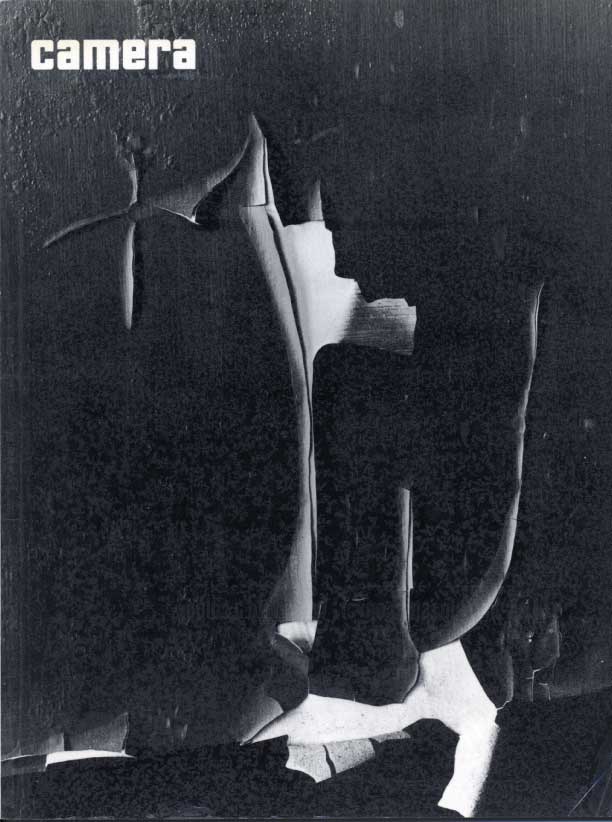
Minor White: Representing the spiritual and metaphorical school, White’s portfolio focuses on the concept of "equivalence"—where a photograph of a physical object (like a rock or a frost-covered window) serves as a symbol for an internal emotional state. His work is characterized by high contrast and deep, mystical tonality.
-
Wynn Bullock: This feature highlights Bullock’s fascination with the mysteries of nature and the dimension of time. His imagery often juxtaposes the human form with the primeval forest, exploring the philosophical relationship between light, space, and existence.
-
Manuel Alvarez Bravo: The master of Mexican photography, Alvarez Bravo contributes images that blend street realism with a quiet, surrealist poetry. His work captures the ironies and indigenous spirit of Mexico, often imbuing mundane scenes with a sense of the macabre or the eternal.
Core Themes
-
Longevity and Influence: The issue focuses on the "living" aspect of these masters, illustrating how their decades-long careers continued to influence contemporary 1970s aesthetics.
-
The Philosophy of the Lens: Each portfolio is accompanied by insights into the artist's personal philosophy, moving the conversation away from technical gear toward the "intellectual eye."
-
Aesthetic Diversity: By grouping these four specific men, Porter showcases the breadth of the medium—from Finsler’s cold objectivity to White’s intense subjectivity.
Editorial Significance
This volume is considered a foundational "textbook" issue for collectors. By labeling these four men "Living Masters," and others in different issues of the magazine, Camera helped establish the 20th-century photographic canon, providing a benchmark against which the "Visual Generation" of younger photographers (featured later that year) would eventually be measured.