Gary Saretzky Photo Books
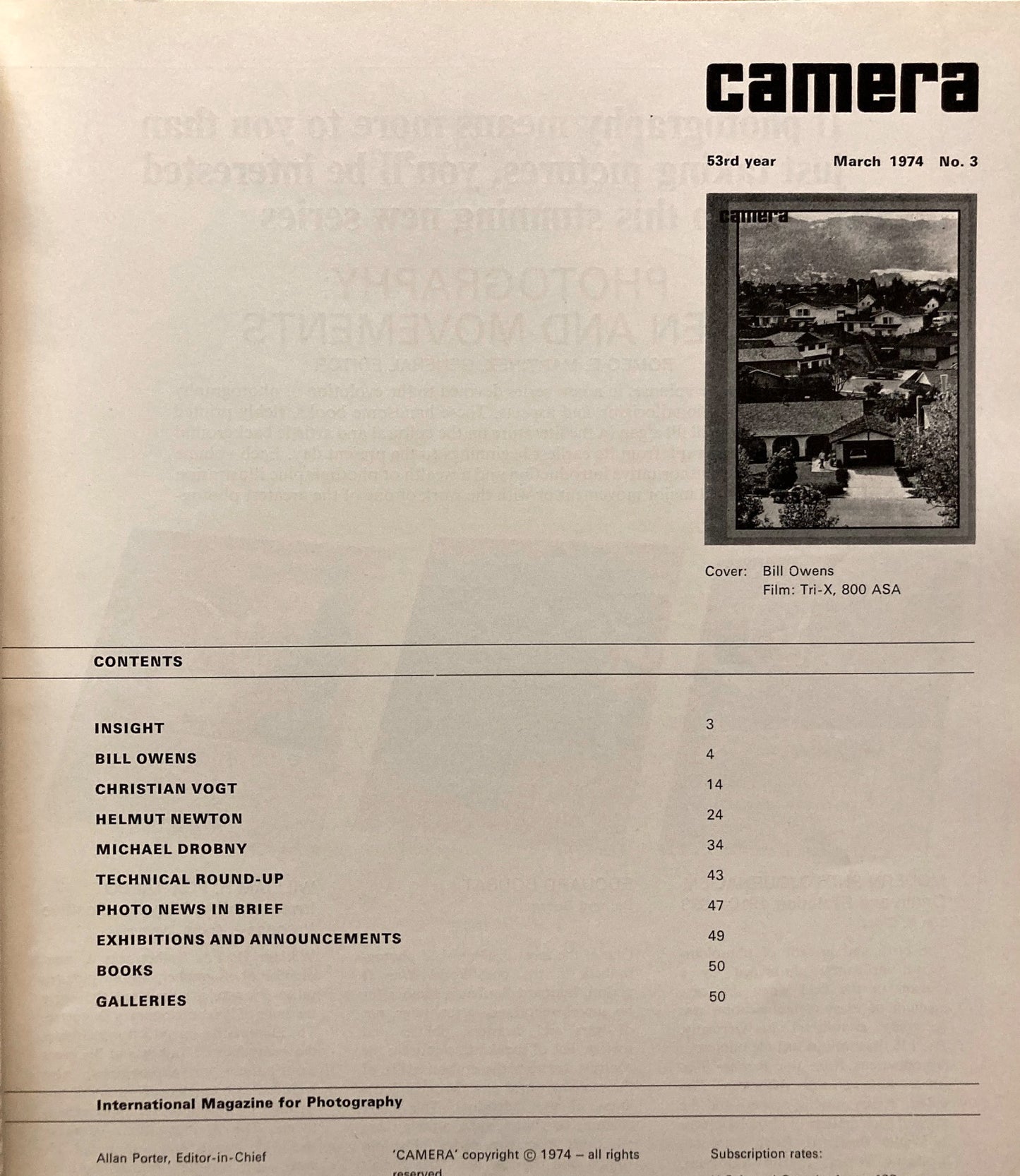
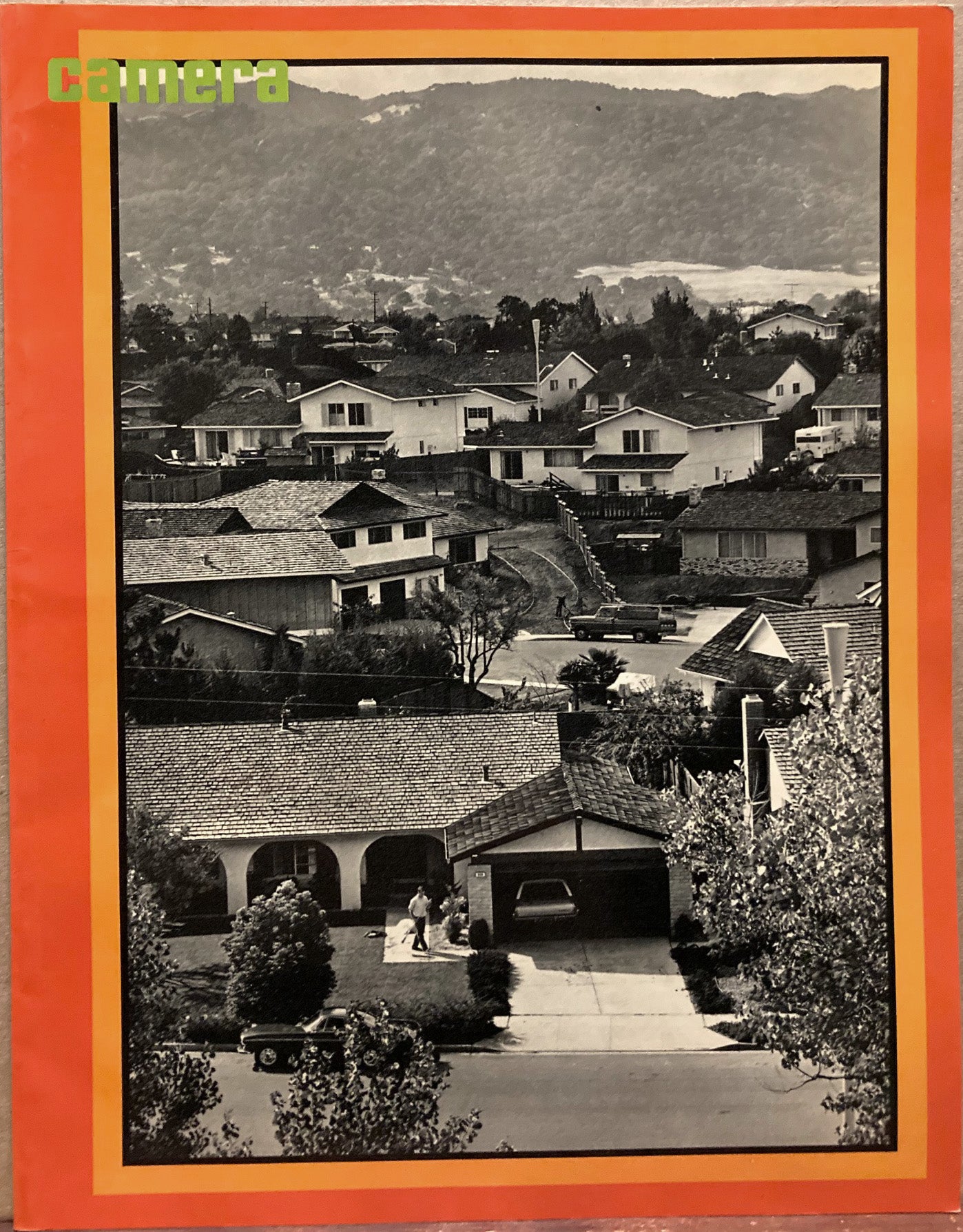
Camera, March 1974. Volume 53, No. 3. Insight. Bill Owens, Christian Vogt, et al.
Camera, March 1974. Volume 53, No. 3. Insight. Bill Owens, Christian Vogt, et al.
Couldn't load pickup availability
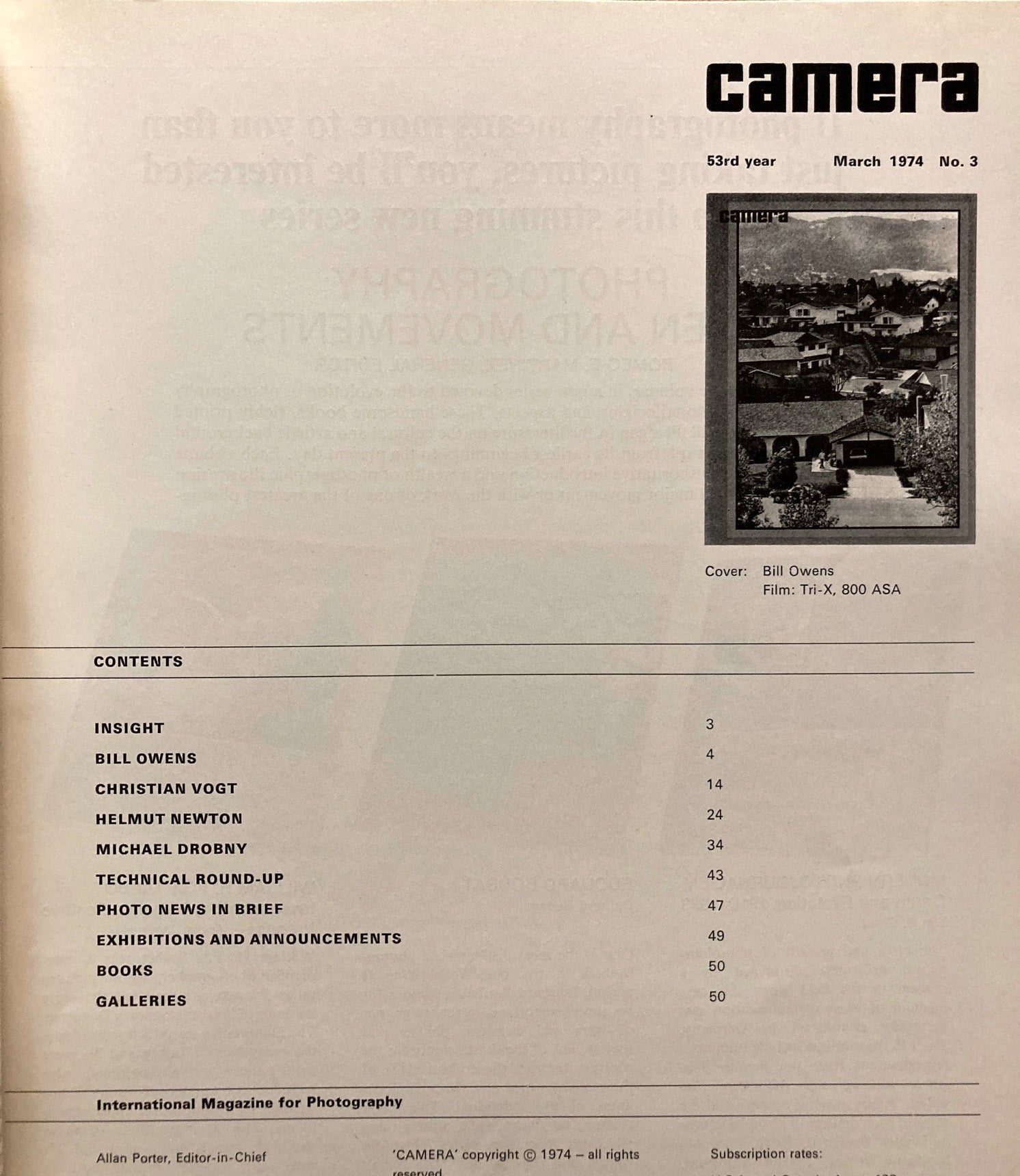
Edited by Allan Porter. Featuring Bill Owens, Christian Vogt, Helmut Newton, and Michael Drobney. Includes nudes. Near fine copy with a small crimp on cover. Summary:
The March 1974 issue of Camera (Volume 53, No. 3), titled "Insight," serves as a curated exploration of how photographers translate personal perception into visual narrative. Under the legendary editorship of Allan Porter, this issue highlights the shift toward psychological depth and social commentary in 1970s photography.
Featured Photographers
-
Bill Owens: Known for his seminal work Suburbia, Owens contributes his distinct "visual anthropology." His images capture the post-war American Dream with a mix of humor, irony, and brutal honesty, documenting the rituals of middle-class life.
-
Christian Vogt: Representing a more conceptual and experimental approach, Vogt’s work in this issue leans toward the surreal and the minimal. He uses the frame to explore the tension between the subject and the space it occupies.
-
Helmut Newton: Already becoming a provocative force in fashion photography, Newton’s inclusion showcases his "erotic realism." His work here emphasizes power dynamics and artifice, blending high-fashion aesthetics with a voyeuristic edge.
-
Michael Drobney: Drobney provides a more atmospheric, perhaps more traditional photographic "insight," focusing on the interplay of light and texture to evoke specific moods.
Core Themes
-
Subjectivity vs. Objectivity: The issue probes whether a photograph is a record of a scene or a reflection of the photographer's internal state.
-
Social Documentation: Through Owens, the magazine examines the shifting social fabric of the era.
-
The Male Gaze: Through Newton, the issue touches on the evolving (and often controversial) representation of the female form in mid-70s media.
-
This edition is often cited by collectors for its eclectic mix of styles, bridging the gap between the gritty documentary style of the late 60s and the polished, conceptual art photography that would define the late 70s.