Gary Saretzky Photo Books
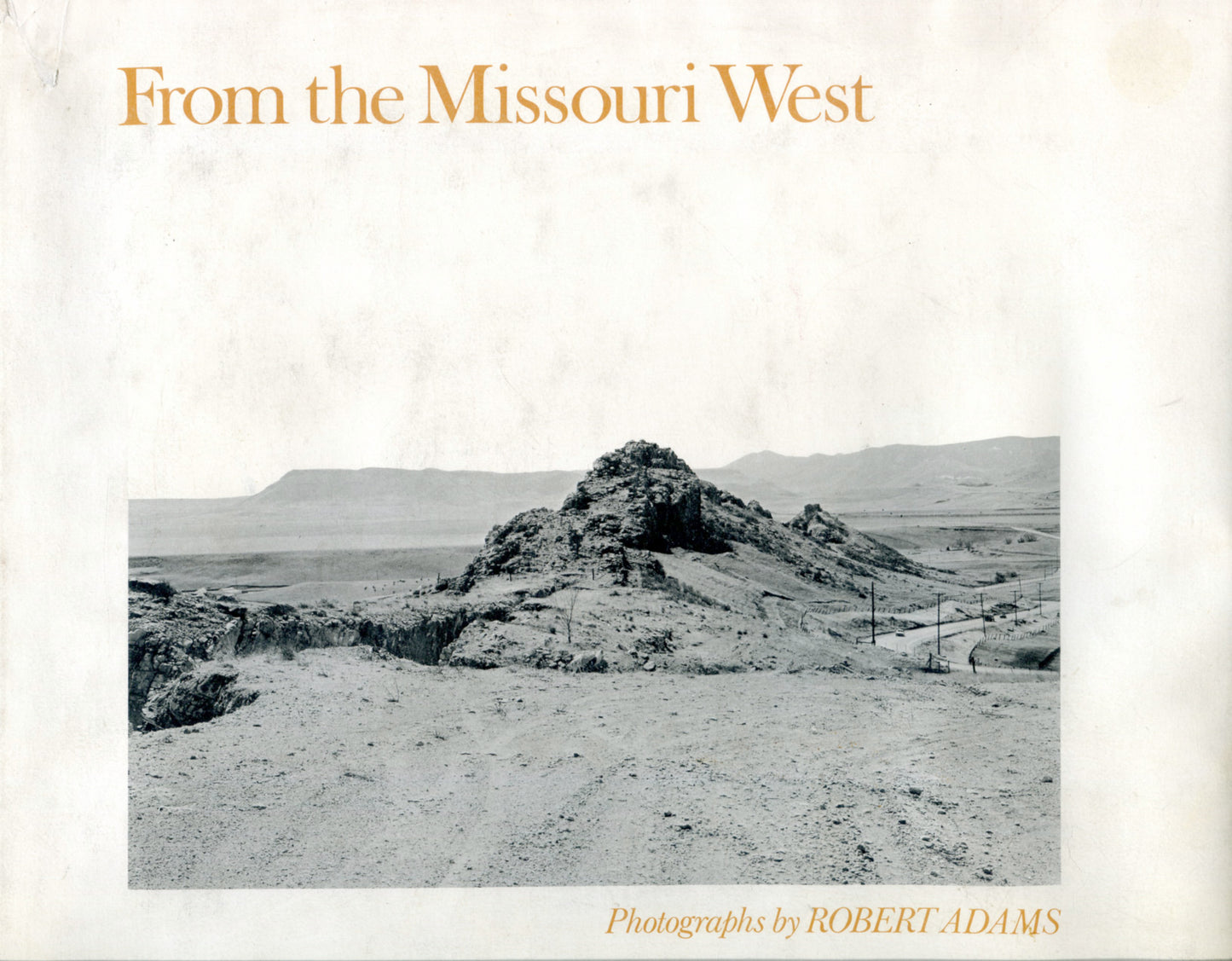
Adams, Robert. From the Missouri West by Robert Adams.
Adams, Robert. From the Missouri West by Robert Adams.
Couldn't load pickup availability
Aperture, 1980. 1st edition. Hardcover with protected dust jacket. The photographer's sixth book of landscape/topographical photography, here west of the Missouri River. Printed by the Meriden Gravure Company using negatives prepared by Richard Benson. 46 black and white photographs. Two closed tears at top front of notoriously fragile dust jacket near spine, the longer one inch. The jacket, as typical, shows light shelf rubbing. Book fine. Summary:
From the Missouri West, originally published by Aperture in 1980, is one of the most influential works in modern American landscape photography. It served as a follow-up to Robert Adams’ landmark The New West, expanding his geographic and philosophical reach from the suburbs of Colorado to the vast expanses of the Great Plains and the Rocky Mountains.
Core Concept: The "Man-Altered" Landscape
While the title suggests a traditional pioneer journey, Adams’ vision is a stark rejection of the romanticized, "untouched" wilderness of the 19th century. Instead, he documents the West as it actually appeared in the mid-to-late 20th century: a landscape defined by human presence and industrial encroachment.
-
Revisiting the Frontier: The book follows the historical path of the pioneers, but instead of finding "Eden," Adams finds clear-cut forests, gravel pits, interstate highways, and telephone wires.
-
The Beauty of the Mundane: Adams argues that even in its scarred and utilized state, the American West possesses a stubborn, quiet beauty. He seeks to find an "aesthetic of the ordinary."
Visual Style and Themes
-
The "Plain" Style: Adams utilizes a bright, even, and almost clinical light (often referred to as "white light"). There are no dramatic "Ansel Adams" shadows here; everything is rendered with extreme clarity and democratic focus.
-
Tension Between Nature and Progress: The photographs often feature a majestic mountain or a vast sky in the background, interrupted by a suburban roofline or a strip-mine in the foreground. This juxtaposition forces the viewer to confront the reality of how we inhabit the earth.
-
The Horizon: Like many of his works, the horizon line plays a structural role, emphasizing the immense scale of the West while grounding it in the physical reality of dirt, sagebrush, and asphalt.
Historical Significance: New Topographics
From the Missouri West is a quintessential example of the New Topographics movement.
-
Objectivity: The work is famous for its "non-judgmental" tone. Adams doesn't overtly preach environmentalism; he simply presents the evidence, allowing the viewer to grapple with the emotional and ecological implications of the imagery.
-
Influence: It helped redefine "landscape" photography for a generation, shifting the focus from the spectacular to the topographical.
Summary
The book is a somber, beautiful, and deeply honest look at the American landscape. It suggests that while the "West" of our imagination might be gone, the physical land remains—transformed, resilient, and worthy of our attention.
Robert Adams (born May 8, 1937) is an influential American photographer, educator, and author renowned for his nuanced chronicling of the changing landscape of the American West. Born in Orange, New Jersey, Adams earned a Ph.D. in English literature from the University of Southern California before teaching the subject and teaching himself photography in the mid-1960s. He gained national prominence through his inclusion in the landmark 1975 New Topographics exhibition and his groundbreaking 1974 book The New West, establishing an austere, quiet black-and-white visual style that explores the tension between suburban development, environmental degradation, and nature's enduring beauty. A prolific writer and artist, Adams has published over forty photobooks as well as seminal essay collections on photographic theory—including Beauty in Photography and Why People Photograph—and his work has earned him major honors, including two Guggenheim Fellowships, a MacArthur Fellowship, and the Hasselblad Award.
"The goal is to find a geography that can be both seen and lived in." — Robert Adams