Gary Saretzky Photo Books
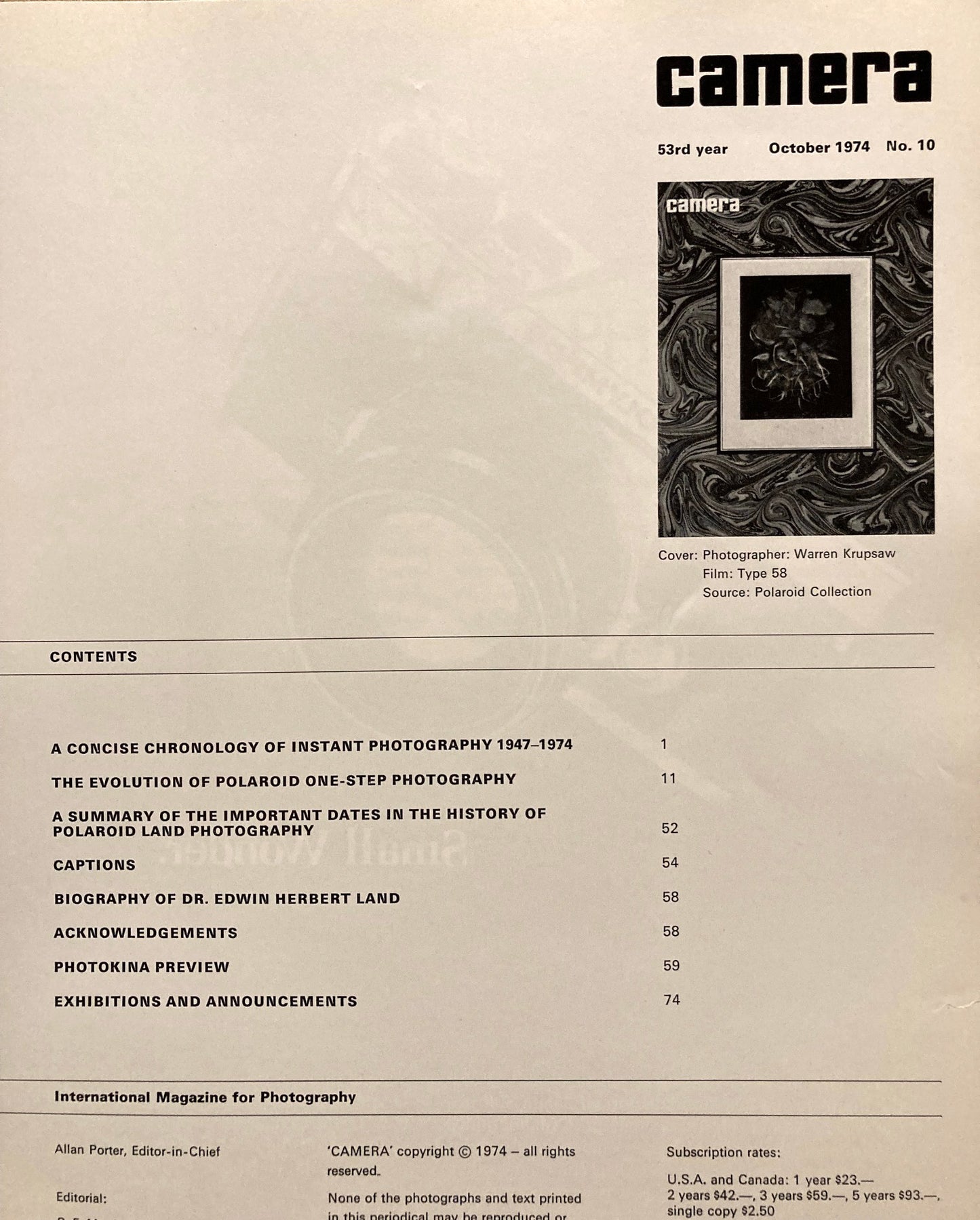
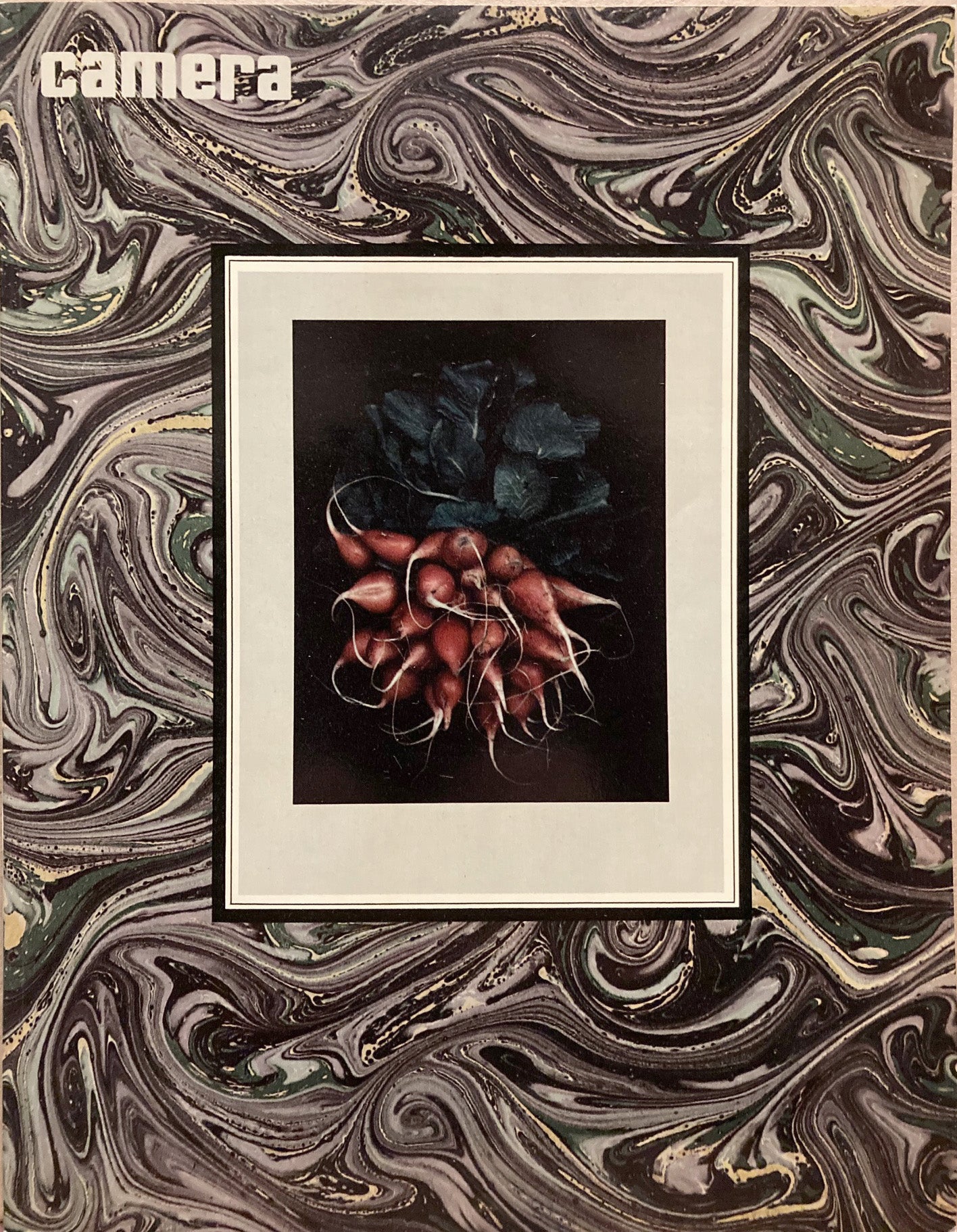
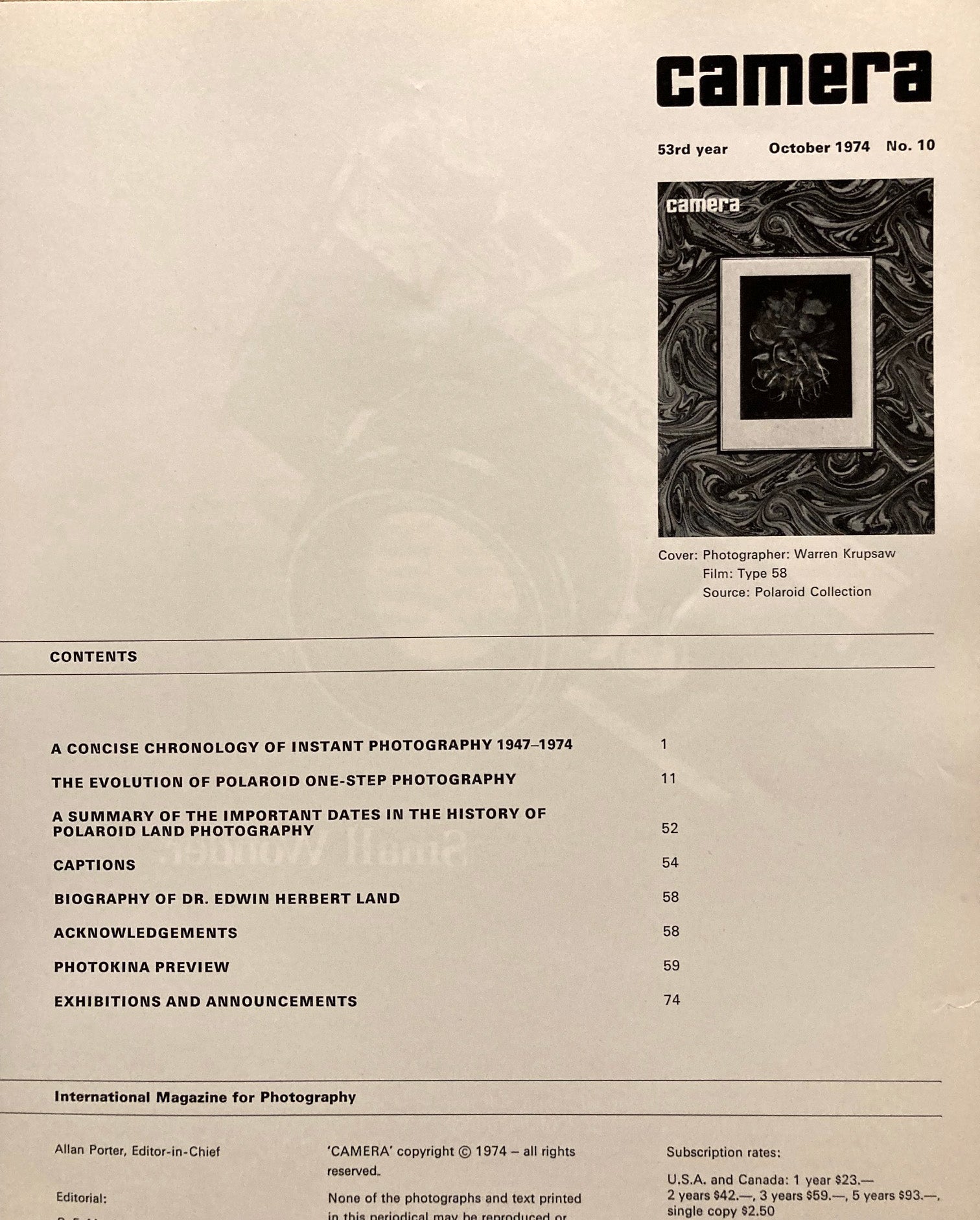
Camera, October 1974. Volume 53, No. 10. Instant Photography.
Camera, October 1974. Volume 53, No. 10. Instant Photography.
Couldn't load pickup availability
Edited by Allan Porter. Includes chronology of instant photography, biography of Edwin Land, evolution of Polaroid photography, and many examples from the Polaroid Collection. Photographs by Adams, Ansel; Wolbarst, John; Edgerton, Harold; Stern, Bert; Hartmann, Erich; Weston, Brett; Paine, Wyngate; Glinn, Burt; Zieff, Howard; Weegee; Caponigro, Paul; Power, Mark; Warrington, Ann; Halsman, Philippe (of O’Keeffe); Silverthorne, Jeffrey; Becotte, Michael; Cosindas, Marie; Clift, William; Gohlke, Frank; Chiarenza, Carl; Gowin, Emmet; Cohen, Mark; Sieff, Jean-Loup; Sudek, Josef; Evans, Walker; Mack, Ulrich; Kane, Art; Samaras, Lucas; Bailey, David. Summary:
The October 1974 issue of Camera (Volume 53, No. 10) is a definitive special edition titled "Instant Photography."Under the editorship of Allan Porter, the issue serves as a technical, historical, and artistic encyclopedia of the Polaroid phenomenon, released at a time when the SX-70 system was revolutionizing the photographic world.
The Visionary and the Machine
The issue places Dr. Edwin Land at the center of the narrative, framing him as a unique figure who bridged the gap between hard science and humanistic art.
-
Biography of Edwin Land: The text traces Land’s journey from his early experiments with polarization to the "miracle" of the 1947 demonstration of the first instant camera.
-
Chronology: A meticulous timeline documents the technical milestones of the Polaroid Corporation, tracking the evolution from sepia-toned rolls to the sophisticated, folding SX-70 SLR camera.
The Polaroid Collection
A significant portion of the issue is dedicated to the Polaroid Collection in Cambridge, Massachusetts. Porter explores how the company’s "Artist Support Program"—giving cameras and film to photographers in exchange for their work—created one of the most unique archives in art history.
Featured Artistic Styles
The issue showcases the versatility of instant film through diverse portfolios:
-
The Large Format (20x24): Examples of the massive, studio-bound instant cameras that produced life-sized, high-fidelity portraits.
-
Experimental Manipulation: Photographers who used the "wet" chemistry of the SX-70 to push, smear, or alter the image during development.
-
The Peel-Apart Era: Classic black-and-white (Type 55) and color (Polacolor) images that demonstrated the film’s legendary tonal range and color saturation.
Technical Evolution
The magazine provides a detailed look at the internal chemistry of the instant process.
It explains the complex "reagent sandwich" that allowed an image to develop in broad daylight, a feat that Allan Porter describes as a "democratization of the laboratory."
Philosophical Impact
The editorial reflects on how the "instant" nature of the medium changed the relationship between the photographer and the subject. By providing immediate feedback, the Polaroid removed the anxiety of the "hidden" negative and allowed for a collaborative, iterative creative process.
Summary Takeaway
Camera, October 1974 is a tribute to innovation and immediacy. It argues that instant photography was not just a commercial novelty, but a legitimate new "language" in art. By combining a rigorous history of Edwin Land’s genius with high-quality reproductions of the Polaroid Collection, the issue stands as the primary historical record of the first great "analog-digital" bridge in photography.
Copies available:
- Near fine.
- Creased vertically on cover near spine, VG-.