Gary Saretzky Photo Books
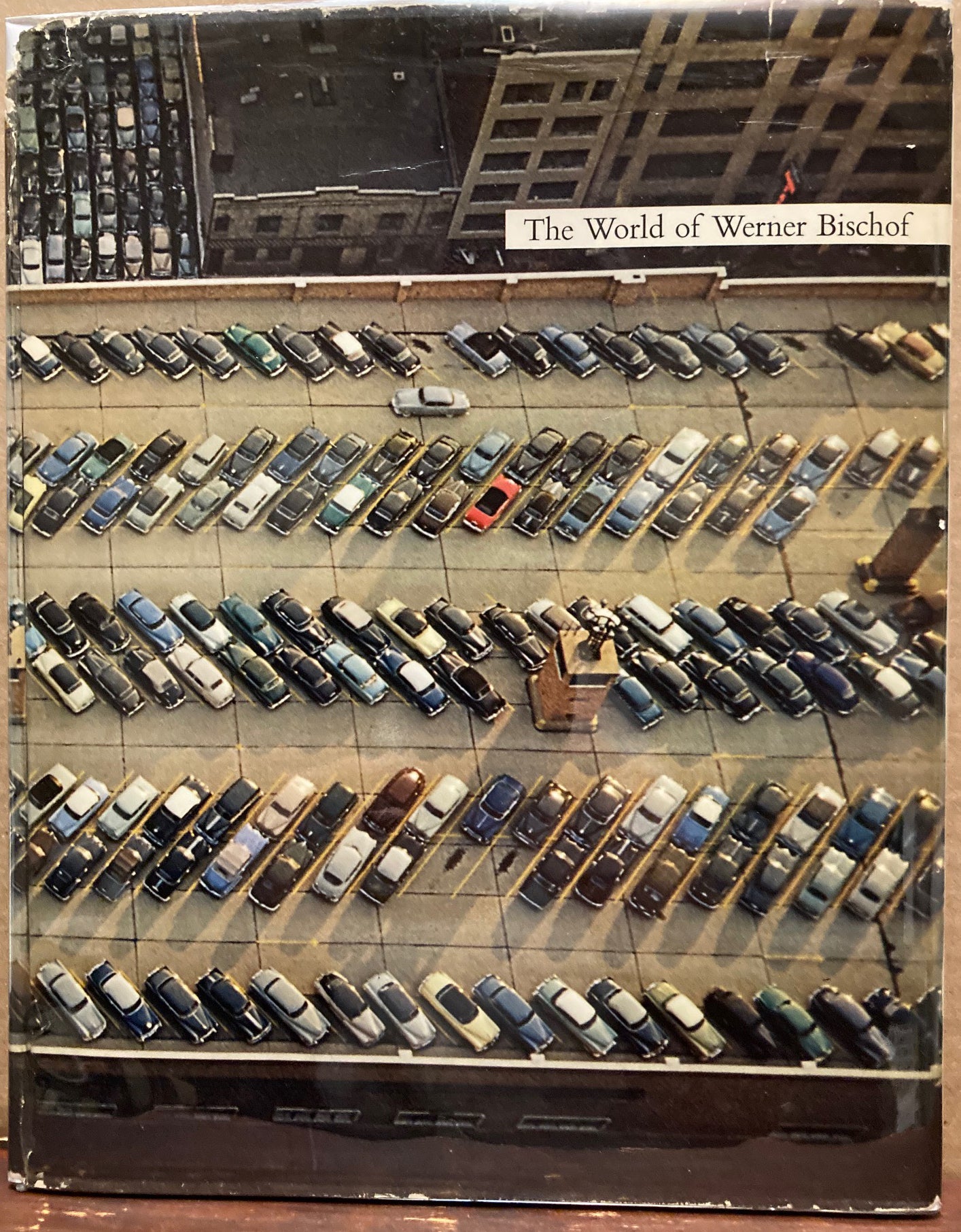
Bischof, Werner. The World of Werner Bischof: A Photographer’s Odyssey by Manuel Gasser.
Bischof, Werner. The World of Werner Bischof: A Photographer’s Odyssey by Manuel Gasser.
Couldn't load pickup availability
E.P. Dutton, 1959. Photographs in color and in black-and-white finely printed in gravure of India; Hong Kong; Indochina; Korea; Peru (including famous flute player used in The Family of Man); Mexico; New York; and Japan. 1st edition, 1st printing. Near fine in cloth with good protected book jacket that has minor edge wear and a one inch chip at top of spine. Surname or previous owner discretely written near spine on front free end paper. Summary:
Published in 1959, The World of Werner Bischof: A Photographer’s Odyssey is a landmark retrospective of the Swiss photojournalist’s brief but prolific career. Edited by Manuel Gasser, a close friend and collaborator, the book serves as a poignant visual biography of a man who bridged the gap between formalist art and compassionate documentary photography.
Core Narrative and Aesthetic
The book chronicles Bischof’s evolution from a studio-bound perfectionist to a globe-trotting member of Magnum Photos:
-
Formal Beginnings: The early sections showcase his mastery of light and shadow in Switzerland, where he photographed shells, shadows, and architectural forms with surgical precision.
-
The Post-War Witness: It follows his transition into a concerned journalist, documenting the devastation of post-WWII Europe with a focus on human dignity rather than mere tragedy.
-
The Global Odyssey: The volume features his most famous journeys through India (notably his coverage of the 1951 famine), Japan, Korea, and Indochina, before concluding with his final, fatal trip through the Andes in Peru.
Key Themes
-
The Ethical Eye: Gasser emphasizes Bischof's internal struggle with the "intrusion" of journalism; the book reflects his desire to capture the beauty of traditional cultures while exposing the hardships they faced.
-
Harmony and Contrast: A recurring theme is the juxtaposition of ancient traditions against the encroaching modern world, particularly in his celebrated imagery of Japan.
-
Universal Humanity: Whether photographing a flute player in the Andes or a priest in Meiji Shrine, Bischof’s work is presented as a search for a common human thread.
Historical Significance
Released five years after Bischof’s untimely death in a car accident in the Andes, this "Odyssey" was instrumental in establishing his legacy as one of the great humanists of the 20th century. It remains a definitive collection for its ability to show how Bischof maintained the soul of an artist while working in the high-pressure world of international news.
Werner Bischof (1916–1954) was an acclaimed Swiss photojournalist and pioneering member of Magnum Photos, celebrated for combining rigorous graphic composition with deep humanistic empathy. Born in Zurich, he studied under Hans Finsler at the School of Arts and Crafts, initially working as an advertising and fashion photographer master of light and form. Shifting his focus following World War II, Bischof traveled extensively through war-ravaged Europe to document human suffering and resilience, work that led to his invitation to join Magnum in 1949 alongside Robert Capa, Henri Cartier-Bresson, and David "Chim" Seymour. Rejecting sensationalist photojournalism in favor of nuanced visual storytelling, he went on to capture defining images of post-war Asia—notably during the 1951 famine in Bihar, India, and the Korean War—before traveling through North and South America. Tragically, his life was cut short at age 38 when his vehicle plummeted off a cliff in the Peruvian Andes, leaving behind an indelible legacy as one of the 20th century's most sensitive and artistically disciplined documentary photographers.
