Gary Saretzky Photo Books
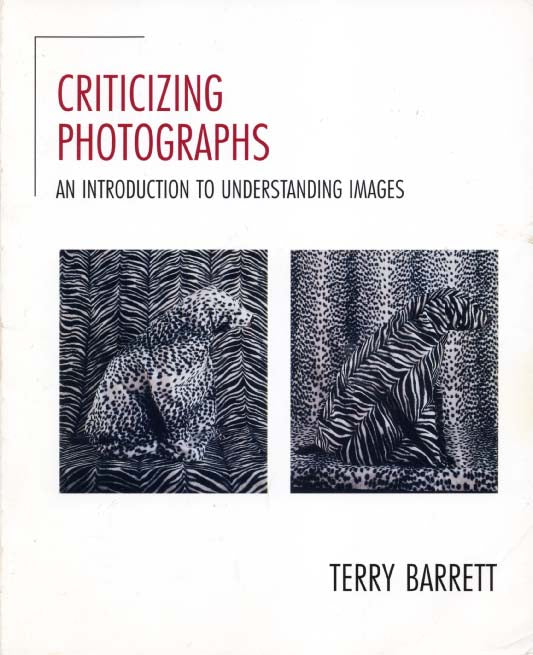
Barrett, Terry. Criticizing Photographs: An Introduction to Understanding Images by Terry Barrett.
Barrett, Terry. Criticizing Photographs: An Introduction to Understanding Images by Terry Barrett.
Couldn't load pickup availability
Mayfield Publishing, 1990. [Includes photos by Cindy Sherman, Robert Mapplethorpe, Jan Groover, Harry Callahan, Bill Owens, Mary Ellen Mark, Jerry Uelsmann, Irving Penn, Cartier-Bresson, Les Krims, Robert Doisneau, Barbara Kruger, Duane Michals, Harold Edgerton, et al.] Summary:
In Criticizing Photographs, Terry Barrett provides a systematic framework for looking at, thinking about, and writing about photography. Rather than viewing "criticism" as a negative act, Barrett redefines it as a constructive process of informed discourse that deepens the viewer's understanding and appreciation of an image.
The Four Pillars of Criticism
Barrett organizes the critical process into four distinct, sequential activities:
-
Description: Focusing on what is "objectively" there. This includes the subject matter, the medium, and formal elements (dot, line, shape, light, and color). It answers the question: What do I see?
-
Interpretation: Attributing meaning to the photograph. Barrett argues that photographs are about something more than their literal subjects. This involves contextualizing the image and answering the question: What does it mean?
-
Evaluation: Judging the merit of the work. Barrett emphasizes that "good" is not a universal constant but depends on the criteria used (e.g., Is it aesthetically pleasing? Is it socially significant? Is it technically proficient?). It answers: Is it successful?
-
Theorizing: Examining the broader philosophical questions photography raises about reality, representation, and truth.
Key Categories of Photographs
To help organize the interpretive process, Barrett categorizes images based on their "internal" and "external" contexts:
-
Descriptive: Aiming for literal representation (e.g., medical x-rays).
-
Explanatory: Providing information about how things work or happen (e.g., Eadweard Muybridge’s motion studies).
-
Interpretive: Offering a personal, poetic, or subjective perspective.
-
Ethically Evaluative: Making a moral or political statement (e.g., social documentary).
-
Aesthetically Evaluative: Prioritizing beauty or formal composition.
-
Theoretical: Photographs about photography itself.
Core Philosophy
-
Pluralism: Barrett encourages multiple interpretations, provided they are supported by evidence found within the image and its context.
-
Context Matters: He stresses that an image’s meaning changes based on where it is seen (a gallery vs. a news magazine) and the biography of the photographer.
-
Writing as Thinking: The book serves as a practical guide for students to translate visual experiences into clear, persuasive prose.
"To criticize a photograph is to make sense of it." — Terry Barrett
Copies available:
- 3rd printing, wraps, fine except previous owner's name on title page.
- 3rd printing, wraps, good with front cover curling at corners, slight water stain on rear end paper.
- 2nd printing, wraps, VG with a few crimps on cover.