Gary Saretzky Photo Books
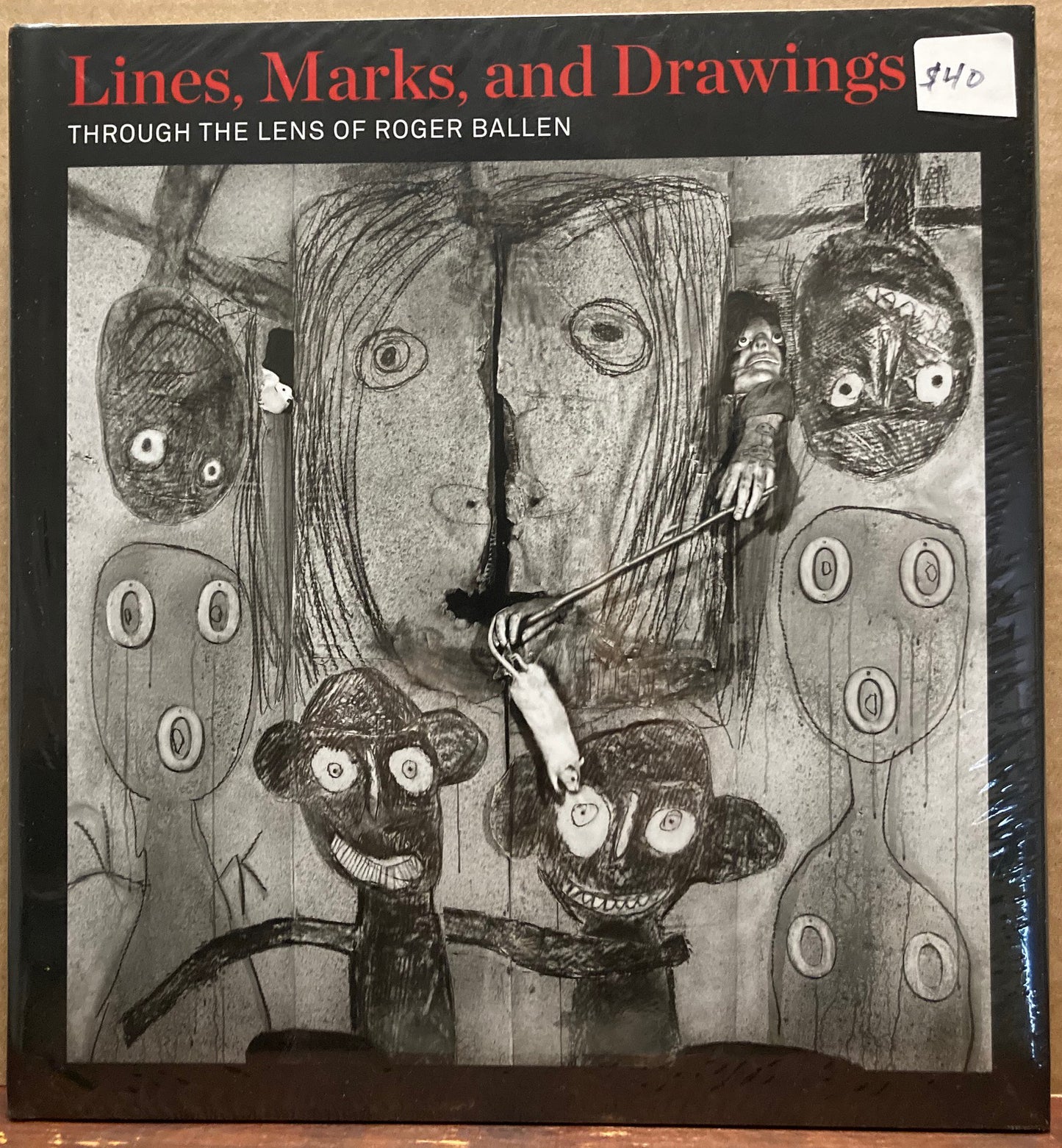
Ballen, Roger. Lines, Marks, and Drawings Through the Lens of Roger Ballen.
Ballen, Roger. Lines, Marks, and Drawings Through the Lens of Roger Ballen.
Couldn't load pickup availability
Smithsonian/Prestel, 2013. [From the essay by Robert JC Young: "Here, where humans seem caged or enclosed while animals urn free, human and animal live in a different relation to each other." Issued in conjunction with an exhibition at the National Museum of African Art.] Hardcover, black cloth with dust jacket, new in original shrinkwrap. Summary:
In Lines, Marks, and Drawings Through the Lens of Roger Ballen, the focus shifts from Ballen’s well-known psychological "documentary" photography to the graphic and linear elements that define his unique aesthetic—often referred to as "Ballenesque."
The book serves as a retrospective analysis of how Ballen integrates drawing into his photographic practice, blurring the lines between fine art, photography, and graffiti.
Key Themes and Concepts
-
The Evolution of the Line: The book traces Ballen’s career from his early documentary work in rural South Africa to his more recent, staged compositions. It highlights how physical marks—cracks in walls, wires, and literal drawings—evolved from background details into primary subjects.
-
The "Ballenesque" Style: This term describes his chaotic yet meticulously composed images. The book explores how Ballen uses drawings (often child-like or primitive) to tap into the "darker" recesses of the human subconscious.
-
Hybridity of Media: A central takeaway is that Ballen does not view photography and drawing as separate entities. Instead, he uses the camera to "freeze" a multi-layered installation that includes painting, sculpture, and sketch-work.
-
Psychological Depth: The "marks" discussed are not just physical; they are symbolic representations of mental states. The book argues that these lines act as a visual language for the "shadow self" and the complexities of the human condition.
Visual Components
Ballen’s work often features a specific set of recurring visual motifs:
-
Wires and String: Used to lead the eye or "trap" subjects within the frame.
-
Wall Graffiti: Often created by the inhabitants of the places he photographs or by Ballen himself.
-
Compressed Space: Using flat backgrounds to emphasize the graphic quality of the marks.
"The line is a path of movement... it is a way of defining a space that is both physical and mental." — A core sentiment reflected in the analysis of Ballen's work.
Roger Ballen (born 1950) is an American-born, South Africa-based photographer known for his psychological, surreal, and dark black-and-white imagery that explores the human psyche. Born in New York City, Ballen earned a degree in psychology from the University of California, Berkeley, and later a PhD in mineral economics from the Colorado School of Mines, which led him to work as a geologist in South Africa in the late 1970s. While traveling through rural South African towns (dorps), he began documenting marginalized populations, culminating in influential books like Platteland(1994) and Outland (2001). Over his five-decade career, his visual style evolved from documentary photography into a distinct aesthetic he terms "Ballenesque"—a theatrical fusion of line drawings, found objects, animals, and disembodied limbs set within claustrophobic, stage-like interiors. Gaining widespread cultural recognition through projects like his art direction for Die Antwoord’s "I Fink U Freeky" music video, Ballen has published over a dozen monographs and exhibited extensively worldwide, solidifying his reputation as one of the most provocative visual artists working in black-and-white photography today.