Gary Saretzky Photo Books
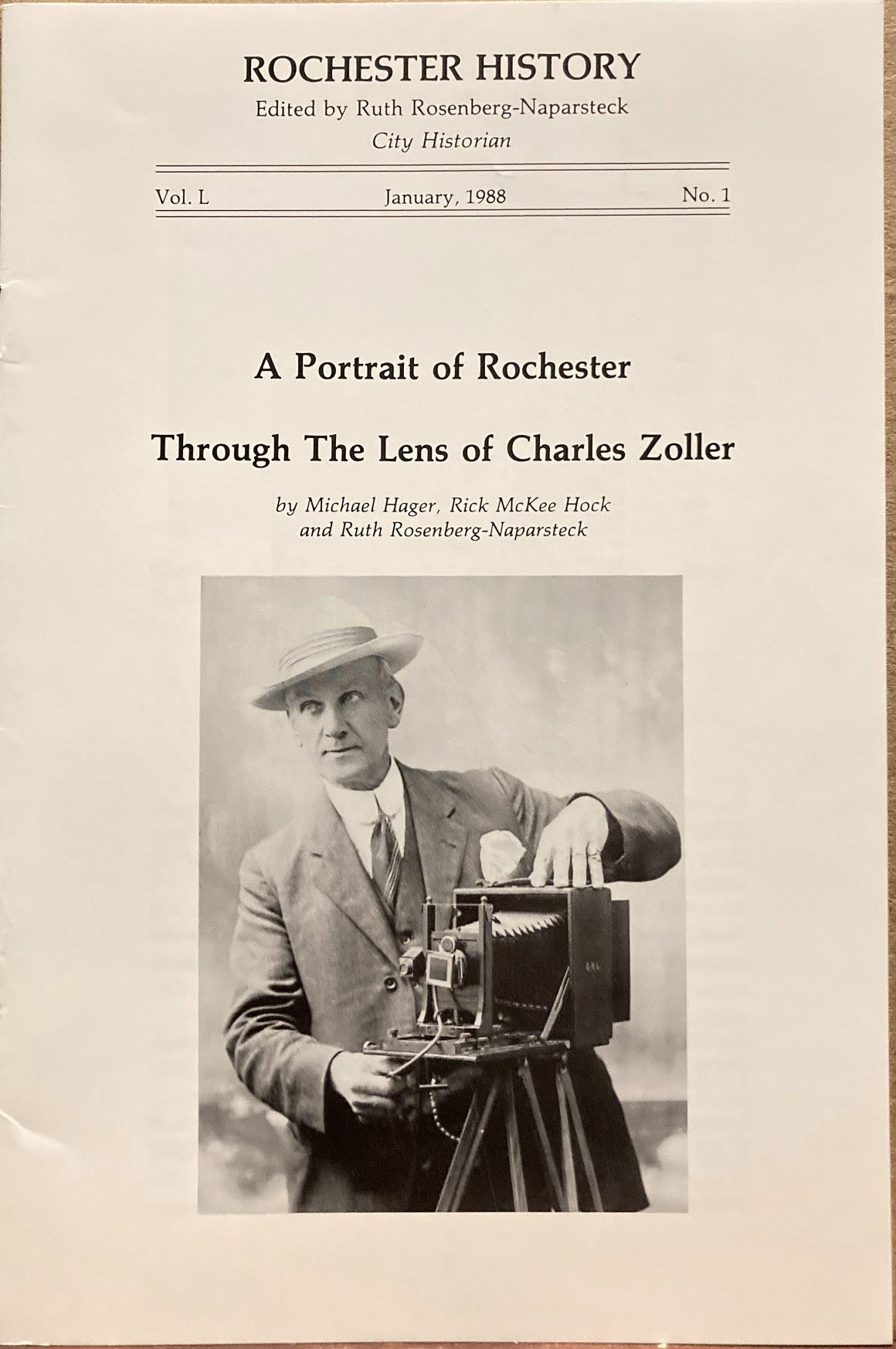
Zoller, Charles. A Portrait of Rochester Through the Lens of Charles Zoller.
Zoller, Charles. A Portrait of Rochester Through the Lens of Charles Zoller.
Couldn't load pickup availability
Rochester History, Volume 1, No. 1, January 1988. Inaugural issue. Published by the Rochester Public Library, Rochester, New York. Stapled wraps, 24 pages. Zoller (1852-1932) left behind 5,000 Autochromes (the first commercial color photographic process that was in the form of transparencies on glass) and thousands of black-and-white negatives now at the George Eastman Museum and the Monroe County Parks Department. Like new.
Charles C. Zoller (1854–1934) was a pioneering American amateur photographer and pharmacist from Rochester, New York, best remembered as an early master of the Lumière Autochrome process—the world's first commercially viable color photography method. Over the course of his life, Zoller amassed a monumental archive of thousands of glass-plate lantern slides and black-and-white negatives that captured vivid, rare color records of early 20th-century American life, including sweeping landscapes of Rochester's parks, local street scenes, private estate gardens, and even notable portraits such as early color photographs of actor Charlie Chaplin. Today, his extensive and historically invaluable body of work is primarily housed in the collections of the George Eastman Museum, serving as a visual treasure trove documenting the transition into the modern era.
The inaugural issue of Rochester History (January 1939, titled A Portrait of Rochester Through the Lens of Charles Zoller) is a landmark publication that uses the pioneer work of a local photographer to document the evolution of the city. While the series was edited by City Historian Dexter Perkins, this specific issue was authored by Blake McKelvey.
Charles Zoller: The Autochrome Pioneer
The summary centers on Charles Zoller (1854–1934), a Rochester pharmacist who became a world-renowned amateur photographer. His significance lies primarily in his early adoption of the Autochrome by Lumière process, the first commercially successful color photograph.
-
The Collection: Zoller left behind a massive collection of over 4,000 slides, providing a rare color record of the early 20th century.
-
Technique: The issue discusses Zoller’s meticulous eye for detail and his ability to capture the "vibrant spirit" of the city before the World Wars transformed its landscape.
Key Historical Themes
The publication uses Zoller’s lens to explore several facets of Rochester’s identity:
-
The "Flower City" Aesthetic: Zoller’s photography heavily featured the city's parks (designed by Frederick Law Olmsted) and private gardens, cementing Rochester's transition from the "Flour City" to the "Flower City."
-
Urban Development: The issue documents the growth of East Avenue, the bustling Erie Canal (before it was filled in to become the later abandoned subway), and the architectural rise of the downtown core.
-
Social Life: Beyond buildings, the summary highlights Zoller’s ability to capture the everyday lives, fashions, and leisure activities of Rochesterians during the Edwardian era.
Significance of the Publication
This issue set the standard for the Rochester History series by:
-
Bridging Art and History: Demonstrating that photography is as vital a primary source as written ledgers.
-
Preservation: Highlighting the importance of the George Eastman House (where many of Zoller's plates are housed) in maintaining the city's visual legacy.
"To Charles Zoller, photography was more than a hobby; it was a mission to preserve the fleeting beauty of a city in bloom." — Rochester History, Vol. 1, No. 1