Gary Saretzky Photo Books
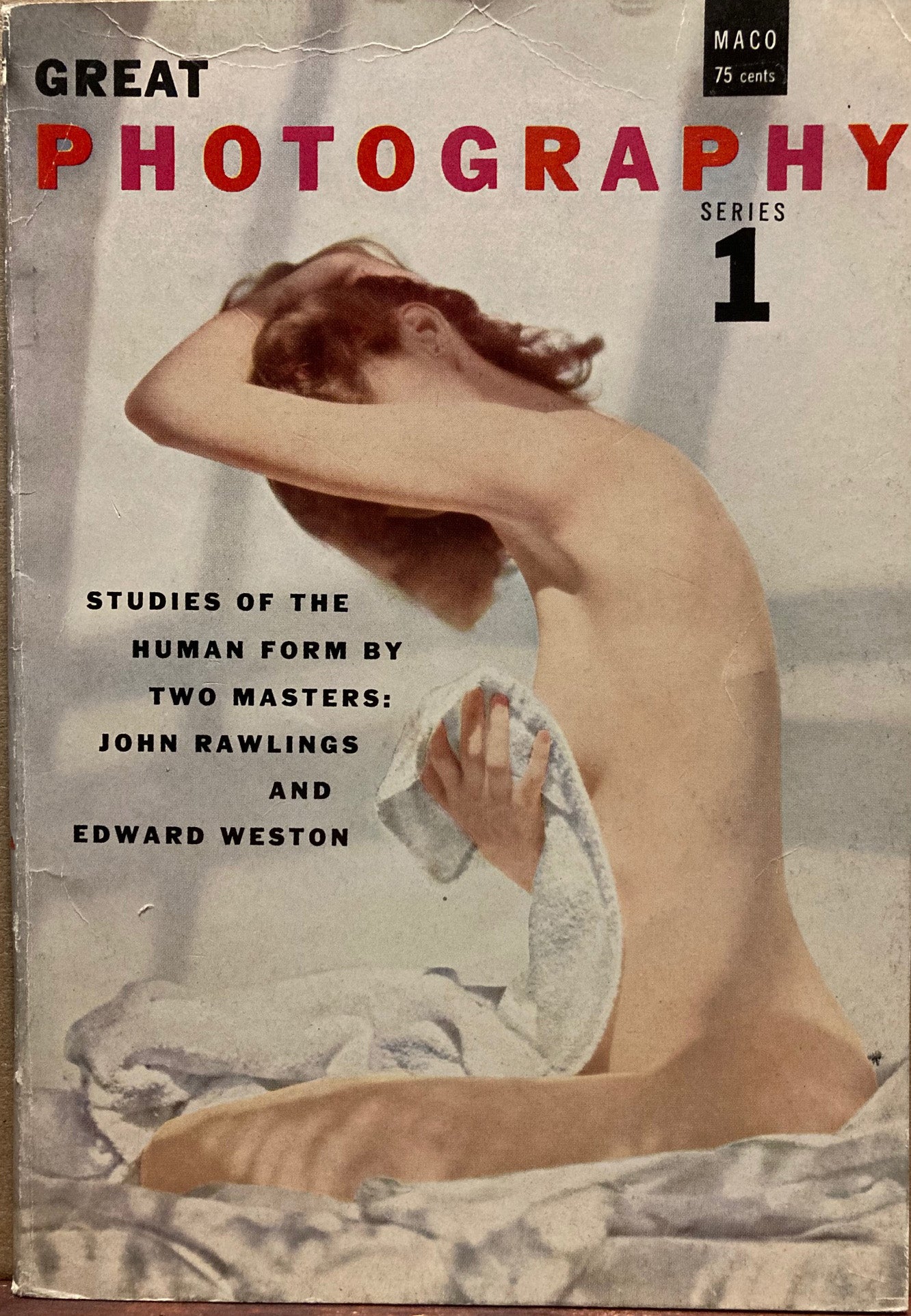
Weston, Edward. Great Photography Series 1. Studies of the Human Form by Two Masters: John Rawlings and Edward Weston.
Weston, Edward. Great Photography Series 1. Studies of the Human Form by Two Masters: John Rawlings and Edward Weston.
Couldn't load pickup availability
MACO, 1957. Female nudes with essays about each photographer, John Rawlings andEdward Weston, with numerous photos by each. Wraps, 128 pages, very good. Housed in archival quality pamphlet binding with stiff covers, item easily removed by opening internal flaps. Summary:
Great Photography Series 1: Studies of the Human Form (1957) is a significant mid-century publication by MACO that provides a comparative study of two titans of the photographic nude: John Rawlings and Edward Weston. By pairing these two artists, the magazine highlights the evolution of the genre from commercial elegance to formalist abstraction.
Contrast in Style: Commercial vs. Fine Art
The publication creates a dialogue between two distinct approaches to the body:
-
John Rawlings (The Stylist): Known primarily as a premier Vogue photographer, Rawlings brought a high-fashion sensibility to the human form. His work in this series is characterized by:
-
Luminous Glamour: A mastery of "high-key" lighting that gives the skin a radiant, almost ethereal quality.
-
Fluidity: Poses that emphasize grace, movement, and the sophisticated silhouettes common in 1950s editorial art.
-
-
Edward Weston (The Formalist): Representing the "straight photography" movement, Weston’s work focuses on the body as a landscape.
-
Geometric Abstraction: His legendary "Pepper"-style approach where the human torso is viewed as a series of sculptural curves, often stripping away the "personality" of the model to focus on pure form.
-
Sharp Focus: High-contrast, deep-shadowed images that emphasize texture and anatomical precision.
-
Key Features
-
The "Master" Format: The magazine was designed for an audience of aspiring photographers and collectors, offering high-quality gravure-style printing that was superior to standard newsstand journals.
-
Technical Insight: Typical of the MACO "Great Photography" series, the issue includes commentary on the technical methods used by both masters—discussing lighting setups, camera choice, and the philosophical intent behind the images.
-
The Transition of the Nude: Published in the late 1950s, the series reflects a cultural shift where the nude began to be accepted in mainstream American publications as a legitimate subject for serious aesthetic study rather than mere cheesecake or medical illustration.
Significance
This issue remains a collectible primary source for its high-quality reproductions of Weston’s in work in natural light and Rawlings’ influential studio techniques. It serves as a bridge between commercial fashion photography and museum-grade fine art, illustrating that the "human form" is a universal language capable of infinite interpretation.