Gary Saretzky Photo Books
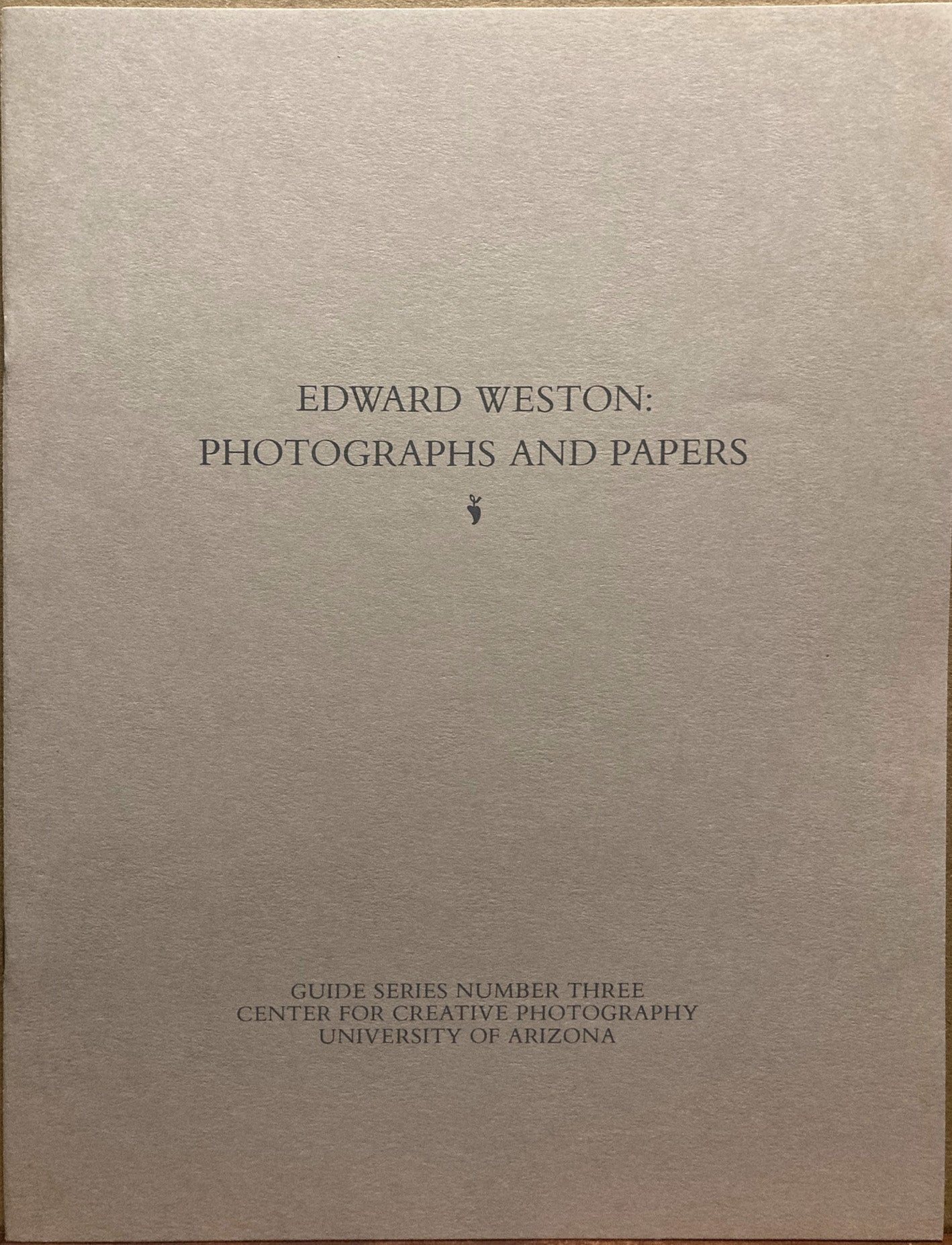
Weston, Edward. Edward Weston: Photographs and Papers.
Weston, Edward. Edward Weston: Photographs and Papers.
Couldn't load pickup availability
Guide Series Number 3. Center for Creative Photography, 1980. Compiled by Terence R. Pitts, Sandra Schwartz, and Marnie Gillett. With "Random Notes on Photography Lecture Notes" by Edward Weston; Correspondence and Papers; and Photographs: A Chronological Inventory. Wraps, 20 pages, fine without typical fading to the light sensitive gray covers. Companion to Edward Weston Papers. Guide Series Number 13. Summary:
Edward Weston: Photographs and Papers, published in 1980 as Guide Series Number 3 by the Center for Creative Photography (CCP), is an essential archival roadmap to the largest and most significant collection of Weston’s work in the world.
Purpose of the Guide
While other books function as artistic monographs, this volume is a research tool designed to provide scholars and historians with a systematic overview of the Edward Weston Archive at the University of Arizona. It documents the massive body of material acquired from the Weston estate starting in 1975.
Scope of the Collection
The guide outlines the two primary pillars of the archive:
-
The Photographs: It indexes thousands of prints, including master sets of his most famous works, early commercial portraits, and rare experiments that never reached wide publication.
-
The Papers: This is perhaps the most vital section, cataloging his voluminous personal records, which include:
-
The Daybooks: Original manuscripts of his famous journals.
-
Correspondence: Hundreds of letters exchanged with key figures like Alfred Stieglitz, Ansel Adams, Beaumont and Nancy Newhall, and Tina Modotti.
-
Business Records: Ledgers, exhibition records, and technical notes that reveal the "day-to-day" labor of his photographic career.
-
Content Highlights
-
Biographical Chronology: A detailed timeline that correlates specific photographic series with the life events documented in his papers.
-
Series Organization: The guide explains how the collection is categorized—from his early "Pictorialist" work to the "Mexico" period and his final years at Point Lobos.
-
Negative Logs: References to his meticulous negative numbering system, which allows researchers to track the lineage of a single image from exposure to various printing iterations.
Historical Significance
-
Primary Source Foundation: This guide transformed Weston scholarship by making his private life and business practices accessible. It moved the study of Weston beyond "art appreciation" into the realm of rigorous historical and biographical analysis.
-
Conservation Record: It stands as a record of the CCP’s foundational role in modern photographic conservation, showcasing how a major artist’s legacy is preserved for future generations.
Note: For researchers, this guide remains the "Gold Standard" for navigating the transition of Weston's private life into a public academic resource.