Gary Saretzky Photo Books
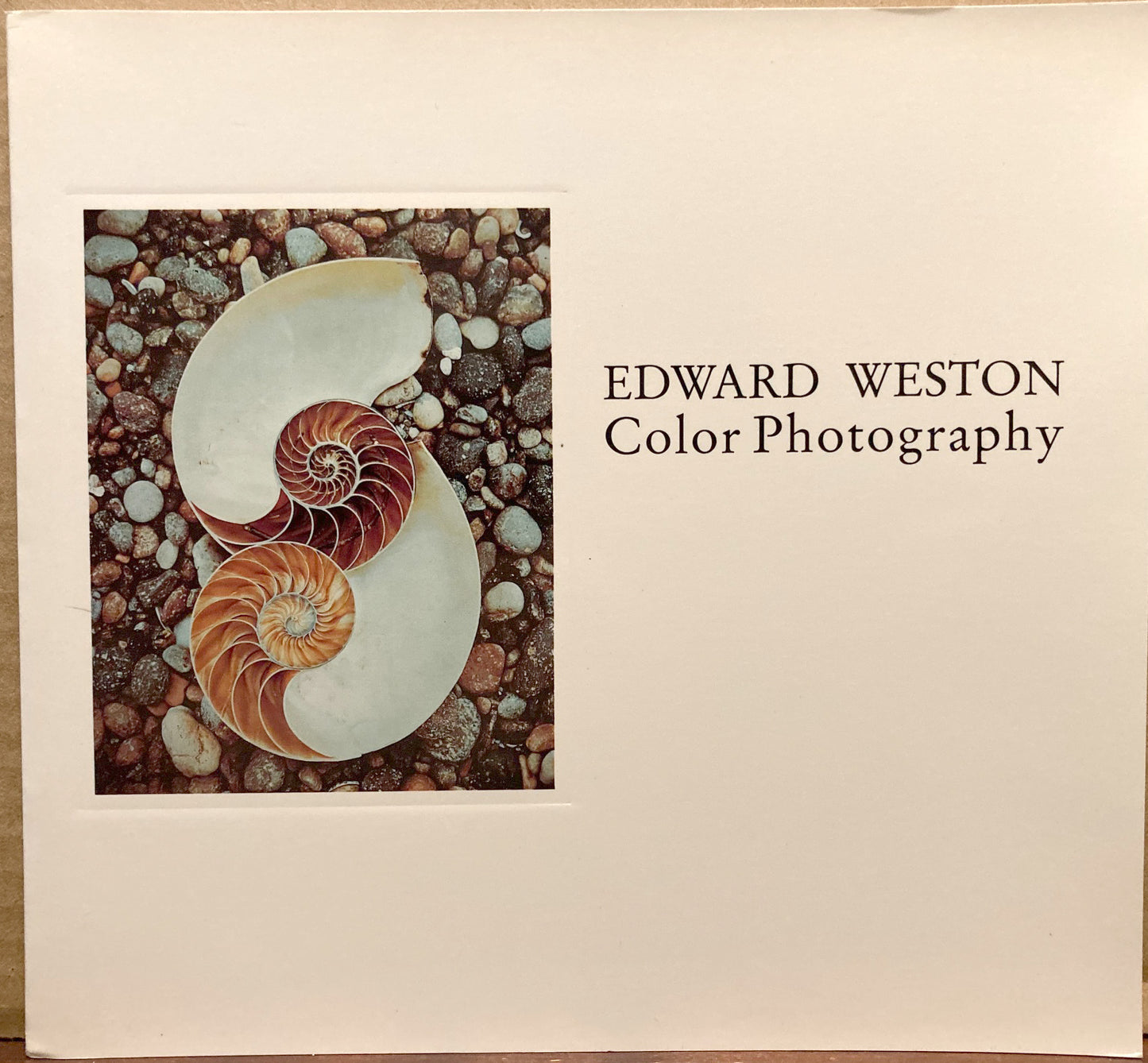
Weston, Edward. Edward Weston: Color Photography. Essays by Edward Weston, Terence Pitts, and Nancy Newhall.
Weston, Edward. Edward Weston: Color Photography. Essays by Edward Weston, Terence Pitts, and Nancy Newhall.
Couldn't load pickup availability
Preface by James Enyeart. Center for Creative Photography, 1986. Reproductions of 32 8x10 color transparencies, 1946-1947, approximately half in the Weston archives at CCP. Stiff wraps, 1st edition, near fine. Summary:
Edward Weston: Color Photography, published in 1986 by the Center for Creative Photography, is a revelatory volume that challenges the traditional view of Weston as a purely monochromatic master. It documents his final creative decade (1946–1948) when, after decades of dismissing color as "superficial," he began experimenting with Kodachrome film.
The Shift to Color
The book explores Weston's late-career pivot, fueled by a commission from the Eastman Kodak Company.
-
The "Straight" Color Aesthetic: Weston applied the same rigorous "f/64" principles to color as he did to black and white. He avoided the garish, saturated hues popular in 1940s advertising, instead seeking a palette that captured the subtle, realistic "integrity" of the subject.
-
Technical Challenges: The essays detail his struggle with the limited latitude of early color film. Unlike the darkroom control he exercised over silver prints, color transparencies required absolute precision at the moment of exposure.
Key Contributions
-
Essays by Terence Pitts and Nancy Newhall: These texts provide the historical and critical framework for this body of work. Newhall, a longtime collaborator, discusses Weston's initial skepticism and eventual fascination with the medium, while Pitts offers a scholarly look at the provenance and preservation of these rare transparencies.
-
Weston’s Own Reflections: The volume includes Weston’s writings on the "problems" of color, where he argues that color should be used as a "formal element" rather than a decorative one.
-
Visual Content: The book features 32 color plates, primarily focused on his beloved Point Lobos, the California coast, and gnarled "found" objects. These images reveal a softer, more atmospheric side of his vision.
Significance
This monograph is historically vital because it showcases the final evolution of a master. Shortly after these images were taken, the onset of Parkinson’s disease ended Weston’s ability to operate a camera. Edward Weston: Color Photography proves that his formalist eye was not dependent on black-and-white tonality, but was a universal vision capable of mastering any photographic technology.