Gary Saretzky Photo Books
Wessel, Henry, Jr. Henry Wessel, Jr. November 21-December 17, 1976.
Wessel, Henry, Jr. Henry Wessel, Jr. November 21-December 17, 1976.
Couldn't load pickup availability
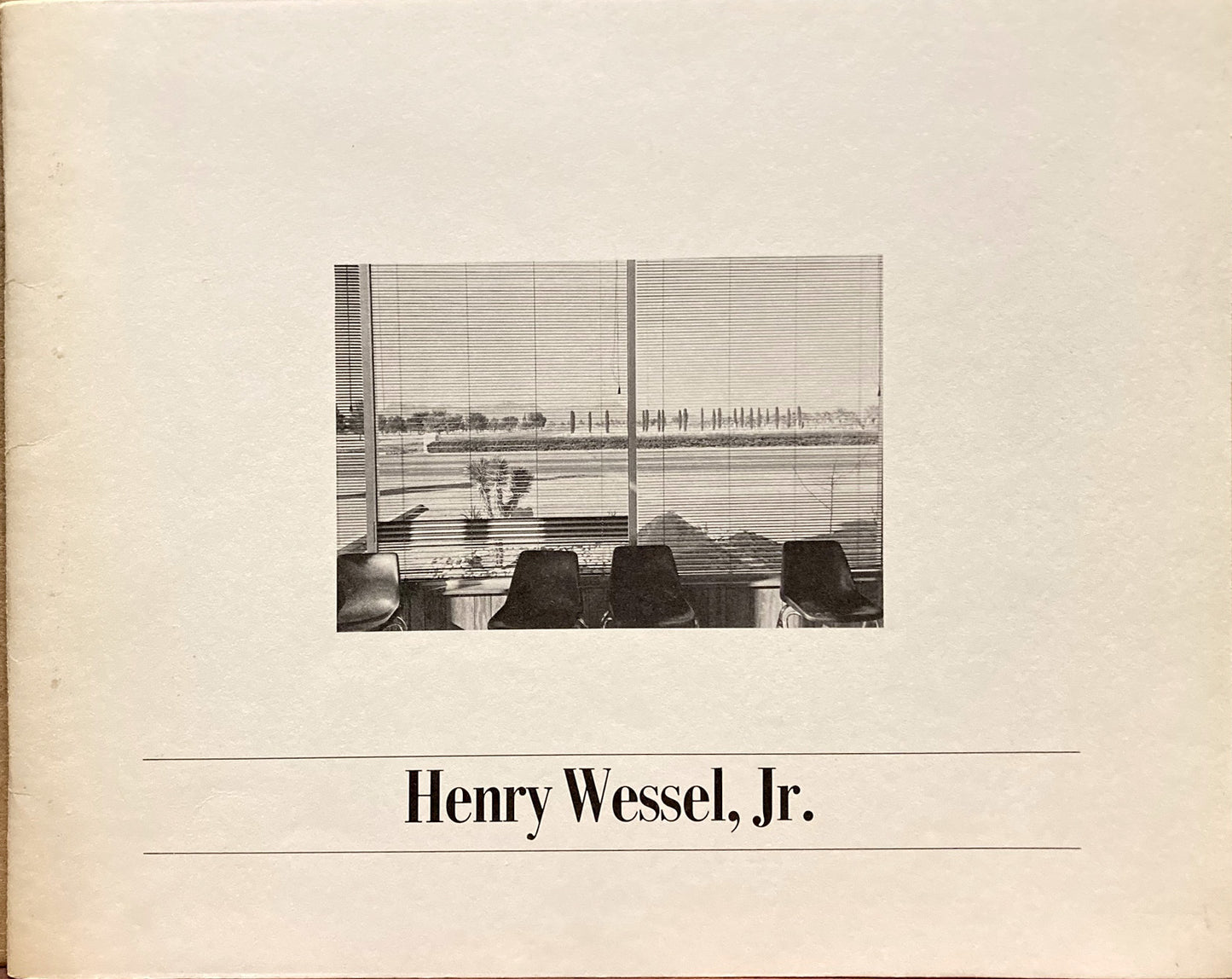
Grossmont College, 1976. Wraps, 48 pages, unpaginated. Essay by Ben Lifson and full page black-and-white humorous landscape photos by Wessel (1942–2018). Catalog for exhibit at Grossmont College Art Gallery. The Museum of Modern Art, New York, holds more than 30 of his photographs. Near fine with slight rubbing on white covers. Uncommon. Summary:
Henry Wessel, Jr. (1976) is a rare, early exhibition catalog published by Grossmont College (El Cajon, California) that captures the photographer at a pivotal moment in his career. Released just one year after Wessel was featured in the seminal New Topographics exhibition, this publication serves as an intimate look at his understated, observational style.
The Aesthetic: The "Social Landscape"
The catalog highlights Wessel’s unique ability to find the extraordinary within the mundane. Often associated with the "Social Landscape" movement, Wessel focused on the unremarkable architecture and foliage of the American West—particularly California.
-
The Quality of Light: A central theme of the catalog is Wessel’s fascination with the harsh, flat, midday sun of the West. He used this "unflattering" light to reveal the stark, geometric reality of houses, telephone poles, and suburban shrubbery.
-
Neutral Observation: The images are characterized by a detached, non-judgmental perspective. Wessel wasn't critiquing the landscape so much as he was fascinated by how human-made structures intersected with the natural environment.
Key Visual Themes
-
Suburban Topography: The photographs often feature isolated bungalows, manicured lawns, and strangely placed palm trees.
-
The Snapshot Aesthetic: While meticulously composed, Wessel’s work in this catalog retains the immediacy of a snapshot, capturing "accidental" compositions that occur in everyday life.
-
Sense of Place: Despite the lack of human subjects in many of the shots, the images evoke a strong sense of 1970s American life—quiet, sprawling, and somewhat surreal in its banality.
Historical Context
-
Post-New Topographics: This catalog is significant because it documents Wessel’s work during the height of the shift away from romantic, Ansel Adams-style landscape photography. It aligns him with peers like Robert Adams and Lewis Baltz.
-
Early Career Record: As a small college gallery publication, it remains a vital primary source for scholars tracking Wessel’s development before his major later retrospectives at San Francisco MoMA and the Art Institute of Chicago.
Significance
The Grossmont College catalog is a testament to Wessel’s "ironic" eye. It demonstrates that a photograph doesn't need a dramatic subject to be compelling; instead, the drama is found in the formal relationship between the camera, the light, and the ordinary world.
"It’s about that moment of recognition, when you see something in the world that corresponds to a feeling you have." — Henry Wessel, Jr.