Gary Saretzky Photo Books
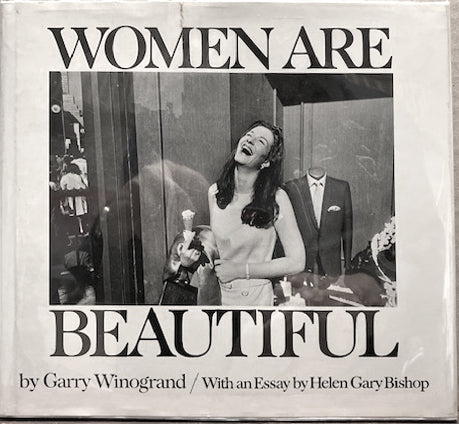
Winogrand, Garry. Women Are Beautiful by Garry Winogrand.
Winogrand, Garry. Women Are Beautiful by Garry Winogrand.
Couldn't load pickup availability
Light Gallery with Farrar, Strauss & Giroux, 1975. With an essay by Helen Gary Bishop. One of the few monographs published by Winogrand during his lifetime; it was criticized by some feminists as evidencing a "male gaze." First edition, hardcover with protected dust jacket. Book is fine. Dust jacket has a vertical crease on rear panel and two short tears formerly repaired with tape which has been removed but small visible brown stains remain. Still nice copy of scarce book. Summary:
Published in 1975 by Light Gallery Books, Women Are Beautiful is perhaps the most controversial and polarizing work by Garry Winogrand, a titan of American street photography. Curated by the influential museum director John Szarkowski, the book consists of 85 candid black-and-white photographs taken during the height of the sexual revolution and the burgeoning women’s liberation movement.
The "Snapshot" Aesthetic
The volume is a masterclass in Winogrand's signature style—characterized by the "tilted frame" and a relentless, high-energy spontaneity.
-
The Street as Stage: Winogrand prowled the sidewalks, parks, and protests of New York City, capturing women in mid-motion, mid-laugh, or mid-glance.
-
Technical Rawness: The images favor emotional and visual "noise" over traditional composition. They emphasize the chaotic energy of 1960s and 70s urban life through a wide-angle lens.
Themes and Subject Matter
The book serves as a visual essay on the changing social landscape of femininity:
-
The "New" Woman: Winogrand captures a generation of women who had shed the rigid formality of the 1950s, appearing in the frames as confident, uninhibited, and physically expressive.
-
Fashion and Form: The book documents the era’s shift in attire—miniskirts, braless silhouettes, and loose hair—using these visual cues to signal a broader cultural shift toward liberation.
-
The Male Gaze: Winogrand famously stated, "I photograph to find out what something will look like photographed." However, many critics point to the book as a prime example of the "male gaze," where the photographer’s own desire and fascination drive the shutter.
Critical Reception and Controversy
Since its release, Women Are Beautiful has sparked intense debate among art historians and feminists:
-
Celebration or Objectification? While some see the book as a vibrant celebration of female vitality and freedom, others criticize it as a collection of voyeuristic snapshots that reduce complex individuals to mere objects of male observation.
-
Szarkowski’s Role: The inclusion of an introductory essay by John Szarkowski attempted to frame the work as a purely formal exercise in "the photography of observation," though this did little to dampen the social critiques of the book.
Legacy
Despite the controversy, the book remains a crucial historical document. It captures a specific "look" and "feel" of a decade in flux, and it solidified Winogrand’s reputation as the preeminent documentarian of the American street, even when his subject matter courted social discomfort.
Significance: In the history of photobooks, Women Are Beautiful stands as a definitive—if complicated—testament to the intersection of 1970s street photography and the politics of gender.
Biographical note: Born in the Bronx on January 14, 1928, Garry Winogrand became a quintessential street photographer who had a major influence on the genre. Although included in the 1955 Family of Man exhibition, Winogrand did not become widely known until the 1967 New Documents exhibit at the Museum of Modern Art, NY, which also included Diane Arbus and Lee Friedlander. Winogrand’s second book, Women Are Beautiful (1975) was not well received by feminists, perhaps because he was frank in his introduction about some women being more physically attractive to him than others. He wrote, “Whenever I’ve seen an attractive woman, I’ve done my best to photograph her. I don’t know if all the women in the photographs are beautiful, but I do know that the women are beautiful in the photographs.” Rather irresponsible about paying bills and managing his personal life, Winogrand left behind 2,500 of rolls of undeveloped rolls of film when he died of gall bladder cancer on March 19, 1984.