Gary Saretzky Photo Books
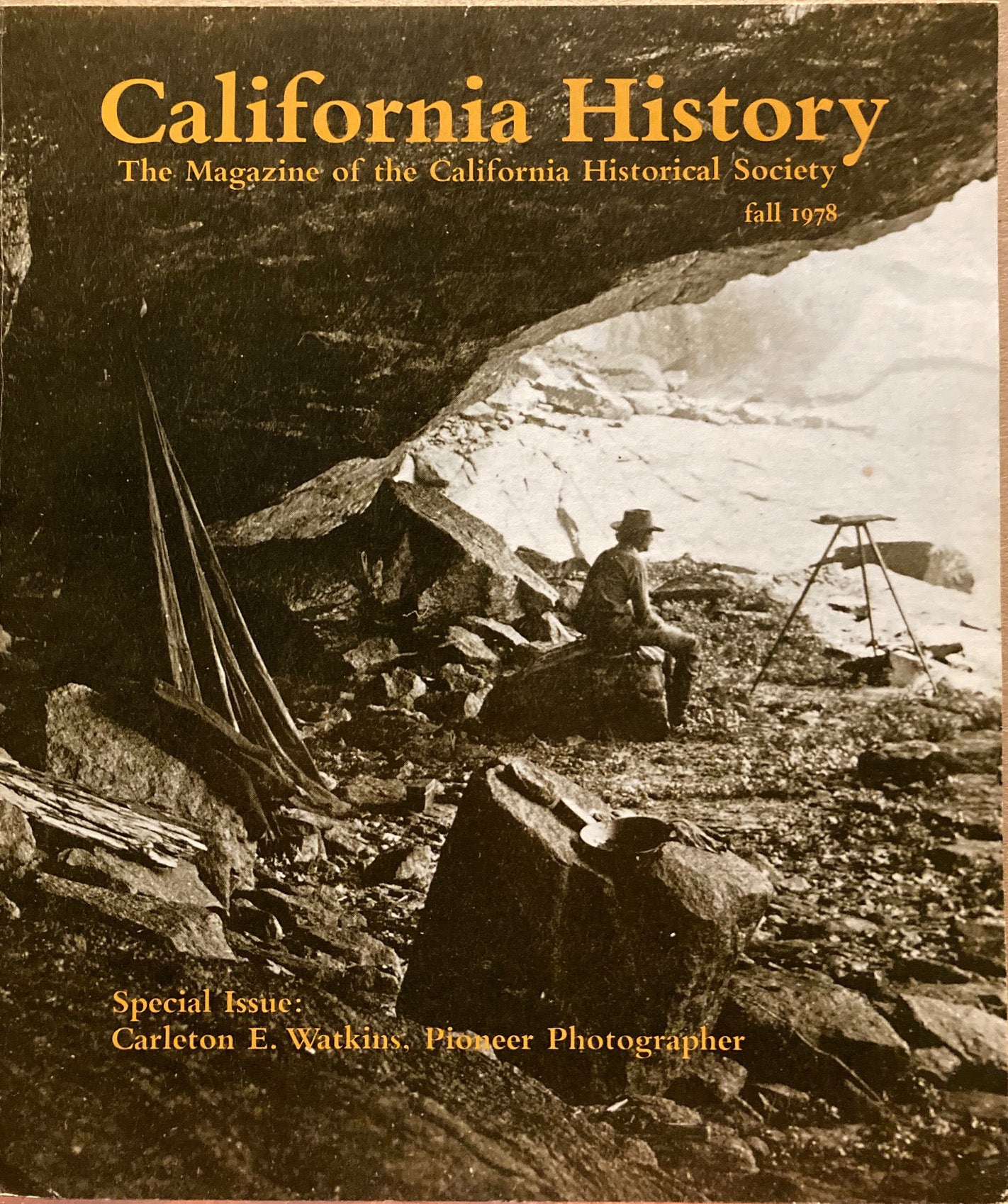
Watkins, Carleton. California History, Fall 1978. Special Issue: Carleton E. Watkins, Pioneer Photographer.
Watkins, Carleton. California History, Fall 1978. Special Issue: Carleton E. Watkins, Pioneer Photographer.
Couldn't load pickup availability
Complete issue, about 80 pages. Chapters by Richard Rudisill, Pauline Grenbeaux, Nanette Sexton, Peter E. Palmquist, et al. An essential source on Watkins. Also includes "Blacks in California: An Annotated Guide to the Manuscript Sources in the CHS Library" concerning African Americans by Diana Lachatanere, and book reviews. Near fine with a few indentations on cover, including from a paper clip. Summary:
California History, Fall 1978 (Volume LVII, Number 3) is a landmark special issue of the quarterly journal dedicated entirely to Carleton E. Watkins (1829–1916), one of the most celebrated American landscape photographers of the nineteenth century. Collecting essays from pioneering photo historians, archivists, and curators, the publication played a pivotal role in the late-twentieth-century rediscovery and critical reappraisal of Watkins, whose historic contributions had been largely forgotten by the mainstream public following the destruction of his studio in the 1906 San Francisco earthquake.
Key Essays and Critical Themes
The volume is structured around specialized scholarly chapters that trace Watkins’s technological innovation, artistic vision, and commercial operations:
-
Biographical and Analytical Overview: The text reconstructs Watkins’s trajectory, detailing his arrival in California during the Gold Rush, his introduction to photography, and his ultimate rise to international fame.
-
The Mammoth Plate and Technical Mastery: A major theme is Watkins’s physical and technical audacity. Essays examine his use of a massive, custom-built camera capable of exposing "mammoth" glass-plate negatives. Writers detail the sheer labor required to transport hundreds of pounds of fragile glass, darkroom tents, and volatile chemicals via pack mules into the rugged wilderness of the Sierra Nevada.
-
Yosemite and Landscape Ideology: The issue features extensive reproductions of Watkins’s iconic 1861 and 1865 Yosemite Valley portfolios. The analysis moves past mere aesthetics to explain how his majestic, pristine compositions helped convince the U.S. Congress and President Abraham Lincoln to sign the Yosemite Valley Grant Act of 1864, establishing the legal precedent for the National Park System.
-
The Photographer as Publisher: This section outlines how Watkins capitalized on the global tourism boom by mass-producing stereoview cards, publishing architectural surveys, and executing lucrative industrial commissions for railroad barons and mining corporations through his commercial storefront, the "Yosemite Art Gallery" in San Francisco.
Additional Contents
While primarily a monographic tribute to Watkins, the roughly 80-page issue also contains independent historical resources, most notably:
-
"Blacks in California": An annotated guide detailing the manuscript sources and archives tracking African American history within the California Historical Society Library.
-
Book Reviews: A curated selection of contemporary reviews evaluating newly published literature on Western American history and regional biography.
Significance
The Fall 1978 special issue of California History stands as a cornerstone text in modern photographic scholarship. By treating Watkins's work not merely as passive historical documentation but as high art and political influence, this publication helped solidify his status as the premier visual chronicler of the nineteenth-century American West.