Gary Saretzky Photo Books
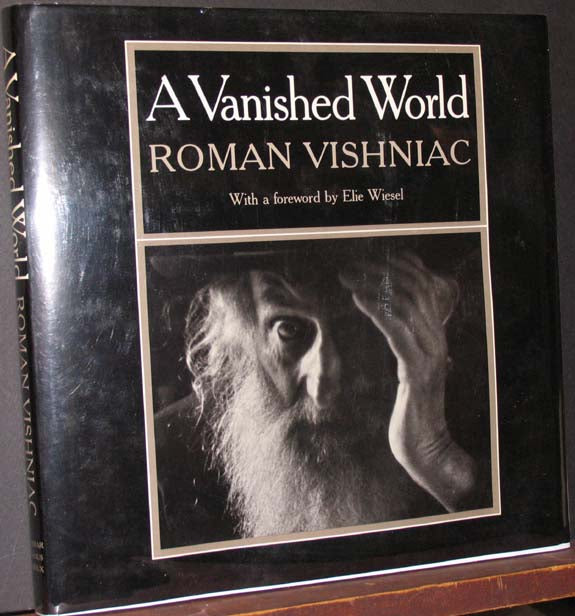
Vishniac, Roman. A Vanished World by Roman Vishniac.
Vishniac, Roman. A Vanished World by Roman Vishniac.
Couldn't load pickup availability
With a Foreword by Elie Wiesel. Farrar, Straus & Giroux, 1983. [A remarkable book on the poorer Jews of Europe just before the Holocaust. While living in Berlin in the 1930s, Roman Vishniac (1897–1990) was commissioned by the American Jewish Joint Distribution Committee to make photographs of impoverished Jews in Central and Eastern Europe that could be used to promote charitable donations. About 2,000 of an estimated 16,000 negatives survived World War II.] Stated 1st edition, hardcover in fine condition with near fine dust jacket. Summary:
A Vanished World (1983) is the seminal photographic record of Jewish life in Eastern Europe just years before its destruction in the Holocaust. Published near the end of Roman Vishniac’s life, the book features a selection of the roughly 16,000 photographs he took between 1935 and 1938 while traveling through cities and shtetls in Poland, Romania, Hungary, and Czechoslovakia.
The Mission of Documentation
Vishniac was commissioned by the American Jewish Joint Distribution Committee (JDC) to document the poverty and relief efforts in Jewish communities. However, Vishniac felt a deeper, prophetic urgency to record a culture he believed was on the brink of extinction.
-
The "Hidden" Camera: To avoid suspicion or religious objection, Vishniac often hid his camera under his coat or used a Leica with a hidden lens, capturing candid, unposed moments of daily survival.
-
Preservation: After his arrest and eventual escape to the United States in 1940, Vishniac managed to smuggle out about 2,000 of his negatives, sewn into the lining of his clothing.
Key Themes and Content
-
The Shtetl and the City: The book portrays the vibrant, albeit impoverished, world of traditional Jewish life—from the bustling streets of Warsaw and Lublin to the remote, snow-covered villages of the Carpathian Mountains.
-
Faith and Education: A significant portion of the work focuses on the spiritual life of the community, featuring famous images of elderly rabbis, scholars in study halls (yeshivas), and wide-eyed children in traditional hederclassrooms.
-
The Face of Poverty: Vishniac did not shy away from the harsh realities of the Great Depression and systemic antisemitism, documenting the cramped basement apartments and the dignity of those living in extreme deprivation.
Visual Style and Emotional Weight
The photographs are noted for their dramatic lighting (often using only natural light from windows or doorways) and a sense of "historical haunting." Because the reader knows the fate of the subjects, the most mundane activities—buying bread, walking to school, or a conversation on a street corner—take on a tragic, monumental quality.
Historical Legacy
A Vanished World is more than a photography book; it is a memorial. It remains the most comprehensive visual archive of the pre-war Ashkenazi world. While modern scholars have occasionally debated some of Vishniac's dramatic captions or the specific "poverty-focused" framing of his assignments, the book’s emotional and historical impact is undisputed. It serves as a definitive "last look" at a civilization that was almost entirely erased within a decade of the photographs being taken.
"I was unable to save my people, only their memory." — Roman Vishniac