Gary Saretzky Photo Books
Turnbull, Colin M. The Mbuti Pygmies: An Ethnographic Survey by Colin M. Turnbull.
Turnbull, Colin M. The Mbuti Pygmies: An Ethnographic Survey by Colin M. Turnbull.
Couldn't load pickup availability
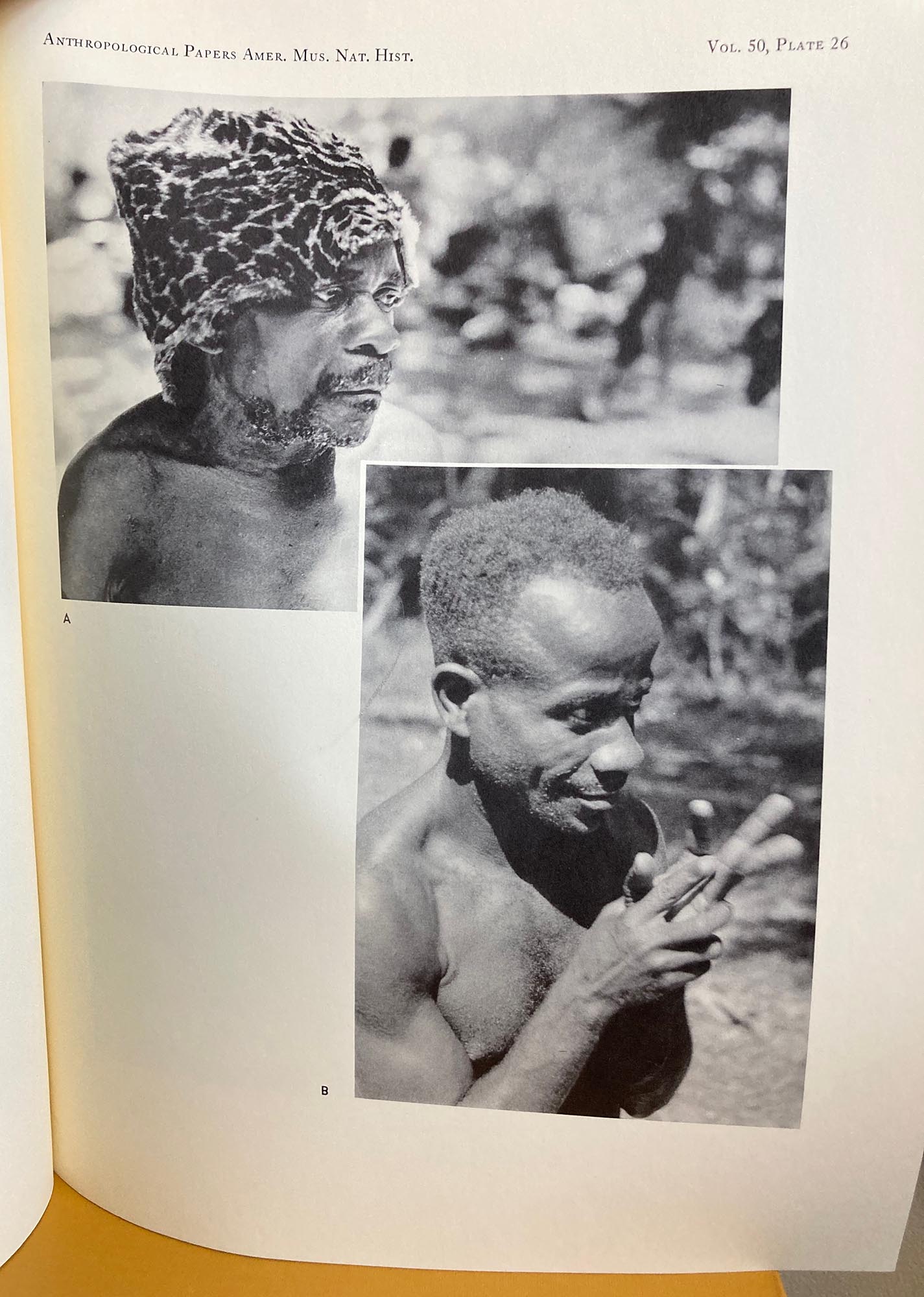
Volume 50: Part 3, Anthropological Papers of the American Museum of Natural History, 1965. Includes photographs of the indigenous people in their natural state. More than 300 pages. Laid in is an article by L.L. Cavalli-Sforza, "Pygmies, an example of hunters-gatherers, and genetic consequences for man of domestication of plants and animals," reprinted from Human Genetics, Proceedings of the Fourth International Congress of Human Genetics, Paris 6-11 September 1971. Wraps, very good with binding slightly skewed, otherwise fine. Summary:
The Mbuti Pygmies: An Ethnographic Survey (1965) is a seminal anthropological study by Colin M. Turnbull, published as part of the Anthropological Papers of the American Museum of Natural History. Drawing from his extensive fieldwork in the Ituri Rainforest of the Democratic Republic of the Congo (then Congo), Turnbull provides a highly detailed, structural-functionalist analysis of the Mbuti hunter-gatherers.
The monograph serves as a more technical, academic counterpart to his popular 1961 book, The Forest People.
Key Themes and Findings
-
The Forest as a Sacred Entity: Turnbull emphasizes the central religious and economic role of the Ituri forest. The Mbuti do not view the forest as a hostile wilderness, but as a benevolent, personified "mother" or "father" that provides food, shelter, and security.
-
Social Structure and Egalitarianism: The Mbuti maintain a highly egalitarian society with no formal chiefs, political hierarchies, or specialized legal systems. Decisions are made through public discussion and consensus. Social control is maintained through ridicule, shaming, or, in severe cases, temporary banishment.
-
Economic Cooperation: The survey details two distinct hunting sub-groups: the net-hunters (who rely on cooperative efforts involving men, women, and children) and the archers (who hunt in smaller, more individualistic groups). Turnbull argues that the choice of hunting technology directly shapes the size and fluidity of their social bands.
-
Kinship and Bands: Kinship ties are bilateral but flexible. The primary social unit is the nomadic band, which constantly shifts in composition (fission and fusion) to prevent interpersonal conflict and adapt to changing food resources.
-
The "Two Worlds" Phenomenon: A significant portion of the monograph examines the complex, symbiotic, yet tense relationship between the Mbuti and the neighboring Bantu-speaking agricultural villagers. While the Mbuti engage in trade with the villagers (exchanging forest meat for cultivated crops) and participate in village rituals, Turnbull argues that the Mbuti maintain a psychological and cultural independence, viewing village life and customs with skepticism and reverting to their pure forest culture once they leave the village.
-
Ritual Life: Turnbull documents crucial life-cycle rituals, notably the elima (a celebration of female puberty) and the molimo (a sacred ritual and trumpet used by men to "wake the forest" during times of crisis, sickness, or death), illustrating how these rituals reinforce social solidarity.
Significance
Turnbull’s survey was monumental in challenging contemporary views that depicted hunter-gatherers as "primitive" or socially disorganized. Instead, he presented the Mbuti as a highly sophisticated, stable society perfectly adapted to their environment, whose social structure was deliberately designed to minimize hierarchy and conflict.