Gary Saretzky Photo Books
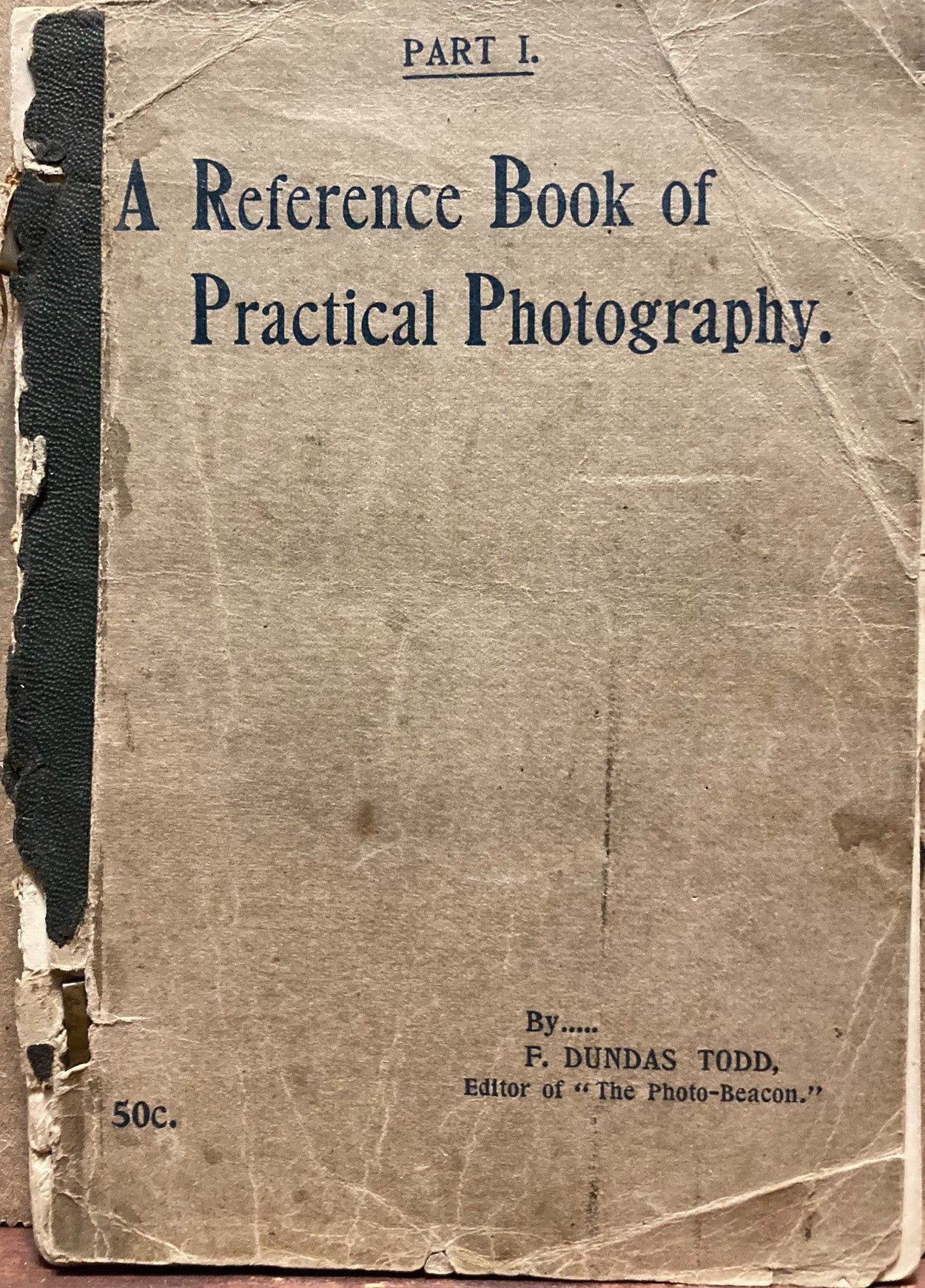
Todd, F. Dundas. A Reference Book of Practical Photography. Part I. (1897) by F. Dundas Todd.
Todd, F. Dundas. A Reference Book of Practical Photography. Part I. (1897) by F. Dundas Todd.
Couldn't load pickup availability
Photo Beacon, 1897. Small book, wraps, 104 pages plus ads, covers and first ad page detached, bottom of back cover and first ad page chipped at bottom, a few lines underlined in pencil. Fair to good. Includes six chapters: Apparatus; Handling the Camera; Exposure; The Artistic Side of Photography; Special Subjects; and Stereoscopic Photography. Index includes topics covered in Part II, not present here. From the collection of photographer Sol Libsohn, co-founder of the Photo League, though his prior ownership unmarked. No copies of the 1897 edition found for sale; one copy of the 1899 edition seen offered on eBay. Author Todd was editor of the journal, The Photo Beacon. Summary:
A Reference Book of Practical Photography: Part I (1897) is a concise, instruction-oriented manual written by Frederick Dundas Todd (1858–1926), a prominent photography editor and publisher of the influential magazine The Photo-Beacon. Spanning 104 pages bound in softcover wraps, the book was published by The Photo-Beacon Company in Chicago.
Designed specifically for the rapidly growing market of late-19th-century amateur and beginner photographers, the manual strips away dense chemical equations in favor of direct, utilitarian advice on how to successfully operate contemporary camera equipment.
Key Content and Structural Themes
The manual is divided logically into six core chapters, providing a step-by-step framework for early photographic practice:
-
Apparatus: Todd breaks down the mechanical components of late-Victorian camera setups. He offers practical advice on selecting lenses, shutters, darkroom equipment, and the era’s popular glass dry-plates, helping consumers navigate a rapidly commercializing market.
-
Handling the Camera: This section serves as a technical guide on physical operation. Todd instructs the reader on proper tripod setup, focusing the lens using a ground-glass screen, managing the camera bellows, and preventing light leaks.
-
Exposure: Addressing one of the most difficult skills for late-19th-century photographers, this chapter details how to calculate exposure times. Because automated light meters did not yet exist, Todd provides formulas and tables based on the time of day, season, weather conditions, and lens aperture to prevent under- or over-exposure.
-
The Artistic Side of Photography: Moving past raw mechanics, Todd introduces fundamental rules of visual composition. He discusses the "artistic eye," warning beginners against flat lighting and teaching them how to use shadows, lines, and framing to create balanced, visually appealing landscapes and portraits.
-
Special Subjects: This chapter troubleshoots specific, challenging photographic scenarios. Todd provides tailored advice on how to successfully capture moving objects, navigate indoor interior lighting, and manage the high-contrast demands of architectural photography.
-
Stereoscopic Photography: Reflecting a major visual trend of the 1890s, the final section explains the principles of making stereoviews (3D photography). Todd outlines the specialized dual-lens cameras required and details the exact cutting, transposing, and mounting techniques needed to create the illusion of three-dimensional depth when viewed through a stereoscope.
Significance
A Reference Book of Practical Photography: Part I is a prime historical example of the "democratization" of photography at the turn of the 20th century. Alongside Todd's other popular manuals, this book helped transition photography from a highly guarded, volatile trade secret practiced only by professional chemists into an accessible, nationwide hobby for the everyday public.
