Gary Saretzky Photo Books
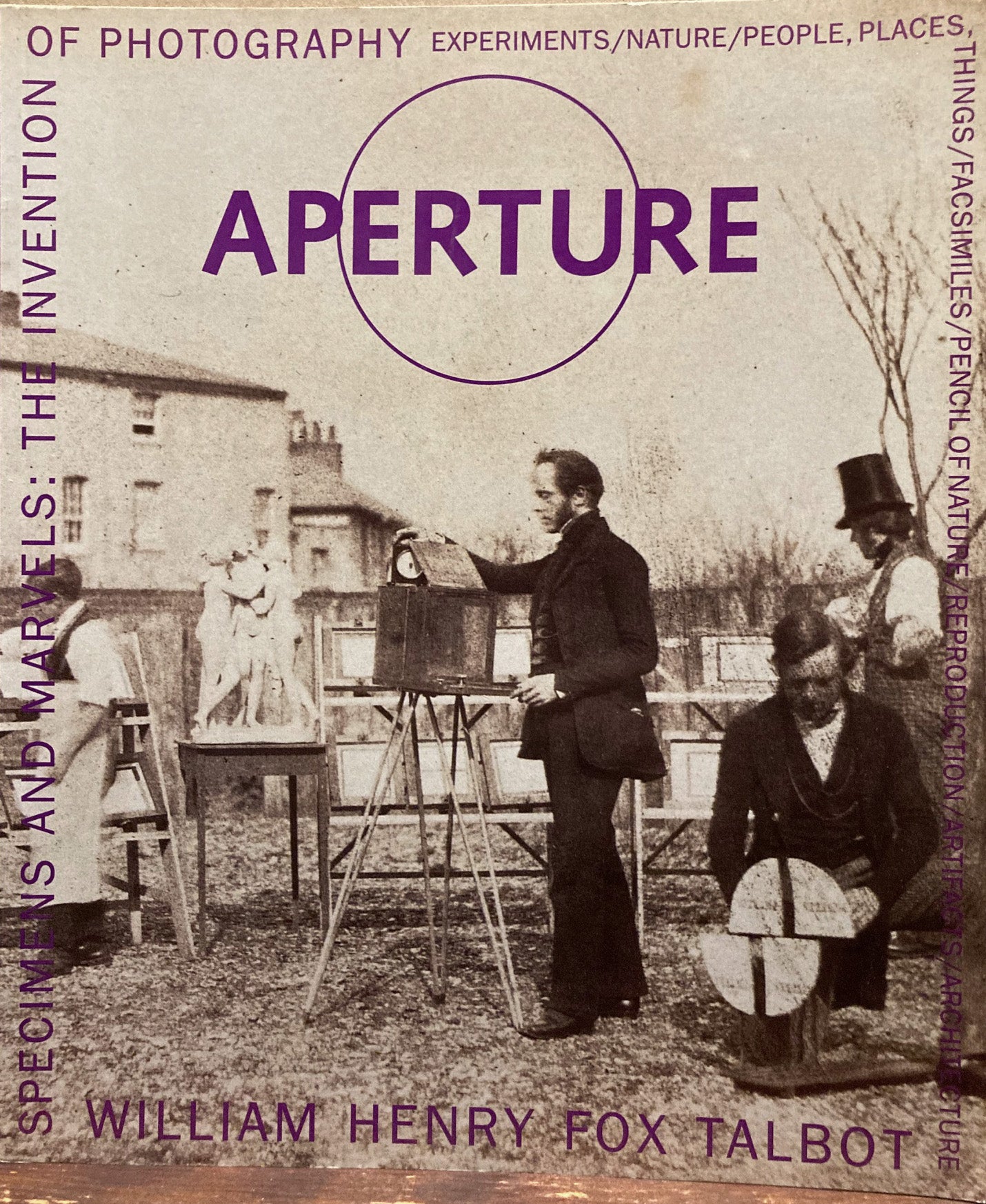
Talbot. Specimens and Marvels. William Henry Fox Talbot and the Invention of Photography. Aperture No. 161. Winter 2000.
Talbot. Specimens and Marvels. William Henry Fox Talbot and the Invention of Photography. Aperture No. 161. Winter 2000.
Couldn't load pickup availability
Theme issue on Talbot with contributions by Anthony Burnett-Brown, Russell Roberts, and Mark Haworth-Booth. Produced in conjunction with the National Museum of Photography, Film & Television, Bradford, England. Wraps, 80 pages. Fine. Summary:
Specimens and Marvels: William Henry Fox Talbot and the Invention of Photography is a special monographic issue of Aperture magazine (No. 161, Winter 2000). The publication serves as a comprehensive visual and critical exploration of the foundational breakthroughs achieved by the British polymath who invented the negative-to-positive photographic process.
Key Content and Themes
-
The Birth of the Calotype: The issue examines the technical evolution of "photogenic drawing" and the patented "calotype" process. The text chronicles how paper sensitized with silver salts allowed for the creation of a negative image, which could then be used to produce multiple positive prints—a concept that became the blueprint for traditional analog photography.
-
Artistic and Scientific Duality: A central theme is the dual identity of early photography as both a scientific specimen and a visual marvel. The monograph features pristine reproductions of early images—including botanical silhouettes, intricate lace patterns, classical architecture, and everyday street scenes—illustrating how chemistry and botany intersected to force nature to record its own image.
-
The Pencil of Nature Context: The publication heavily analyzes the legacy of The Pencil of Nature, the first commercially published book illustrated entirely with photographs. The essays unpack how the camera was envisioned not merely as a passive recording tool, but as a revolutionary medium destined to transform art, science, and global communication.
-
Critical Essays and Visual Reappraisal: The imagery is accompanied by scholarly essays that provide modern critical context. The text balances historical reverence with contemporary analysis, examining the fierce mid-nineteenth-century rivalries, patent battles, and the profound psychological shift that occurred when humanity first learned to capture fleeting moments in permanent, physical form.
Significance
The Winter 2000 issue of Aperture stands as a definitive tribute to the dawn of the photographic medium. By presenting fragile, century-old salt prints and paper negatives with modern, high-fidelity printing techniques, the publication bridges the gap between historical artifact and fine art, cementing a legacy as the true architectural father of reproducible photography.
