Gary Saretzky Photo Books
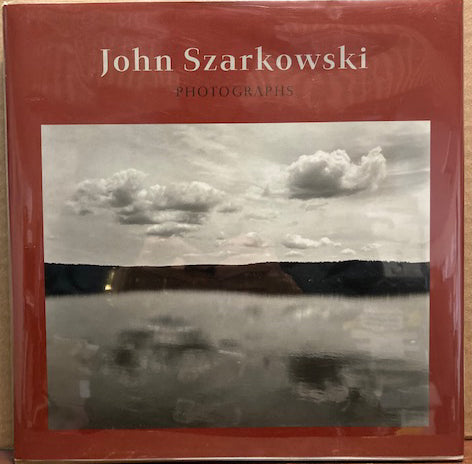
Szarkowski, John. John Szarkowski: Photographs.
Szarkowski, John. John Szarkowski: Photographs.
Couldn't load pickup availability
Bulfinch, 2005. 1st ed. [Best known for his curatorial role at the Museum of Modern Art in New York, where he succeeded Edward Steichen, Szarkowski also was a fine photographer before taking on that job and resumed photography during his retirement.] VG+ with a slight bump on one corner and protected dust jacket that has a slight crease near bottom corner.
Thaddeus John Szarkowski (1925–2007) was an influential American photographer, historian, and curator who fundamentally shaped the appreciation of photography as a fine art. Born in Ashland, Wisconsin, Szarkowski studied history and art history at the University of Wisconsin before pursuing photography full-time, initially establishing himself through large-format documentary projects influenced by Walker Evans and Edward Weston. His early photographic work yielded acclaimed monographs such as The Idea of Louis Sullivan (1956) and The Face of Minnesota (1958), supported by two Guggenheim Fellowships. In 1962, he succeeded Edward Steichen as the Director of the Department of Photography at New York's Museum of Modern Art (MoMA), a position he held until 1991. During his nearly three-decade tenure at MoMA, Szarkowski authored landmark critical texts—including The Photographer's Eye (1966) and Looking at Photographs (1973)—and championed game-changing photographers such as Diane Arbus, Lee Friedlander, Garry Winogrand, and William Eggleston. Following his retirement from MoMA, Szarkowski returned to his personal practice, producing understated, formalist landscape photographs of upstate New York and rural America that were exhibited widely and compiled in his 2005 retrospective monograph, John Szarkowski: Photographs.
John Szarkowski: Photographs (2005), published by Bulfinch Press in conjunction with a major retrospective organized by the San Francisco Museum of Modern Art (SFMOMA), is a 156-page monograph that pivots the spotlight onto the creative output of one of photography's most influential figures.
While Szarkowski is universally famous for his decades as the Director of Photography at the Museum of Modern Art (MoMA)—where he shaped the canon of photographic history—this book establishes his parallel legacy as a brilliant, deeply sensitive practitioner behind the lens. The volume features an introductory essay by Sandra S. Phillips and a chronology by Maria Morris Hambourg.
Key Content and Themes
-
The Midwestern Landscape and Vernacular Architecture: The monograph chronicles Szarkowski’s early career in the 1940s and 1950s, heavily focusing on his roots in the American Midwest. The plates document his structural, elegant documentations of Louis Sullivan’s architecture and his poetic, Guggenheim-funded visual study of the Minnesota wilderness.
-
The Quiet Practice of a Formalist: The imagery beautifully mirrors Szarkowski's own critical theories. His photographs of rural barns, deserted streets, backyards, and interior spaces avoid theatrical drama. Instead, they celebrate the inherent properties of the medium he championed in his writing: precision of detail, the geometry of the frame, and a meticulous command of vantage point.
-
The Post-MoMA Return to the Lens: A poignant section of the book covers his return to full-time photography after retiring from his high-profile curatorial post at MoMA in 1991. These later, often intimate pictures capture his personal farm in upstate New York, focusing on apple trees, old stone walls, and the subtle shifts of seasonal light, demonstrating a lifetime of refined looking.
-
A Definitive Visual Portfolio: The volume contains 84 high-fidelity plates that trace his entire artistic trajectory from 1943 to 2005, proving that his critical eye as a museum titan was forged entirely by his practical understanding of printmaking and composition.
Significance
John Szarkowski: Photographs serves as a vital historical correction, proving that the man who taught the world how to look at photographs was himself a master of the craft. By decoupling his identity from the institutional walls of MoMA, the monograph cements Szarkowski’s legacy as a vital American photographer whose quiet, deeply intelligent pictures stand proudly alongside the masters he spent his life validating.
