Gary Saretzky Photo Books
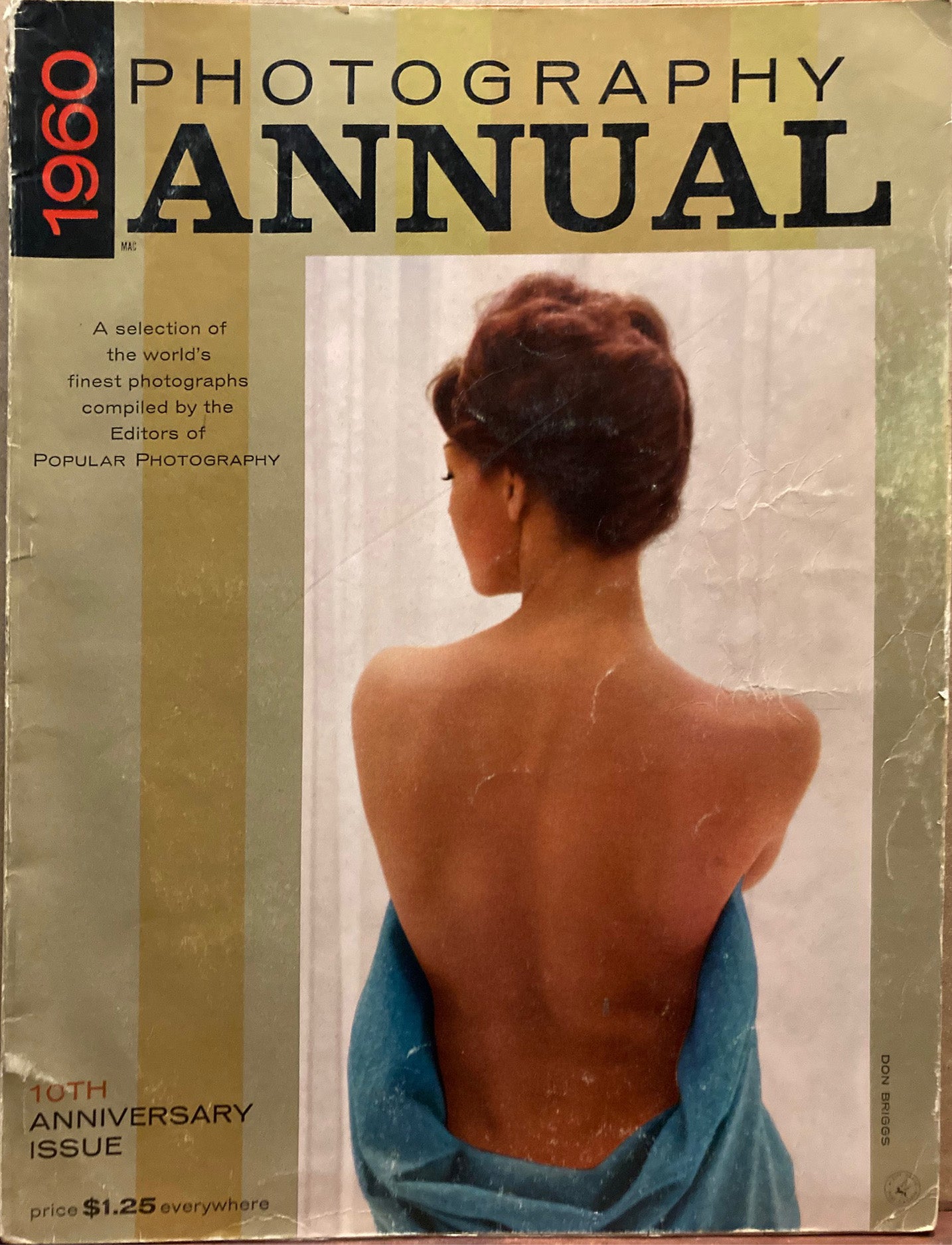
Annuals. Photography Annual 1960. 10th Anniversary Issue.
Annuals. Photography Annual 1960. 10th Anniversary Issue.
Couldn't load pickup availability
A Selection of the Worlds' Greatest Photographs by the Editors of Popular Photography Magazine. Edited by Bruce Downes. Ziff-Davis, 1959. Includes the former American Annual of Photography. Features Ken Heyman (Sister of the Bride); Bruce Davidson (Old Woman of Montmartre); Avedon (color photo essay on Marilyn Monroe); Elliot Erwitt; Wingate Paine; Dan Weiner (tribute); Lisa Larsen (tribute); Philippe Halsman (of Ansel Adams and Edith Sitwell); Dennis Stock (of Andre Kostelanetz); Otto Steinert; Harold Feinstein; Sonja Bullaty; Sanford Roth (of Audrey Hepburn); Cartier-Bresson (of Stieglitz); Man Ray; Nell Dorr; Alfred Stieglitz (Steerage); Edward Steichen; Dorothea Lange; Barbara Morgan; Ansel Adams (Moonrise); Irving Penn; Alfred Stieglitz & Clarence White; Edward Weston; Charles Sheeler; Lewis Hine; Bill Brandt; Yousuf Karsh (of Churchill); Harry Callahan; Arnold Newman (of Andrew Wyeth); Arnold Genthe (of Grete Garbo); Manuel Alvarez Bravo; Clarence White; Andreas Feininger; Berenice Abbott; et al. Wraps, crimps on cover, chip at top of spine, VG-. Summary:
Photography Annual 1960, edited by Bruce Downes and published by Ziff-Davis in late 1959, marks the 10th Anniversary of the series. This landmark issue serves as a high-water mark for mid-century photojournalism, celebrating a decade of "The Concerned Photographer" while showcasing the avant-garde talent that would define the 1960s.
Star-Studded Portfolios
The anniversary edition is distinguished by three major features that highlight different facets of the photographic medium:
-
Richard Avedon (Marilyn Monroe): Avedon contributes a revolutionary color photo essay on Marilyn Monroe. Moving away from the typical Hollywood pin-up style, Avedon’s images capture a raw, vulnerable, and introspective Monroe, utilizing his signature minimalist backgrounds to focus entirely on her psychological state.
-
Bruce Davidson (The Old Woman of Montmartre): This poignant essay showcases a young Davidson’s mastery of the "humanist" style. By documenting the solitary life of an elderly widow in Paris, Davidson demonstrated the intimacy and narrative depth possible with 35mm photography, foreshadowing his later work with the Magnum agency.
-
Ken Heyman (Sister of the Bride): Heyman’s contribution is a classic example of "candid" photography. His ability to capture the complex social dynamics and fleeting emotional gestures of a wedding party solidified his reputation as one of the era's premier sociological photographers.
Key Themes and Anniversary Features
-
A Decade of Progress: As the 10th-anniversary volume, the book includes retrospective commentary by Bruce Downes, analyzing how photography evolved from 1950 to 1960—specifically the shift from rigid, posed compositions to the "Decisive Moment" philosophy.
-
The Rise of 35mm: The annual documents the total triumph of the small-format camera (Nikon, Leica) over the bulky Speed Graphics of the previous generation, enabling the candid, street-level realism seen throughout the portfolios.
-
Color as Art: The editors emphasize that color was no longer just for advertising; the Avedon/Monroe spread serves as a manifesto for color as a serious tool for character study and mood.
Technical and Scholarly Value
-
Technical Data Section: Following the Popular Photography tradition, the book includes an exhaustive appendix detailing the cameras, lenses, and shutter speeds used for every featured image, providing a "masterclass" for aspiring professionals.
-
Global Scope: Beyond the headliners, the volume features an international selection of work from the Soviet Union, Europe, and Japan, offering a rare cross-cultural look at the Cold War era through a visual lens.
Significance
The 1960 Annual is often cited as one of the best in the series. It captured the exact moment when the "Old Guard" of technical perfectionism met the "New Wave" of psychological realism, making it an essential reference for historians of 20th-century visual culture.