Gary Saretzky Photo Books
Annuals. U.S. Camera Annual 1971. Josef Sudek, Elliott Erwitt, et al.
Annuals. U.S. Camera Annual 1971. Josef Sudek, Elliott Erwitt, et al.
Couldn't load pickup availability
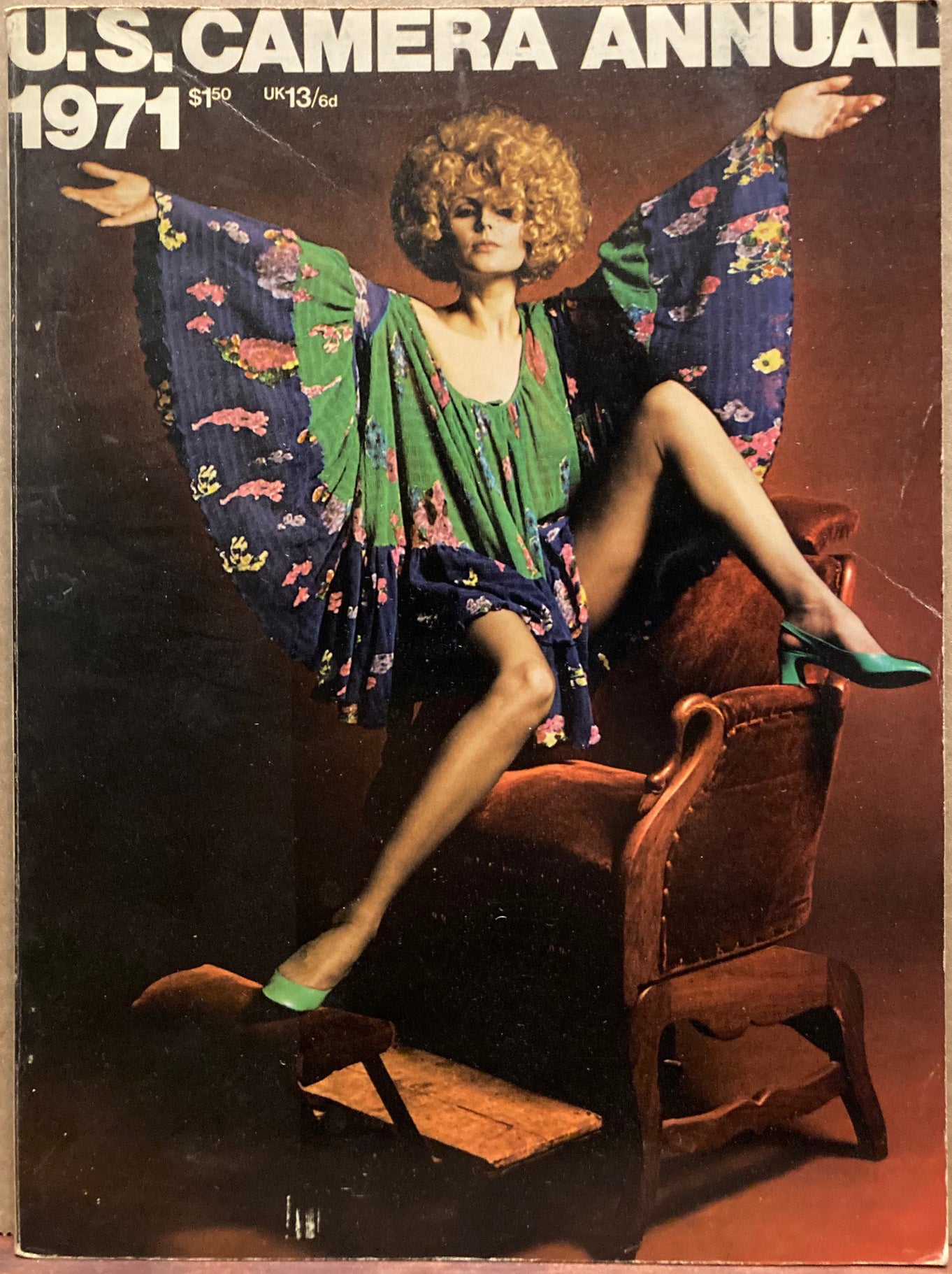
Edited by David Vestal. U.S. Camera Publishing Co., 1970. Featuring Josef Sudek; Elliott Erwitt; Sonja Bullaty and Angelo Lomeo; Edward Steichen; Michael Semak; Solomon D. Butcher; The Circus by Charles Reynolds; Molly Maguires by George Harvan; Brett Weston; Nell Dorr; Famous Photographers School: Student Photographs; Minor White; One by Ken Ohara; and Caulfield & Shook of Louisville, Kentucky. Also photos by William Barksdale, Lou Bernstein, Richard Blinkoff, Robert Bolton, Walter Bredel, Herb Breuer (cover), Dan Budnik, Helen Buttfield, Mark Cohen, Martin Dall, Edward F. D'Arms, Jr., Liliane De Cock, Sandy Dewing, P. Doele, Robert Doisneau, Mrs. Fred M. Dole, Rev. Fred M. Dole, Jerome Ducrot, Maury Englander, Will Faller, Antonio A. Fernandez, Laurence Fink, Bob Fletcher, Leonard Freed, Benno Friedman, Don Getsug, Mario Giacomelli, Ralph Gibson, Ronnie Ginnever, John Gossage, Emmet Gowin, M.J. Guariglia, Charles Harbutt, Kay Harris, Howard Harrison, Rosmarie Hausherr, James B. Johnson, Dorothea Kehaya, Sean Kernan, Russ Kinne, Alan Klotz, George Krause, Les Krims, Paul Kwilecki, Helen Levitt, Ricahrd Makino, Frank Maresca, Bard Martin, Dan McCoy, Fred McDarrah, Marlis Muller, Anne Noggle, Catherine Noren, Hal Okun, Michael Putnam, Herb Quick, Lilo Raymond, Ronald Rose, Steven Schoen, Michael Semak, Ann Zane Shanks, Jerry Siegel, Byron Stone, Richared Ustinich, Ed Van Der Elsken, Winston Vargas, Sam Wang, and Robert Weiss. Summary:
U.S. Camera Annual 1971, edited by Tom Maloney, serves as a high-water mark for the long-running series, capturing a distinct shift from traditional photojournalism toward deeply personal, conceptual, and "New Topographic" styles. This volume is particularly noted for its wide aesthetic range, juxtaposing the romanticism of the "old masters" with the gritty, experimental energy of the 1970s avant-garde.
Major Features and Portfolios
-
The Masters: The annual pays homage to the legendary Edward Steichen and Josef Sudek. Sudek’s "The Magic Garden" sequence showcases his unparalleled ability to capture the poetic, atmospheric light of Prague, while Steichen's inclusion reinforces the historical lineage of the medium.
-
The Westons and Minor White: Brett Weston contributes his signature high-contrast architectural and natural abstractions, while Minor White represents the "spiritual" wing of photography, emphasizing the photograph as a metaphor.
-
Ken Ohara ("One"): One of the book's most striking contemporary features is a selection from Ken Ohara’s One, consisting of tight, anonymous, full-face portraits that strip away social context to find a raw, universal humanity.
-
Elliott Erwitt: Representing the humanist/wit tradition, Erwitt’s portfolio provides a characteristic blend of irony and candid social observation.
-
The Circus (Charles Reynolds): A major thematic essay that uses the spectacle of the circus to explore the intersection of fantasy and the reality of performance.
Social and Regional Documentation
-
The Molly Maguires (George Harvan): A gritty, documentary-style look at the coal regions of Pennsylvania, capturing the stark lives and history of the miners.
-
Solomon D. Butcher: The annual includes a historical look at Butcher’s 19th-century frontier photography, providing a stark contrast to the modern urban work elsewhere in the volume.
-
Caulfield & Shook: A regional archive feature focusing on the industrial and social development of Louisville, Kentucky.
-
The New Generation: The volume is packed with "new" talent that would soon become the establishment, including Emmet Gowin, Ralph Gibson, John Gossage, Mark Cohen, and Leonard Freed. Their work highlights a move toward fragmented, high-tension street photography and intimate domestic studies.
Themes and Technical Shifts
The 1971 edition reflects several key cultural and technical transitions:
-
The Snapshot Aesthetic: The work of Emmet Gowin and Mark Cohen signals a move away from "perfect" composition toward a more jarring, immediate, and subjective way of seeing.
-
Global Humanism: While the "Concerned Photographer" movement remains strong in the work of Leonard Freed and Mario Giacomelli, it is increasingly tempered by the formalist experiments of Ralph Gibson and Benno Friedman.
-
Educational Outreach: The feature on the Famous Photographers School students offers a rare look at how the medium was being taught and consumed by the general public at the start of the decade.
Significance
U.S. Camera Annual 1971 is a vital archival document because it successfully bridged the gap between the mid-century "Humanist" era and the fragmented, postmodern 1970s. By placing Josef Sudek and Emmet Gowin in the same volume, the editors acknowledged that the definition of a "great photograph" was expanding to include both the sublime and the suburban.
Copies available:
- Wraps, as issued. A couple of crimps in cover, otherwise fine.
- Wraps, as issued. Rear cover creased, otherwise VG.